• Skip to main content
  • Skip to secondary menu
  • Skip to primary sidebar
  • Skip to footer
  • Home
  • About Us
  • Say hello
Rethink Real Estate. For Good.

Rethink Real Estate. For Good.

  • Podcast
  • Posts
  • In the news
  • Speaking and media
    • About Eve
    • Speaking requests
    • Speaking engagements
    • Press kit
  • Investment opportunities

Affordable housing

Quadruple the pace.

December 7, 2020

Housing shortages are not a new thing in California. California has suffered from housing shortages since the 1970s. By 2018, the shortfall was estimated to be at around 3 – 4 million.

This shortfall is at all levels of affordability but especially so for low- and moderate- income people. According to the annual report by the Department of Housing and Urban Development, the national rise in homelessness between 2018 and 2019 was 2.7 percent, but in California, which is struggling with out-of-reach housing costs and intractable fights over affordable housing construction, it grew by a staggering 16.4 percent, making it the third highest in the country. 20 percent of the Californian population is now living in poverty and high housing costs in urban centers has led to displacement and continued urban sprawl. According to Zillow, the median price of a Californian home is now almost the highest in the country.  

As California’s population continues to grow, the state struggles to provide enough housing. To keep up with expected growth, housing production needs to double. And to prevent further price increases and reduce rents, production would have to quadruple over the next decade. This is an enormous problem. A number of causes have been cited as the root of the problem including density restrictions, the high cost of land, NIMBYs (Not in My Backyard) or residents who oppose new construction, the high cost of construction, and cities that instead of encouraging residential development favor commercial and retail development to bring higher tax revenue. 

The Californian legislature has passed several bills in an attempt to address this issue, but the magnitude of the problem requires even more. Changes to zoning regulations to permit higher density, faster development approvals and better ways to involve stakeholders would all influence the production of new housing units positively. Lower construction costs achieved through manufacturing or by preserving existing buildings would help as well.

Heather Hood, VP at Enterprise Community Partners, is fully immersed in the affordable housing crisis, working to help solve it in Northern California. She’s written influential pieces on housing issues, helped to create technical assistance programs and co-chaired Oakland’s Housing Cabinet. 

Listen in to my conversation with Heather to hear an expert’s take on the housing crisis.

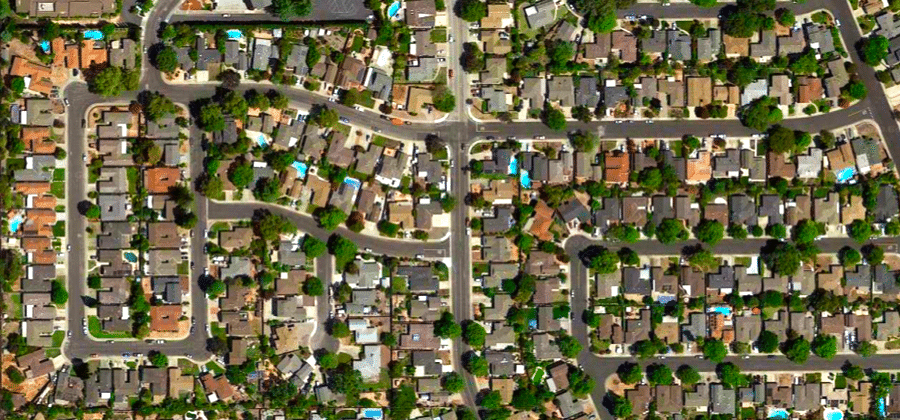
Image ©Google 2020

Learn some more …

Manufacturing change.

December 2, 2020

Green builder, Scott Flynn, co-founded indieDwell with Pete Gombert four years ago “to change the building industry by offering high quality, sustainable and healthy homes to underserved communities.” In the early 1990s, Scott worked as a carpenter’s apprentice building and remodeling homes, and even after he graduated from college as a chemical engineer, he continued to do building projects on the side. In 2001, Scott set up shop full-time, as Flynner Homes, a design-build firm based in Boise, Idaho, where indieDwell is also based. There, he was an early pioneer in the construction of high-performing, certified green homes, including at least two net-zero homes.

IndieDwell’s mission is to produce similarly sustainable houses, with a smaller footprint, that everyone on the income spectrum could afford. They work with developers or local organizations that can develop housing with an emphasis on creating mixed income, place-based communities. The first half of indieDwell’s model is about embracing modular construction, creating components in factory that then can be assembled on site. The second half of indieDwell’s model involves partnering with local communities to create employee owned/joint venture factories that produce housing for that community and region. They have already opened a second facility in Pueblo, CO, and they are in discussion with communities in Northern and Southern California, Virginia and Florida.

indieDwell’s innovative approach has received support from the Chan Zuckerberg Initiative, Enterprise Community, and a number of both financial, civic and philanthropic organizations. Scott, himself, is a Certified Green Builder, and both his companies have earned B Corp recognition.

Insights and Inspirations

  • It took months to manufacture their first home. Now IndieDwell is manufacturing 2 homes per week per line. With 5 lines in place, and more planned, the number of homes is growing.
  • IndieDwell is an employee-owned B-Corp. People are at the heart of everything Scott does.
  • Containers are complicated to build into homes. In a few months, IndieDwell will be moving to steel-studded framed systems for their modular homes.
  • IndieDwell sells their modular homes to like-minded organizations to ensure that the end-user gets the full-benefit of their carefully planned modular homes.

Information and Links

  • Scott likes B Corp.
  • He likes to listen to the Simon Sinek podcast.
  • And he wants to point out the great resource that is the Greater Good Science Center, at UC Berkeley.
Read the podcast transcript here

Eve Picker: [00:00:13] Hi there. Thanks so much for joining me today for the latest episode of Impact Real Estate Investing. My guest today is Scott Flynn, chief impact officer for indieDwell. Scott founded and ran indieDwell for four years, growing it from a one per quarter modular home manufacturing company to 10 per week. And it keeps on growing with joint venture manufacturing facilities planned all over the country. For indieDwell, the focus has been on affordable modular homes made from recycled shipping containers, although that is about to change. Be sure to go to EvePicker.com to find out more about Scott on the show notes page for this episode, and be sure to sign up for my newsletter so you can access information about impact real estate investing, and get the latest news about the exciting projects on my crowdfunding platform, Small Change.

Eve: [00:01:23] Hello, Scott. I’m really pleased to have you on my show today.

Scott Flynn: [00:01:27] It’s a pleasure to be here, Eve.

Eve: [00:01:28] You build tiny, affordable homes in Boise, Idaho. And I wanted you to tell us how, how do you do that?

Scott: [00:01:37] Well, it’s much bigger than just Boise, Idaho. I mean, we’re starting to scale this across the country. We’re scaling our impact with factories, with partners, factories across the country. Just to be clear, we don’t build tiny homes. We build modular homes.

Eve: [00:01:57] Umhmm.

Scott: [00:01:57] So, you know, for just some background here, the difference between a modular and a manufactured home, there’s a big difference. So, a manufactured home is built to lower quality codes, and that’s where you get the trailer homes and the mobile homes come into that category.

Eve: [00:02:17] Ok.

Scott: [00:02:17] But a modular is the same as a site-built stick-built home. It goes on a permanent foundation. It appreciates with the market. That’s the big thing here, the difference between these two.

Eve: [00:02:30] Umhmm.

Scott: [00:02:30] A manufactured home is considered personal property, so it depreciates over time.

Eve: [00:02:35] Kind of like a recreational vehicle.

Scott: [00:02:37] It’s exactly the same …

Eve: [00:02:39] Ok.

Scott: [00:02:39] Yes. But we build modular, so it’s real property and therefore it appreciates with the market. And therefore, when you can get anybody into one of these homes, say, the underserved or the left behind, so to speak, they can start to build wealth.

Eve: [00:02:58] And you’re doing that using shipping containers.

Scott: [00:03:02] That’s true. Yes. We started this five, about four and a half years ago now, the idea came into my head and it just seemed like the right thing to be building with. And, you know, we’re not builders, we’re manufacturers, so, you know, there was 50 million shipping containers in the world. And now there’s well, more than that. And half of them are sitting around being decommissioned, but still have the structural integrity in them, and I thought, wow, they’re, the structure’s there. It’s a resource. It’s doing nothing. You can put them on flatbeds easy and ship them around. So, that’s what we started building with.

Eve: [00:03:49] And that’s amazing recycling story, right? Are you still building with shipping containers?

Scott: [00:03:55] We are. But I will let you know we are starting to phase out of them in about four to six months. We realize that they’re extremely hard to work with.

Eve: [00:04:08] Interesting.

Scott: [00:04:08] Yeah, they’re really complicated. Especially when you get into a commercial-type project where you have more restrictive codes. You’ve got fire codes you have to comply with, and boy, it can really become challenging. And, you know, we’re in the business to put as many people in homes as possible, not try and build with the most complicated thing. Shipping containers are extremely difficult to work with, especially when you’re doing a commercial project, so that means, you know, a multi-family, multi-story project. And it’s, you know, we’re not in the business to prove that we can build the most complicated home. We’re in the business to put good citizens into a high quality, healthy home. And so, we are in the process of switching into a steel studded frame system. So, the story is still there.

Eve: [00:05:12] Right.

Scott: [00:05:12] It’s still steel screwed to steel. And there’s still high performance and energy efficient and durable and sustainable, and healthy. It’s just going to be packaged in a way that where, it’ll just make our lives easier and we’ll have more homes.

Eve: [00:05:29] Right. Right. So, a little more efficient to build. And what about cost-wise? Because I think, you know, these sound like they’re pretty affordable homes.

Scott: [00:05:39] Yes. I mean, the new product will actually lower the price even more. Our base model is a 640 square foot, two bedroom, one bath, large kitchen and living room. We’re offering that at 85,000 dollars. You still have to have your land, and then you put in foundation.

Eve: [00:05:59] Right.

Scott: [00:06:00] But depending on where you are in the country, you could be on the ground for 100,000, plus your land.

Eve: [00:06:09] Yeah. You know, I built a tiny house in Pittsburgh and that’s pretty well, what it cost me was a bit smaller, but the land was the killer because it was on vacant city land and that was an old basement for the house in the land. And we had to dig it out and remediate it. And that cost more than the actual house.

Scott: [00:06:30] Yes, that’s typically the case.

Eve: [00:06:33] Yeh, so you have to pick your land carefully, right? It’s great that you’re evolving and with the goal of keeping prices down. And what do these homes look like? You said there’s a typical, did you say two bedroom, one bathroom … or was it one bedroom, one bathroom house?

Scott: [00:06:50] The base model is two bedrooms. One bath.

Eve: [00:06:53] Ok.

Scott: [00:06:53] Has a full shower.

Eve: [00:06:54] Yes.

Scott: [00:06:55] And then it has a large kitchen area, and that leads right into the living room. So, when you walk in the home, you walk right into this 16 foot wide, 20 foot deep space that has your living room and kitchen in it. It feels very homey.

Eve: [00:07:15] Mmhmm. And what happens if someone wants extra bedrooms? How do they add them on?

Scott: [00:07:20] We just add another container onto it. We can get up to four bedroom, two bath.

Scott: [00:07:24] Ok, so that’s pretty, pretty simple. And when you do the steel frame system, you’ll have a little bit more flexibility, right?

Scott: [00:07:33] Yes. We’ll be able to go a little bit wider. So, we’re still deciding between a 12 and 14 foot module, but it’ll make a world of difference.

Eve: [00:07:43] Ok, and who do you sell these to? I was reading that you only sell to organizations, not to individuals.

Scott: [00:07:50] Yeah, our goal is to partner with like-minded developers, foundations, possibly other builders. We go through so much effort to build a product that is high performance and healthy, and a business culture that comes along with that, and capping our margins. We haven’t talked about that yet. We cap our margins to keep our pricing down.

Eve: [00:08:19] Mm hmm.

Scott: [00:08:21] And what we want to do is work with partners that are going to take the product from us and continue that impact all the way to the end customer. We don’t want somebody coming in along the way and taking that margin that we worked so hard to keep down.

Eve: [00:08:44] Yes.

Scott: [00:08:45] So, that’s why it’s really important for us to align with like-minded people.

Eve: [00:08:51] So, what sort of organizations have purchased these so far? And I suppose they’re purchasing them in bulk. So, who lives in the homes? Today?

Scott: [00:09:01] Our first two, and we’re heading into our third and fourth with them, is a charity. LEAP charities, led by Bart Cochran. And Bart did something amazing. He built the first ‘extremely affordable,’ so, we’re talking 30 percent AMI, with the most underserved group of people in this country, with healthy, high performance homes. And then he made the community net zero energy by putting solar panels on all the roofs. So, he has demonstrated the ultimate community is possible, that we can build high performance, healthy communities and serve everybody in the income spectrum. It’s beautiful. And so, we did a small community with him called Windy Court One. He built a Windy Court Two right next to it. So, he even made the community bigger, you know. Right across the street, he’s putting in, I believe it’s a 12-block subdivision. And you can see he’s just going to grow off of this.

Eve: [00:10:11] Mm hmm.

Scott: [00:10:12] That’s the like-mindedness that we do our darndest to connect with.

Eve: [00:10:19] And so where else in the country, like what other organizations are you connecting with?

Scott: [00:10:24] Well, some of the biggest names are Chan Zuckerberg Initiative, are you familiar with Chan Zuckerberg?

[00:10:31] Um Hmm, yes.

[00:10:31] Yeh, so they’re one of our partners. Northern Trust, Gary Community Investments out of Colorado. Enterprise. And there are several more.

Eve: [00:10:44] So, it sounds like you’re going to explode …

Scott: [00:10:46] Well …

Eve: [00:10:47] … building these little things.

Scott: [00:10:47] We have our second factory in Pueblo, Colorado, and it’s actually four times the size of our first factory here in Boise. You know, our first factory is 20,000 feet. It only has one line in it. It’s more of like our R&D line, as we like to say. But Pueblo is 100,000 square feet with four lines. And that’s what we are modeling all of our factories off of. And we have a minimum of four to six other partners that are inches away from pulling triggers in Northern California, Southern California, Virginia and Florida. And others on the way.

Eve: [00:11:38] So, with all these joint venture factories, like right now, how many of these homes are you manufacturing, and how big do you hope your production numbers will grow?

Scott: [00:11:49] Well, right now, it’s estimated that each line will produce about four modules a week, which is on the low side. And if you scale that across eight to 10 factories, that’d be about eight to ten thousand modules a year, which would be equal to about an average of, say, so half that. You start to put modules together, you know, four to five thousand homes.

Eve: [00:12:20] That’s pretty good.

Scott: [00:12:22] Yeah.

Eve: [00:12:24] What’s the biggest challenge you have in scaling like this?

Scott: [00:12:29] It’s actually scaling the business. It’s scaling the the inner workings and the processes and procedures of all of this, you know, as it scaled? That seems to be our biggest challenge. Here’s the amazing thing. We have zero dollars in outbound sales marketing. Zero. We have over 700 million dollars in our sales pipeline.

Eve: [00:12:57] Wow.

Scott: [00:12:58] So the sales and the inbound traffic is not the problem. There’s no problem there. Our product is in high demand. It’s just getting all of the inner workings to flow a little bit better as we scale. But typical, I mean, this is the definition of, you know, a startup and scale.

Eve: [00:13:25] Mm hmm. So what led you to start indieDwell.

Scott: [00:13:27] Oooo. Love this question. I’ve been in the construction industry for approaching 30 years and the last, well, starting in like 2003, I actually left my engineering career. I was a, I was a chemical engineer, for my passion in building and homes and architecture. And I started my own company, name of that company, Flynner Design and Build. And that company became the Boise Valley’s, you know, green builder. Healthy, high performance custom homes. And I, because I coupled my passion for design and architecture and construction with chemical engineering, which is heat energy and mass transfer. Well, that’s what a home does. A home is constantly transferring heat, energy and mass. And that’s at the core of energy efficiency and comfort. That’s what it is. And that’s what drew me into becoming a net zero energy builder, and just known as a green builder. The Flynner Homes cater to say the top 10 percent. Right? I put a question on myself, what would it take to put everybody on the income spectrum into a Flynner home? And that’s where IndieDwell came out of that question. And I had to figure out how to disrupt the typical construction business in ways to make that work, and one of them was how we incorporate as a corporation. We became a public benefit corporation. And really, that’s the heart of everything here. It’s, you know, typical corporations are inherently bound to maximize profits for its shareholders. That’s its job. A public benefit corporation, we’re still a for profit company, so it’s still business 101 at its core, but we are here to maximize our impacts on all of our stakeholders, just not our shareholders. And so when we look at it through that lens, it just opens our eyes to all of the possibilities of what business can have on impacting society and the environment positively. And that’s what’s brought us here today.

Eve: [00:16:06] That’s pretty great. You know, my husband also got a background in chemical engineering, but he ended up becoming a philosopher of science instead.

Scott: [00:16:14] Well, we could talk that, too, if you want, but …

Eve: [00:16:18] So, careers are meandering, aren’t they? And everything you learn is useful in the end. And so, like, how long did it take you to produce your first ten homes?

Scott: [00:16:32] Oh, my gosh, this is starting a manufacturing process from scratch …

Eve: [00:16:40] I can only imagine.

Scott: [00:16:41] … isn’t the most efficient thing today. We measure our throughput in days. You know, how many modules can we get through a day. I think when we first got started, it was almost two and a half years ago, it was how many weeks, if not months, I think it could be months, to get the first …

Eve: [00:17:01] Yeah.

Scott: [00:17:01] … home through.

Eve: [00:17:03] Yeah.

Scott: [00:17:04] And I mean, you just look at our efficiency curve and we’re being close to where we want it to be.

Eve: [00:17:10] That’s fantastic. What’s your big, hairy, audacious goal then?

Scott: [00:17:16] Oh, it’s really to demonstrate that when you put all of your stakeholders first. All of them. That not only are you more satisfied, but everybody you touch is fulfilled. Right? And so, you don’t have to be a manufac …, you could build any widget or have any service to have a company that impacts every person and place and thing’s life in a positive way.

Eve: [00:17:55] I mean, that’s an interesting statement because, you know, I think that’s probably the difference you’re talking about between a public benefit organization and a regular corporation, because most people would have a goal, like 50,000 homes a year. But your goal is to put people first, right?

Scott: [00:18:17] Yes. And when you do that, all of the metric goals come out of that.

Eve: [00:18:24] Yes.

Scott: [00:18:24] Right. But this is the, this is the foundation, the human connection, the, that creates all of those metrics.

Eve: [00:18:37] Yeah. So, just shifting gears a tiny bit. Are there any current trends or innovations in construction or real estate development that you think are really important for our future?

Scott: [00:18:51] Well, being a building scientist, because I can couple my engineering with construction. So as far as assemblies go, is understanding how to use less material and achieve the same outcome. For instance, our container home, we’ve got, it’s what is known as a double thermal break. It means that …

Eve: [00:19:16] Mm Hmm.

Scott: [00:19:16] … it’s hard for energy to get insi … from outside and in, and inside and out. And because of that, we get to shrink our wall down to four and a half inches instead of a typical five and a half inches that a two by six would deliver.

Eve: [00:19:32] Mm Hmm.

Scott: [00:19:32] Right? So how many more areas can we do that in? What is available to use less, but achieve equal or more?

Eve: [00:19:43] Right, because that translates into cost savings, right? And …

Scott: [00:19:47] Costs …

Eve: [00:19:47] … material savings and everything else.

Scott: [00:19:50] That’s, yes, absolutely. Less waste. You know, and on that front, it’s, you know, generally, it’s how efficient can you become and waste as little as possible, if not zero waste, which we’re working towards that, too.

Eve: [00:20:09] I have to wonder, like, you’re creating this enormous production line and, have you thought about anything else you might produce on it? You know, once you have a system in place.

Scott: [00:20:19] You know, we we have this book that we pass around. It’s about manufacturing. And it’s this particular book is specific to modular manufacturing. But the author in his first paragraph says, ‘I’ve spent many time in all sorts of manufacturing processes like automation and pharmaceutical and aeronautical.’ But he said, ‘the hardest one by far is building homes.’ So, are all of our efforts are going to be put into how to build the most efficient home in a manufacturing process. And for us to run other product through it is just not even discussed.

Eve: [00:21:00] Distracting.

Scott: [00:21:02] Oh yeh, plenty.

Eve: [00:21:04] Well, what’s next for you? Besides focusing on this for the next few years?

Scott: [00:21:10] Well, you know, so I’m the chief impact officer. I ran the company for the first four years, say I was the CEO, and then we put an amazing person in my place, Christina Ortiz, and she’s doing a fantastic job. I couldn’t ask any more out of her. And I took the role as the chief impact officer. So, you know, we’re looking at culture, going back to the people. How do you inspire the people? How do you, you know, we say that we have workplaces of safety, support and trust, and a culture of inclusion, diversity and equality, or equity. And so, my job is to make sure all of that is going into place, so that we do protect one of our most cherished stakeholders, which is our teammates, and I say teammates, because everybody at IndieDwell is an owner. We all have shares in this company. So, you can say it’s an employee-owned company.

Eve: [00:22:16] Mm hmm.

Scott: [00:22:16] So, everywhere along the line is like, where can we add more inclusion? Is everybody being heard? And do they know that everybody from the top actually cares about them and cares about everything that we touch, and making sure that message is driven home. And we’re not going to get it perfect all the time. There’s a long road ahead to make sure all these trainings and programs are put into place, but, you know, we’ll keep pushing forward and continuing to elevate it.

Eve: [00:22:56] Well, Scott, IndieDwell sounds like a fantastic company, and I can’t wait to see how it grows and evolves. And it’s very exciting. So thank you very much for sharing with me today.

Scott: [00:23:08] You are so welcome.

Eve: [00:23:19] That was Scott Flynn. His winding career has taken him from chemical engineer to home builder to home manufacturer. He calls himself a building scientist. But while Scott is focused on reducing building costs and unpacking the science of building homes, I hear quite loudly that first and foremost, he’s focused on people. He wants to build homes that everyone can afford. But he also wants to build a company that makes a difference in each employee’s life. And he’s doing that by providing ownership for all employees in the company that he’s building. You can find out more about impact real estate investing and access the show notes for today’s episode at my website EvePicker.com. While you’re there, sign up for my newsletter to find out more about how to make money in real estate while building better cities. Thank you so much for spending your time with me today. And thank you, Scott, for sharing your thoughts. We’ll talk again soon. But for now, this is Eve Picker signing off to go make some change.

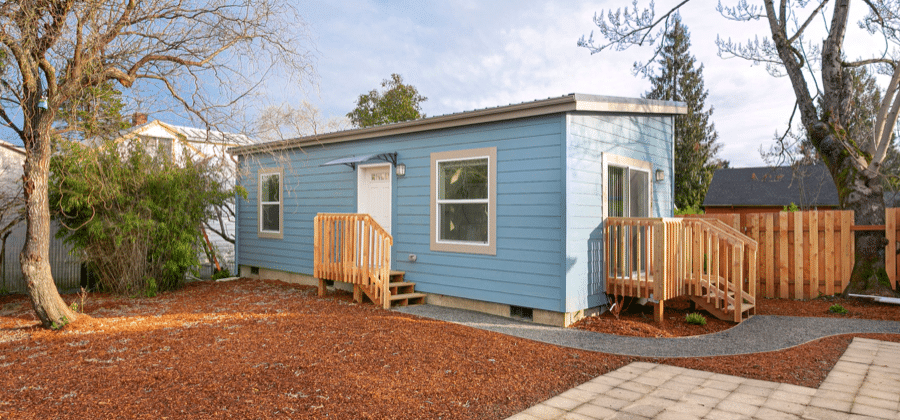
Image courtesy of Scott Flynn/indieDwell.

Why ADUs are a good idea.

November 30, 2020

What’s an ADU?  It’s a granny flat or a mother-in-law unit, now more widely known as an Accessory Dwelling Unit and usually built as an additional living unit in the backyard of a single-family home. ADUs are typically small, so that they can fit neatly into a backyard, with a compact and efficient floor plan big enough for one or two people to live in.

Adding value all around

One of the greatest benefits of an ADU is the value it adds to a property. Already a popular selling point in many areas, they not only add square footage of independent living space but can also provide supplementary rental income to the homeowner. In the past, zoning laws have prevented this but with the current shortage of housing availability cities and states are enacting policies which encourage the building of ADUs but permitting them to be built “by right”, with no special permitting needed.

Building ADUs increases the amount of housing units while reducing the pressure of cities to expand outwards. Instead of building large-scale low-income housing, building a multitude of small-scale ADUs will increase property values across the board as the integrity and  character of a neighborhood is preserved. And higher density populations can not only bring more commercial activity, more transport options and walkability, but the value of infrastructure investments such as transportation, is expanded when more people use it.

Multigenerational housing

With the housing shortage at crisis levels, multigenerational housing is becoming more widely accepted in the US, and ADUs are likely to become more frequently used for expanded families. An ADU can provide housing for ageing parents, home care helpers or young adult members of a family. It can provide additional work-from-home space or it can allow senior homeowners to age in place.

Cost and efficiency

Building an ADU in your backyard means you don’t have to acquire land and their compact size requires less building materials. In some cases, costs are minimized by manufacturing off-site. Their size makes them inherently energy efficient as well.

Zoning

In some cities zoning laws can make it tough for homeowners to create an entirely new dwelling on their property. They may also face backlash from NIMBY (Not in My Backyard) neighbors. But homeowners who build ADUs are filling an important affordability gap and are helping to address the ever-growing housing crisis.

In Portland, Oregon, the city has introduced a combination of zoning reforms, fee waivers, and outreach to jumpstart the building of ADUs and help address the critical housing shortage. That’s where Patrick Quinton launched his company, Dweller. Dweller specializes in building and providing ADUs to homeowners who want one. Not only do they build the modular ADUs offsite, saving substantial time and money, they handle all aspects of the process, from site planning and permitting, to utilities, installation and landscaping. And they pay for the ADUs as well – financing that most homeowners don’t have. Dweller enters into a ground lease with each homeowner, giving them the option to buy the ADU at some later date, making the process of adding a housing unit and adding a little income for each homeowner, as easy as can be.

Listen in to my conversation with Patrick.

Image courtesy of Dweller, Inc

Learn some more …

The world beyond banks.

November 18, 2020

Annie Donovan knows impact investing. She joined the Local Initiatives Support Corporation (LISC) last year, as COO, having built a truly remarkable career in community investment by embracing a pursuit of fairness in economics and finance. She found her way to this mission in part through her roots growing up in a working class family, where she was exposed to ideas of social justice early in life.

After a career working at the national level, she says what attracted her to LISC was its “deep, long-term connection to communities.” Previously, at the CDFI Fund, which provides capital to distressed communities, Annie worked on strategies to address local needs using programs like New Markets Tax Credits, CDFI Bond Guarantee Program, Capital Magnet Fund and the Healthy Food Financing Initiative.

A Pittsburgh native, Annie has described how community investment work ‘found her’ while she was serving in the Peace Corps after college. She says, “I learned powerful lessons about entrepreneurship and community finance – and about the capacity for community members to drive their own success if they have the right resources. I wanted to do more of that kind of work after I returned home.”

Annie has served as CEO of CoMetrics, a social enterprise that works with nonprofits to improve their financial management, and as a senior policy advisor in the Obama Administration. She has been a senior fellow at the Beeck Center for Social Impact and Innovation at Georgetown University, as well as at the Center for Community Investment at the Lincoln Institute of Land Policy. She also served as president of the New Markets Tax Credit Coalition.

Insights and Inspirations

  • Annie likes toiling close to the ground. She is committed to ‘local.’
  • She has a heart for social justice.
  • Community engagement is of utmost importance to building equity.
  • “You need to know the community where you build”, says Annie.
  • We can’t solve the issues of inequity without thinking comprehensively – housing, schools, education, the lot.
  • Disruptive capital is critical for solving these problems.
  • What if lots of corporations, like Netflix, contributed their PR funds to helping small businesses instead?

Information and Links

  • Annie has been deep diving into all the American history we never learned in school. She says Scene on Radio is a fantastic podcast, especially Season 2: Seeing White, and Season 4: The Land that Never has been Yet.
  • And she recommends two books she is immersed in: The Color of Money, by Mehrsa Baradaran, and for spiritual food during this crazy year, When Things Fall Apart, by Pema Chodron.
Read the podcast transcript here

Eve Picker: [00:00:11] Hi there. Thanks so much for joining me today for the latest episode of Impact Real Estate Investing. My guest today is Annie Donovan, COO at LISC, an organization deeply rooted in the community. Annie has built a truly remarkable career in community investment by embracing a pursuit of fairness in economics and finance. She found her way to this mission through her roots in Pittsburgh, growing up in a working-class family where she was exposed to ideas of social justice early in life. In no particular order, she has served as a senior policy adviser in the Obama administration’s Office of Social Innovation, as the CEO of the social enterprise, Core Metrics, heading the Community Development Financial Institutions Fund, and she spent two decades at Capital Impact Partners, all before taking over as COO at LISC. Be sure to go to EvePicker.com to find out more about Annie on the show notes page for this episode, and be sure to sign up for my newsletter so you can access information about impact real estate investing and get the latest news about the exciting projects on my crowdfunding platform, Small Change.

Eve: [00:01:39] Hello, Annie, I’m really honored to have you on my show and pretty excited to talk to a fellow Pittsburgher.

Annie Donovan: [00:01:46] Well, thank you, Eve. I’m very happy to be here and I’m always thrilled and delighted to talk to Pittsburghers.

Eve: [00:01:55] Good. So, the first question I have is actually about Pittsburgh. So, you grew up in Pittsburgh, and I’m wondering how that shaped the way you see the world.

Annie: [00:02:04] Thank you for that question. It very much did shape the way I see the world. Well, first of all, let me just tell you a little bit about my context. I grew up on the North Side of Pittsburgh. From an Irish Catholic family, I am the 10th of 11 children.

Eve: [00:02:19] Wow.

Annie: [00:02:19] My father’s family, so he was first generation American. His parents both came from Ireland. They actually bought a house on the North Side. So, the way that my, my parents were actually able to afford to raise a family that big was because my grandparents passed their home on to my parents. And so they never had to pay a mortgage. So, yeah. So, that’s how we sort of made ends meet economically, and, you know, were able to create some mobility in our family.

Eve: [00:02:58] What neighborhood was that?

Annie: [00:03:00] Brighton Heights.

Eve: [00:03:01] Brighton Heights. Ok.

Annie: [00:03:03] But the things about Pittsburgh, you know, when you’re from there or when you’ve lived a long time there, you know, Pittsburgh can take a hit for, you know, being provincial. And that’s certainly the case. I mean, in my parents’ generation, my parents had an ethnically mixed marriage because, you know, my father was Irish, and my mother was part German. But in their generation, people even went to church based on ethnicity. So, you know, so there’s a lot of that sort of ethnic pride and it can feel a little provincial. But Pittsburghers are also very unpretentious and very warm and open hearted, I think, and just possess a lot of resilience and, you know, grit. Those are qualities that I’m very proud to have had instilled in me growing up that I’ve relied on throughout my career.

Eve: [00:03:58] So, you know, I think also what I noticed in Pittsburgh and I heard stories about the steel mills actually purposefully separating neighborhoods into ethnicities.

Annie: [00:04:09] Yes.

Eve: [00:04:10] And that sort of prolonged that here.

Annie: [00:04:13] Yes.

Eve: [00:04:13] And it’s made the city architecturally interesting …

Annie: [00:04:15] Yes.

Eve: [00:04:15] … because the neighborhoods are really distinctive and unique …

Annie: [00:04:20] Yes, yeah, very much so.

Eve: [00:04:21] … and look very different. It’s fascinating. And then, of course, there’s the managers neighborhoods and the steelworker neighborhoods, so you know …

Annie: [00:04:28] Right. And you know, interestingly, what happened in my family, I grew up in a working-class neighborhood and it was very working class. My father actually went to school at night and earned a college degree from Duquesne, and he was the only person in the neighborhood who had a college degree. And he was an accountant. He worked for the Allegheny County. So, we had this interesting blend of, you know, when our country was experiencing sort of white flight. Right, so lots of white folks moving out to the suburbs.

Eve: [00:05:03] Yes.

Annie: [00:05:03] And those white folks moved out and then they went on toward more upward mobility. And we stayed in the working class neighborhood. But we were still, in my family, able to experience upward mobility because we owned our home. And my father had a college degree.

Eve: [00:05:21] A degree, yeah yesh, yeah. What led you into the world of community finance?

Annie: [00:05:25] I had always had, I think, a heart for social justice work. I thought a lot about poverty, and I thought a lot about the kind of injustices that were in my world growing up. Of course, I was born in 1964, Pittsburgh being, you know, not only ethnically divided, but lots of really hard lines around racial division, as well.

Eve: [00:05:54] Yeah.

Annie: [00:05:54] And I have to say, I have to hand it to my mother, because when we were growing up, this is probably the mid-70s and my brothers … well, so, in my family, there are six girls, and then three boys, me, and a boy. So, it’s almost like having two generations, you know. And I grew up with the boys. They wanted to start a street hockey league. And you know so, of course, I was out there playing street hockey with them. I’m a Title IX gal, and they were looking for a coach. And so they put an ad in the newspaper and a guy responded to it. And his name was Curtis. He was from the Hill District. And of course, the Hill District is the historically Black neighborhood. And so they signed him up and he came over to Brighton Heights, which was a very white place, and coached the street hockey team. For me, you know, they just got me thinking about, like, why why do we have these divisions? And I have these ideas of what people from from Black communities were supposed to be like. And he wasn’t like that. He wasn’t like my image. And my mother, you know, they’d play street hockey and it’d be time for dinner, and of course, whoever was around my mother invited in for dinner. So, often times Curtis would eat dinner with us. When we said Grace before dinner, the way he bowed his head and prayed, you know, it just struck me that everything I’d kind of learned about our Black neighbors I didn’t see in him. And so this is what got me thinking, like, what was all that education about? And so I’ve always been on a quest to understand what these racial lines are, too, and what the class lines are. And so, you know, I studied economics in college. Early on in my journey there was a 101 economics class and we were learning about rational thinking and optimization.

Annie: [00:07:53] And I remember thinking, well, this isn’t really a fair way to allocate resources across a society. And so I said that to my professor afterwards, who was, you know, a classically-trained economist who was like, Chicago School. And he said, well, this isn’t about fairness, it’s about efficiency. And that was like, OK, I’ve found my mission. And so, you know, and then I joined the Peace Corps, went to the Peace Corps after college. You know, lived in a very poor place. And then, you know, then it really sunk in because the people that I lived around were supremely resourceful and smart and really dirt poor. And so, what was that about? So, that’s when I became sort of even more fiercely committed to it. And, you know, that’s so, that’s been the pursuit of my career since then, is how do we use the tools of economics and finance, and how do we rewrite them in a way that produces a more inclusive prosperity, because we are leaving a lot of talent on the table.

Eve: [00:09:10] Ok, so you’ve had some really big roles from the White House to the head of the CDFI Fund. And now you’re at LISC. And I’m wondering, I’m familiar with LISC, I actually benefited from a loan from LISC years ago …

Annie: [00:09:23] Good.

Eve: [00:09:23] … for one of my projects. And I’m wondering what brought you there.

Annie: [00:09:28] Yeah. So, what brought me to LISC was, so after my experience at the CDFI Fund, I knew I wanted to go back into practice, because that’s kind of where my heart and soul lies. And so, one of the characteristics about LISC is that it is very committed to local – ‘local initiatives’ is part of our name. And I wanted to be in a place that was toiling more closely to the ground. You know, we have local offices, we have 35 and growing, local offices that really are programmatically focused and focused on capacity building alongside lending. And so, that’s where I saw the ability to more closely connect those pieces and not just be finance oriented. But to get deeper, closer to the community. And then the second thing was I saw in Maurice Jones, a leader in our industry who is boldly ambitious, is ambitious for the sake of impact, and I was attracted to that as well. So, yes, so that’s what drew me to LISC.

Eve: [00:10:41] Then like about community capital, what does community development capital look like today versus 20 years ago?

Annie: [00:10:49] Yeah, that’s a really good question. So, I think 20 years ago, if you think about, or even 25 years ago, you know, the sort of the history of community development or community capital, community investment … The community investment world, really, it braids together organizations and institutions that come from different origin stories. So, there’s the origin story of the black-owned banks and minority depository institutions that got underway right after emancipation, for Black Americans to build wealth. There is the credit union movement that was tending to people of modest means who wanted to come together and save together and, you know, have access to financial services that were owned and controlled by them. And then you had the nonprofit loan fund world that emerged because community development really took shape in the war on poverty and the commitment of the federal government to funding community development corporations. There was an era there where there’s a lot of federal funding, and we can talk about urban policy and how that, you know, CDCs kind of shifted urban policy. But then in the beginning of the Reagan era is when the feds really pulled back. And that’s when loan funds really started to emerge to say, well, we have to create new ways to finance the activity of community development. And that’s when the loan funds really started taking root. And then when Clinton came into office, he created the CDFI fund. And that has been a really important policy innovation, still as a policy innovation today, that has been investing the kind of equity capital that the industry needs to grow, that you can’t really get anywhere else.

Annie: [00:12:46] So, the industry has really blossomed, partly because we had good seed capital and partly because we just have been a bunch of people who have had a faith in the people and the communities that we’re investing in and have found a way to work with traditional and non-traditional sources of capital, to blend them in a way that allows investments to work in, you know, places where, you know, my old economics professor would have said you wouldn’t invest in because it wasn’t efficient, the rate of return wasn’t commensurate with risk, and all those sort of traditional measures, you know, that’s the reason capital doesn’t flow to some of the communities that we care about. And we are becoming more mainstream. And even though we’re still a tiny percentage of the financial services sector, I think through, even through the pandemic, you start to see CDFIs emerge, getting more attention in mainstream media. And certainly LISC has gotten a lot of, we’ve been able to raise a lot of resources through this pandemic because there’s a recognition, and we’ve not only done the investing and gotten the money there where people said it can’t go, but we’ve done it financially in a fiscally responsible way. So, we’ve proven that the places and the people we’re investing in are creditworthy. That has allowed this industry to grow. And I think it’s going to continue to grow. I’m optimistic about that.

Eve: [00:14:19] Years ago, I helped found a CDC in Pittsburgh. And what was really fascinating to me, because I was pretty new here and I didn’t really understand this lay of the land very well, you know, I sort of dropped in from another country. But, you know, all of the work we did was to get us to the same place as neighborhoods and places that were doing OK. And I’ve been in, I’ve been in this work for a long time and we never seem to get there. And so, I’m wondering, you know, because when you take a step forward with CDFIs, and maybe this is, you know, a really naive way to look at it, but you take a step forward with CDFIs, and you take a step back with banks who no longer really want to bank in or lend in communities, or want more equity or want, you know, more traditional products to lend in, and it’s just this never ending catch up, so, how does it all get better.

Annie: [00:15:30] Yeah. So, of course, I, I’ve been doing a lot of thinking about this and I think a lot of, a lot of folks have been soul searching around this, particularly because of the uprisings, demanding more, you know, racial, that we address racial equity. And so, it does often feel like, you know, some days it really just feels like we are just doing the work of bandaid, you know, putting bandaids on things. And that’s, that’s where I think this the work right now is really important because we can’t be satisfied with what we’ve done because it’s clearly not enough. And, but I think we are in a moment that we have to take, make the best use of, because we can’t do this on our own, as our, with our little bitty organizations. And even if we’re a billion dollars or two billion dollars or 10 billion dollars, we’re still to itty bitty to to create change on the scale that needs to be, that needs to happen. But that doesn’t mean this stuff shouldn’t happen. And it’s, and it does have to happen because even over my career, you know, 25 years ago if somebody had said that you’ll be working for a CDFI or you will help the, you know, build a CDFI, that will get to be a billion dollars. You know, wow, that would have been, because we, these loan funds were starting at, they just wanted to get to 10 million, you know.

Eve: [00:17:04] Right.

Annie: [00:17:05] And and we we wouldn’t be we wouldn’t have the opportunities that are in front of us now if we hadn’t taken all those baby steps to get to here. So, over the long haul, you know, I hope that we can get there. But, you know, there’s the bigger, we have to be able to impact the bigger picture. And, you know, for example, it was discouraging to me when I was at the CDFI Fund, and the second two years I was there under this administration that, you know, that a tax policy got, got enacted that just, you know, felt like it was going to undo everything that we were trying to do. So, there are these macro forces that, you know, that we have to try to turn the tide on.

Eve: [00:18:04] Yeah, that’s depressing. But I know (laughter) but I know it’s a really long patient game because I’ve been, I’ve seen that, you know, on things I’ve worked on that initially were like, what are you doing? You’re nuts to now being, OK, this is mainstream. Like co-working or lofts downtown or revitalizing downtowns …

Annie: [00:18:27] Exactly.

Eve: [00:18:27] … or all of that. And we’re actually …

Annie: [00:18:29] Exactly.

Eve: [00:18:29] … I think you’re right. We’re in a moment. All of the progress we were heading towards has been unbelievably compressed by everything that’s happened this year. So, maybe that’s a good thing, but …

Annie: [00:18:44] Yeah, and I think that it’s also very complex too, right? Because, even we see in some places tremendous progress running exactly alongside of things that feel like tremendous regression …

Eve: [00:18:56] Yes.

Annie: [00:18:56] … you know, so, and both of those things are happening at the same time.

Eve: [00:19:01] Well, what’s … I’m going to ask you, may not know the answer. But I really puzzle about what’s happening in traditional financial institutions. So, you know, I have this crowdfunding platform and what’s been startling to me and, you know, and our purpose is to help raise money for creative change-making projects and help developers get a little equity together, that seems to be a little more and more equity every year as banks change their position on what they lend for. Because we think that creative, those projects are important for making cities better. B

Annie: [00:19:41] Yeh, yes.

Eve: [00:19:41] But it seems to me that they’re retracting even further because we’re just being flooded at the moment, and equity requirements go up. It just seems to be harder and harder to borrow money, to do things, that are different than the things we have today. And we know we need to do things differently to fix some problems.

Annie: [00:20:09] Yeah, yeah. Well, the way I think about this and what I see from my perch is that I think that we have to, we have to start thinking about the world beyond banks, and, you know, think about and work hard on this, you know, the idea of having broader stakeholders. I mean, banks have been brought to the table on community finance because of the Community Reinvestment Act.

Eve: [00:20:45] Right.

Annie: [00:20:45] And so, so what are the ways in which, you know, there might be policy levers that need to be pulled to get more folks to the table. But also, you know, what the next generation of employees and employers, I mean, I think that we’re in for change and I’m really hoping that we’re in for change with the next generation of leaders. Because they have been raised with different expectations and they are already changing, corporate, the way … corporations are reacting. And you see now, you know, we’ve been the beneficiary of, you know, almost a 100 million dollars in corporate contributions that are going out to small businesses, as, you know, in this pandemic, in the form of relief grants.

Eve: [00:21:44] That’s pretty fabulous.

Annie: [00:21:45] And what we did was, the first one that came in, the first corporation that came in and said, can you do this for us? And we said, yes, we can do it for you, but we’re going to do it in our LISC way. And that means we are going to get to community-serving businesses that are majority-owned by people of color and women. And they said, OK, cool. Go ahead and do it. So, you know, and then the next company that came in said we want to buy that, we want to buy, especially as PPP, the paycheck protection program and SBA, major piece of the the CARES Act, you know, was clearly written in a way that was just going to follow the old rules for how you distribute capital. And then people started saying, wait, wait, wait, there has to be other ways to do this. And so the work that we were doing was tipping the scales. We put our thumb on the scale in favor of community-serving small businesses and gave preference, and we’re ending up with, you know, somewhere in the low 90 percent, of the businesses that we’re funding, are owned by people of color.

Eve: [00:23:04] That’s pretty great.

Annie: [00:23:05] And yeah, and in the paycheck protection program, we got to about 80 percent of our companies being minority women- and women-owned companies. And when you put together and in the, on the private sector side, our formula was where we’re going to advantage certain census tracts. We’re going to advantage minority ownership and women ownership, and we’re going to advantage certain size. So, when you line all those up, it’s not that hard to come up with lots of folks to invest in. And that’s where our money’s gone.

Eve: [00:23:43] So, another question I have is looking at the other side of it. If a real estate developer has access to community capital, what should her reciprocal responsibilities be to that community?

Annie: [00:23:59] I think that’s really, really very important because, and we have to all get better at this as well, in terms of how we doing community engagement, and how we’re bringing people into ownership of what happens at the community level. And so I think, you know, there are just these models and this seems to me to be what’s out there on the fringe right now, you know, and it’s always what’s happening on the fringe that’s eventually going to be where where we all go, hopefully. But what I see is, I’ve been been advising on a project that’s being done by a foundation of philanthropy. It’s not a traditional philanthropy. It’s one of the newer philanthropies. And they are, they’re going to do they’re investing in a real estate project in a very, one of the most distressed census tracts in Washington, D.C. And they are bringing together community stakeholders to say, how do we create a vehicle for people who live in that community right now before the development happens? How do we create a vehicle for them to invest in it and to get ownership in it? And those are, I think, the kind of strategies we need to be thinking about. You know, how do we, because otherwise if you just let this play out via market forces, you get gentrification a lot of times.

Eve: [00:25:40] Right, right, right.

Annie: [00:25:42] So, you know, we don’t want to go in that direction. And that that means giving people real ownership stakes.

Eve: [00:25:48] I mean, I agree. That’s what we at Small Change, I’m having similar conversations with some very large developers who are starting to think about that ownership piece, in really humongous projects in D.C. and New York. And it’s really exciting to see that people are thinking about it. It is hopeful.

Annie: [00:26:08] So, yeah. And if you think about like, so, another example, and this is not at the project level, this is at the fund level. But, you know, we’re managing we’re going to be managing money on behalf of Netflix. And Netflix went out, and this was somebody inside Netflix who said, you know, in their treasury department, why are we sitting on all this money and not thinking about where it’s invested? Why don’t we get this to black-owned institutions and, you know, and that, and that’s when, so, you know, like back to your question, when are we ever going to see this get better? I mean, that’s when it’s going to get better, right? When that person inside that corporation goes to the CEO, and the CEO says, yeah, absolutely, why aren’t we doing that?

Eve: [00:26:53] Yeh, yeh.

Annie: [00:26:53] And then you put it out there. And once, when Netflix put that out there and they made the investment in us, we had so many corporations respond to say, well, how do we do that, too? So, that’s what we have to do. We have to create the bandwagon. But the bandwagon that’s moving money in this direction.

Eve: [00:27:12] Yeh. Yeh, yeh. So, I mean, how would you define impact investing then?

Annie: [00:27:20] Ok, so impact investing to me, I always define it as it’s a spectrum, right, because I like I think it’s important for all of us to have a big umbrella and be inclusive. Right? And on one end of the impact investing spectrum are the folks that would say, you know, you can invest, and do good and do well at the same time. Right? And there’s not really a trade off. And then the other end of the spectrum is, you know, where my work has always been, which is on the whether you call it concessionary or catalytic capital, where you’re trying to, because on that that first end of the spectrum, you’re not disrupting any kind of the market forces. You’re sort of saying the market can do this, but there’s something missing in terms of information flow. So, if everybody had perfect information, then you know that that would solve the problem. So, I’ve never bought into that because I don’t think that it accounts for the systemic racism that exists in our society and in our economy. And so, I think you have to be more disruptive than that. And that requires capital that, that is, that can be designed in a, and stacked and engineered in a way that allows more people to get access to it, to do the kind of projects, to create the kind of businesses that are going to let them into, you know, more economic activity. So, yeah. And my dream is always in my work is always trying to think about, how do we get the people who are on one end of the spectrum down toward the catalytic end? Because if you want to disrupt poverty, you can’t do it on the market end, purely market end.

Eve: [00:29:28] No. Interesting. I mean, impact investing has been growing, I still think it’s small. Do you expect, I’m, I suppose I’m wondering if you expect this, the events of this year to rapidly increase interest in that, too. Well, certainly if you see it from Netflix.

Annie: [00:29:52] Yeah, I think I think it is. And I think the question is, you know, the question that’s on our mind at LISC is how do we, how do we convert the short-term interest into long-term relationships. Because, and how do we get people to see? Because actually, frankly, in the short run, it’s good for a corporation’s brand to step up and do this kind of work.

Eve: [00:30:17] Oh, yeh.

Annie: [00:30:17] I mean they’re … Yeah, and there’s not really much at stake there. And frankly, you know, they could direct, if they wanted to, they could purely direct this out of their PR budgets.

Eve: [00:30:28] Yes.

Annie: [00:30:29] You know, and so how do we, how do we, you know, convert people to the long-term play? That’s the work that’s in front of us right now.

Eve: [00:30:40] Right. So, Just shifting gears a little bit, how, you know, what do we need to think about to make our cities and neighborhoods just better places for everyone?

Annie: [00:30:55] Yeah. I think that we have to, we have to think comprehensively, first of all. So, I don’t think, that’s the other another reason that I wanted to join LISC is because I like the comprehensive approach. Because I don’t think there’s any one dimension to neighborhood life that is a silver bullet. Right? So we have to invest more in education and housing stability is fundamental to economic mobility. And so, we have to invest in all of these things. And, you know, back to, back to the big picture of tax policy and how we tax and spend. I do think we just, the thing is, we know exactly what we need to do.

Eve: [00:31:54] Yes.

Annie: [00:31:55] We just have to invest in it. Right? We know the payoff of early childhood education. We know the payoff of education in general. We know the payoff of preventive health care. So, you know, what more evidence do you need? We just need to have the will and the commitment as a society. And once that’s there, I think everything else follows.

Eve: [00:32:24] Yeh. And I see physically, too, we know the payoff of neighborhood parks and better streets and better lighting and all of those things that everyone wants in their own neighborhood. And some people don’t have.

Annie: [00:32:39] Right. And we have to develop we have to develop our collective will to say that that’s not OK. That’s not the world we want to live in.

Eve: [00:32:49] So, what community engagement tools have you seen that have worked that, you know, you mentioned that that’s a critical piece of it and that’s hard.

Annie: [00:32:59] It is hard. It’s hard for a lot of reasons, one of which is that when community developers who don’t know community, if they don’t know the community, if you’re coming in to this, you know, as a sort of professional, you may have certain assumptions about what people, and I think one of the things we make a mistake on this all the time, like what does the community want? Well, you know what? Not everybody in the community agrees on what they want, just like, and just like in your community, you know.

Eve: [00:33:35] Yes.

Annie: [00:33:35] So, I think starting with listening, and being open is really, really important. And so, I mentioned a, you know, the project where, you know, in Washington, D.C., where the funder was coming in and actually saying, OK, we want to do, we want the result of, to be that people have an ownership stake. But why don’t we find out from the community what that means to them, how they would do it? What, is that what you, is that what’s really wanted? You know, so I think, you know, good community engagement starts with listening, not making assumptions and and bringing people in and just providing the space for voices to be to be heard and listened to. And, you know, just having a faith in that. That that’s, you know, that that’s going to going to lead you down the right path is a good way to get people involved. And I think that also, you know, when I started my career, after I got back from the Peace Corps, I went to work for the Campaign for Human Development. And in that work, we funded a lot of community organizing. And the ability of communities to organize themselves is also an important piece of this. Like the, there’s very little investment that goes into community organizing. And I think that’s a really important component.

Eve: [00:35:24] You know, that’s what I was just going to say, because I think about, like when you’re a very large developer doing a large scale project, you can absorb that community organizing piece.

Annie: [00:35:35] Yes.

Eve: [00:35:35] But when you’re a small developer doing like interstitial projects that are, you know, fit into a neighborhood, that becomes a pretty heavy lift in terms of resources …

Annie: [00:35:46] Exactly.

Eve: [00:35:46] … and there to help, and how do you get that done properly. It’s really, it’s hard. It’s hard.

Annie: [00:35:53] Right. Right. And it’s also, you know, and we need more philanthropy dollars in that because that’s a really hard role for government to play. And we administer a lot of Section 4 money, and that’s out of the HUD budget, and that’s for capacity building of local organizations, and, tt’s really hard money to work with.

Eve: [00:36:16] Yes. Yeh, yeh.

Annie: [00:36:16] You know, it’s, so there’s a need for investment in, of flexible dollars into neighborhood organizing and leadership development.

Eve: [00:36:27] Yeah, no, I agree. So, what’s what’s next for you and LISC? I mean, what do you think the next five years will look like in this pretty fast-moving time that we’re having here?

Annie: [00:36:40] Yes. So. Well, I think that we are on a pathway, move, you know, moving to the next level of growth and scale. And for us, that’s about how do we, how do we use the assets that we’ve built so far to get to the next, to get to that next level? And I think for us, you know, putting impact first, you know, the racial equity piece of this is really important. And I think, I am very hopeful that we are going to be able to do the deeper work there, that we’re going to, you know, take, choose the pathway of doing the harder, deeper work. Because the long-term outcome is going to be better. And we’re going to, you know, try to bring our partners along for that ride. And I think that we are through this period, we have greatly increased our capacity to reach small businesses, and to think about inclusive economic development. How do we build the infrastructure for more inclusive economic development? And ecosystems that support community, small community-owned or locally owned small businesses? And, you know, and we have to be thinking about how are we disrupting systems? So, because we’re at the edges of them now, you know, in terms of their usefulness and we have to build something that’s built to suit, for the next level of scale. So.

Eve: [00:38:41] Thank you very much. I really enjoyed the conversation. And I can’t I really can’t wait to see what you build and where LISC goes and where you go with all this.

Annie: [00:38:52] Well, thank you and I love the work that you’re doing, every dimension, you know, that, every strategy that brings in more capital and the, you know, more of the kind of equity capital that you’re pulling in and democratizing that, I think is a really powerful strategy. And I also wish you the best.

Eve: [00:39:17] Yeh, all takes … Thank you, Annie.

Annie: [00:39:19] Yes. I can’t wait to. I can’t wait to see that happening.

Eve: [00:39:22] Bye.

Annie: [00:39:22] OK. Bye, bye.

Eve: [00:39:29] That was Annie Donovan. Annie thinks we need to start thinking about the world beyond banks. We need to find a way to let communities invest in order to change how we tackle development. To give them a real stake in their own future. Listening is key, as is providing the space for people to be heard. For Annie, impact investment needs to have a big umbrella and be deeply inclusive. She also understands playing the long game, saying that we know exactly what to do, but that we need to develop as a society, the collective will to invest in that knowledge. You can find out more about impact real estate investing and access the show notes for today’s episode at my website, EvePicker.com. While you’re there, sign up for my newsletter to find out more about how to make money in real estate while building better cities. Thank you so much for spending your time with me today and thank you any for sharing your thoughts. We’ll talk again soon. But for now, this is Eve Picker, signing off to go make some change.

Image courtesy of Annie Donovan / LISC

Spread the wealth.

November 11, 2020

Since 2004, Charmaine Curtis has headed her own development and consulting companies, emerging as a leader in the Bay Area developer arena. Her three decades of real estate experience include multi-family, mixed-use and urban infill projects, and she has overseen or worked on the development of over 7,000 units of housing, in both San Francisco and Seattle.

Passionate about developments that can crack the affordable in the land of unaffordable, Charmaine believes we are due for a paradigm shift in how we think about wealth and equity. She has written and spoken about the implicit challenges of being a developer who also happens to be a woman and Black, noting that even where she has lived and worked for decades, “in liberal San Francisco [there] is unconscious, pervasive bias against Black people and women. It would be hard to overstate how much more difficult it is to gain access to capital and be taken seriously as a real estate developer if you’re Black, and compounded if you’re a woman. In spite of this, my career is incontrovertible proof that a Black woman can succeed in the industry.”

Previously, Charmaine served as president of A. F. Evans Development, director of housing development at Mercy Housing California, and project manager at McKenzie, Rose & Holliday Development. One of her early jobs was as an associate planner for the city of Berkeley.

Insights and Inspirations

  • Charmaine didn’t realize what she was up against (Black + woman) until she was in her 30s.
  • She wonders what her net worth would be today if she were not a Black woman?
  • She’s interested in developing real estate around market principals that would pay her enough to be comfortable, but ensure that those she is building for are comfortable as well.
  • What would it take to spread the wealth? Charmaine wonders if you added up all the wealth in the world and distributed it equitably, what would everyone have? Would it be enough?

Information and Links

  • Charmaine likes a blog put out by Neha Sampat. Neha has a consulting practice called GenLead BelongLab, and her blog is mostly about empowering women by helping us identify what holds women back. 
  • And then art. Charmaine was part of a group of women who collaborated to bring this amazing 55′ sculpture, “Truth is Beauty,” to San Leandro, to educate about violence against women and to inspire survivors to speak up. The “visionary developer” who installed it was Gaye Quinn.
  • And Charmaine also wanted to point to a mural (on a project she co-developed in Oakland) called “Hands Across”. Designed by noted artist, Kota Ezawa, it has become even more resonant in 2020.
Read the podcast transcript here

Eve Picker: [00:00:10] Hi there. Thanks so much for joining me today for the latest episode of Impact Real Estate Investing. My guest today is Charmaine Curtis, who’s had a significant career as a real estate developer on the West Coast. She owns her own company, Curtis Development and Company, and she’s focused on impactful housing projects trying to crack the affordable in the land of unaffordable. But we’re not video blogging, so you probably don’t know that Charmaine has two strikes against her. She’s a woman and she’s Black. And if you’ve ever wondered what that’s like, here’s a chance to learn. Charmaine says that she didn’t know what she was up against until she was in her 30s, when reality struck. “How much more personal wealth would I have, she wonders, if I were a white man?”

Eve: [00:01:12] Be sure to go to EvePicker.com to find out more about Charmaine on the show notes page for this episode and be sure to sign up for my newsletter so you can access information about impact real estate investing and get the latest news about the exciting projects on my crowdfunding platform. Small Change.

Eve: [00:01:36] Hello, Charmaine, it’s just lovely to have you on my show.

Charmaine Curtis: [00:01:40] Well, it’s really nice to meet you.

Eve: [00:01:42] Yes, I hope we meet in person some day …

Charmaine: [00:01:45] Me too.

Eve: [00:01:45] … when this silly pandemic is over, right?

Charmaine: [00:01:49] Yes.

Eve: [00:01:50] So, I wanted to ask by, start by asking you what, what drew you into real estate?

Charmaine: [00:01:59] It was a very serendipitous and intentional way. I got a master’s degree in urban planning from UC Berkeley with every intention of being a planner and, you know, doing my part to save the world. And then I got jobs as, not counterplanner kind of jobs, which is, I think that most people think of planning, they think of people who are sitting at a desk in a municipal building and, you know, giving people information about what they are or not allowed to do on their properties. I worked for the redevelopment agency in Berkeley. But my first job, first of all, was working for Libby.

Eve: [00:02:35] Oh.

Charmaine: [00:02:35] Doing market studies. Yeah. You probably didn’t hear that part.

Eve: [00:02:39] No.

Charmaine: [00:02:39] Yeah. Yeah. So, yeah, Libby was the first person I worked for out of grad school.

Eve: [00:02:45] For our listeners, Libby, Libby Seifal heads up a growing women’s development collaborative that we’re both part of. So backgrounds. Go ahead.

Charmaine: [00:02:54] So. I went to work for the city of Berkeley, for the redevelopment agency, and I was just a young whippersnapper who threw out into the wilderness when they were trying to expand … into a couple parts of the city. And, so I got chewed up in that process with very little support and realized I was really not interested in being a public employee. But I didn’t know what I wanted to be at that point, because I had just spent these years getting a graduate degree. And then I serendipitously was introduced to a developer who was starting his own company and looking for a young whippersnapper to come and work for cheap and help him build this company. So, that’s what happened, that, you know I kind of fell into the business, not intentionally, but through that introduction, which, which was great because I got to work on some super exciting projects in San Francisco that were really pioneering. And I got to learn the business, at least that side of the business. It was, it was a for-profit company converting loft buildings or warehouse buildings into lofts, which was a new thing for San Francisco, a very old thing for New York, but a new thing for San Francisco. So, that’s how I got into the business. And I did that for a few years and really got, you know, sort of trial by fire, learning that, you know, all about entitlements and actually worked on one of the first low-income housing tax credit syndications in the country.

Eve: [00:04:32] Oh.

Charmaine: [00:04:32] We did all kinds of, it was just, it was a wacky thing. You know, some of it was consulting work that we did for others. But so, I got, I got a real broad range of experience in that, in that company.

Eve: [00:04:47] Kind of always the case when you’re in a small company, isn’t it? You get to do everything because there’s no one else to do it.

Charmaine: [00:04:54] Yeah, and small was me and him. That was it was just the two of us at the beginning. And it was really, it was a great experience. And then it was a challenging experience as the company was growing. And I kind of felt like I was not able to grow as much with it at some point because other people were brought in. And so I decided to move on. And that was in the early 90s. And I decided I really wanted to learn the affordable housing side of the business and build some affordable housing. I mean, I was sort of, back to, you know, my part and trying to save the world, and I got a job working with an organization, it was called Catholic Charities at the time in San Francisco, but was later acquired, shall we say, by the Sisters of Mercy, who were starting their own development, affordable housing development, company, which is now, as you probably know, a pretty large national company, a non-profit, and based in Denver. And so that was really an interesting transition from being part of the male dominated Catholic Church to moving into the female dominated part, which was a revelation. And so many amazing, I mean, the women who were, who started that organization, including Sister Lillian Murphy, who died last year, I think, were just extraordinary women in every way, just in terms of their true passion for providing affordable housing and alleviating poverty, you know, trying to make a dent in poverty, not just, you know, putting people in buildings. And just because they were brilliant, you know, any of these women could have run a successful for-profit development venture. But, you know, they were nuns, and so they put their talents into building an operation to build more and more affordable housing, which is, now it’s just, it’s, it is, as I said, one of the largest nonprofits in the country. And, you know, that was also super informative experience for me. Also a burnout, because, you know, if you’ve worked in affordable housing, you know that at least here in California what it takes to put an affordable housing development together is like 10 pieces of funding, small pieces of funding from, from multiple sources and then trying to marry those sources. And the brain damage and the transaction costs of affordable housing is excessive. I was also, you know, I was being a project manager, and then I was, I was managing people, and then also managing projects, which just totally a recipe for burnout. You just can’t do both.

Eve: [00:07:52] Right.

Charmaine: [00:07:53] I decided to take a break, and actually decided to go to film school, which I did …

Eve: [00:07:59] Oh wow.

Charmaine: [00:07:59] Which I did well. And I went to film school at San Francisco State, and for a semester, and during that time, I was also working and doing consulting work for Mercy and others, and to support myself. It was something that I was passionate about, but it was also something that, you know, I didn’t feel I had the financial bandwidth to pursue.

Charmaine: [00:08:28] I grew up in a working class family and I wasn’t really intending to be a working class person, myself. You know, the goal was to move beyond that. And to do my family proud, and to do myself proud in terms of being able to do what all generations want to do, which is just do better than the one before or the ones before, especially when you’re your Black person in in this country. And I had opportunities growing up because I was recruited into a program called A Better Chance. And I left my home in Cleveland to move to Minnesota where I went to high school for three years, and went back home on vacations. That program is a program that was founded on the East Coast back in the late 60s, early 70s, to identify promising young people, kids in inner city areas who were in crappy schools and to give them an opportunity to go to, initially boarding schools on the East Coast, but it expanded to the school like I went to in the Midwest, which was a public high school in a really wealthy suburb. So, I ended up getting into Dartmouth College after that. And so, you know, I was a smart kid and I had these opportunities and, you know, and I seized them. But, you know, getting those opportunities and taking advantage of them doesn’t mean that you kind of leave behind all of your, you know, the baggage of coming from a family that, where my mother, everybody worked two or three jobs. And my mother grew up picking cotton in the South. And, you know, it’s really not until, I would say probably in the last 10 years of my life or so, that I’ve really been able to sort of think about the impact, the sort of generational impact of, of poverty and, you know, slavery and racism in this country.

Eve: [00:10:29] Yeah, well, it sounds like in one generation you’ve come a long way.

Charmaine: [00:10:34] Indeed. I mean, I’m the one who from my immediate family that left Cleveland and, you know, kind of made my way in this insanely expensive world of San Francisco. So, after that, I kind of did some consulting on my own, and then when I went to work for a company, there was a for-profit developer. But they develop both market rate and affordable housing, which was kind of the best of all worlds for me. And I ran the multifamily part of that company and under a really great boss who is still somebody who I’m really close to. Art Evans, who was a, I think, a real visionary in the, in the field. And who came out of a redevelopment background and held that vision of both doing well and doing good. And I would say probably more doing good, ultimately. Art, he did a lot of really great work and ended up getting clobbered like a lot of people in the, in the Great Recession of 2008, 2009.

Eve: [00:11:36] Yeh.

Charmaine: [00:11:36] And then, I just did the addition the other day. I’ve been out on my own as long as I’ve worked for other people in the business. I’ve been on my own since 2004, and started out doing my own development, building condos in the East Bay and working on some stuff up in Seattle. And at the time I thought I had a financial partner who I thought was going to back my business, but that ended up not happening. And so I really ended up on a shoestring putting these deals together, between my own capital, and back in those days before the recession, you could do really high leverage …

Eve: [00:12:11] Right, right.

Charmaine: [00:12:13] … with participating debt and other kinds of financial participation by investors. And so, anyway, that was, that ended up being a, not a wise thing under the circumstances, which, of course, no one could have anticipated what was coming.

Eve: [00:12:28] No one. No one. That was a disaster.

Charmaine: [00:12:31] Yeah. And so, I built a couple of really nice projects that were in, what I would call transitional neighborhoods, which was the focus of my business plan, which was looking around the edges of, and looking at, you know, where people in San Francisco were fleeing to, frankly. Which was parts of Oakland and Berkeley, and seeing that those neighborhoods were ripe for …

Eve: [00:12:57] Yes.

Charmaine: [00:12:57] … change and also wanting to build an entry level product, not trying to …

Eve: [00:13:03] Not luxury.

Charmaine: [00:13:03] … not luxury, not, I would, I’ve never been interested in that, which I think was ultimately one of the reasons that my potential financial partner decided that he didn’t want to invest in me, because I wasn’t thinking that way. I wasn’t thinking huge and expensive. My interest really is much more in transformation of neighborhoods in a relatively organic manner.

Eve: [00:13:26] And isn’t that in the end, a little bit more recession proof, or a lot more recession-proof.

Charmaine: [00:13:31] Oh my God, if that was exactly my thinking at the time. Yeah.

Eve: [00:13:35] In 2008, 2009, I had a number of buildings in Pittsburgh that I had redeveloped, sort of against the grain. They were transformational. They were, I don’t want to say luxury products, but they weren’t affordable because I couldn’t, just couldn’t get the numbers right. But they were different. And honestly, I barely felt the recession. It was very odd because they were in underserved neighborhoods and places that most people weren’t looking at, just as you said, on the edges. Right?

Charmaine: [00:14:05] Yeah.

Eve: [00:14:05] It was an interesting learning experience for me.

Charmaine: [00:14:09] Yeah. You know, if I’d been at a different stage in those projects, I might have been able to pull it out. But one was not yet complete. It was about 75 percent done. And the other one was basically complete.

Eve: [00:14:21] Oh yeh, almost done, yeh.

Charmaine: [00:14:24] We were just starting sales. So, it was, you know, lenders were not feeling it.

Eve: [00:14:33] That’s really painful.

Charmaine: [00:14:33] Oh my God.

Eve: [00:14:34] Oh, that’s painful, you know.

Charmaine: [00:14:36] It was awful. And it really, I think took me a good 10 years to recover both financially and emotionally from it. Frankly, it was really, it was devastating. It was, you know, I talked to, I was talking to one of the local developers here who’s done well and I think comes from wealth. And  that, he said to me we were at a conference or something and he said, I personally lost six million dollars. And I’m like, oh, really? Well, I kind of lost everything except for my house. And so, you know, sorry, but our pain is not equal.

Eve: [00:15:09] Yeh.

Charmaine: [00:15:09] So, it, yeah, it’s, that’s the difference, you know for me in a way that crystallizes the difference between being a Black woman who comes from where I come from, with my sensibilities. Right? Not just, I didn’t get into development, too, I mean, I think maybe initially I did kind of get into development to become a rich person and, you know, prove that that’s possible for a Black woman to do that in the industry. But it’s the difference between being, you know, someone who doesn’t come from resources versus someone who does. And who is then able to build more races on top of those resources, that provide the cushion that you need when the shit hits the fan. So. It was a crystallizing experience for me that way, in terms of, the just the stark difference. Everyone was not impacted equally by that. What happened, for sure. Since then to, that my daughters were born in 2008. I was lucky to, you know actually marry later in life and have these two girls with my husband. And that was 2008. While the world was crashing down around me, I was also pregnant and with twins and …

Eve: [00:16:20] Oh!

Charmaine: [00:16:20] So, they were born in late 2008 and I spent the next few years just rebuilding, basically, and working on a really interesting project I worked on exclusively for a few years, which is a master plan and community work and both, internal community work with this public housing project in San Francisco and, and the surrounding community to re-envision what was a 600-unit project over 39 acres into what would be, what will be a 1600-unit mixed-income project and …you know, in addition to working all the physical planning, working with the community to get their buy in and support, and working with the folks who live in the public housing to help them envision a better future, and to bring a new way of working with very low-income people. That’s ongoing, and that is really, I didn’t do on my own, or at all. There were many other people involved in this community building effort and really, in recognizing the trauma that comes with generational poverty and all the, you know, the things that happen to people who live in poverty and that keep them down. And so, that has been, and continues to be, a reasonably successful effort to lift, not just rehouse people in better housing, but to sort of lift them up and provide, protect the developmental health of the littlest ones, in particular, by also helping their parents.

Eve: [00:18:06] yes.

Charmaine: [00:18:06] So, that was a really great opportunity for me to do this amazing work on what will be a transformative project in that part of San Francisco. And now I am doing development on my own or with others and co-development capacity. And I’m still doing, I’m doing development consulting work. That gig with the nonprofit, where I did the master planning work and all that other work, was a consulting gig. And so, you know, really just the last many years been about finding the balance between supporting my family in this insanely expensive town and reinvigorating my development career as a principal, which is where it’s at for me because I like to create things, you know.

Eve: [00:18:52] Yes, I know that.

Charmaine: [00:18:54] And in order to create, you need to have some measure of control …

Eve: [00:18:57] Yeh.

Charmaine: [00:18:57] … which is when I started my business, in 2004, that was a moment when I was just on fire with, with passion to make buildings and be a part of transforming neighborhoods.

Eve: [00:19:10] Yeah.

Charmaine: [00:19:11] And I feel like I’ve kind of rediscovered that, that passion in the last few years.

Eve: [00:19:16] It’s such a great thing to make, like something happen out of nothing.

Charmaine: [00:19:20] Exactly.

Eve: [00:19:20] It’s so great. There’s really nothing like it.

Charmaine: [00:19:22] Yeah. And it’s, I mean, that’s really, I’m just a very, you know, goal oriented, like I can see it and touch it and feel it at the end of it, I’m so happy. If I can’t touch it, see it and feel I’m like, what am I doing? What is, what is this?

Eve: [00:19:35]  Yes.

Charmaine: [00:19:37] So. I’m definitely a … touch feel person and love, love to see the results.

Eve: [00:19:43] Oh yeah, me too. So, you are a Black woman in an industry that is incredibly, heavily dominated by white men, and I know that’s impacted your work, but I’d love to hear from you … how.

Charmaine: [00:19:59] You know, I will start answering that question by talking about a TV show I watched last night, which is a new show on Hulu called “Woke.” And it’s really interesting. I suggest you check it out. It’s …

Eve: [00:20:16] I will check it out. I’m writing it down.

Charmaine: [00:20:18] I think it just dropped last night. And it’s based on the life of a cartoon artist, named, I think, Keith Knight, who invented these cartoon characters. And I don’t know if the true story is butter and toast, but those were the characters, the cartoon characters in his strip, that he was, that this show was talking about. And how this guy, this Black guy thought that he was kind of exempt from, you know, the impact from being impacted by Blackness in this country until he was taken down by some cops and, you know, thrown to the ground and guns at his head because they thought that he was a mugger who had just been reported, and how that experience transformed him, and his thinking, and his perception of himself in the world. It’s the first one, I just watched the first one, and I’m like, oh, my God, that’s kind of me in my 30s, you know. I thought, oh, my God, I’m, I’m smart, I’m driven, I work hard, and therefore I will succeed in this business. And, you know, while there’s always, you know, when you’re a Black person who comes from poverty in this country, I think there’s always another part of you that’s back there saying, hh, that’s not going to happen, Come on. But I, basically I would say I took for granted, for a very long time, what a disadvantage I was at being a Black woman in the business. I thought my smarts was enough. And it, you know, it’s just not.

Eve: [00:22:01] And, It should be enough, right?

Charmaine: [00:22:02] Well, yeah. In a in a in a perfect world.

Eve: [00:22:06] In a perfect world. Yeah. Yeah.

Charmaine: [00:22:08] But, you know, in a way I, I think it was liberating to not see that limitation, like, at least not ostensibly. I probably felt it more than I saw it. And you know, and I, I built a great reputation here in this city and this region, parts of the region, anyway. But what I would say honestly and truthfully, and this is, this comes from somebody who was really hard on herself a lot of the time. If I were a white dude in this business with my skills, ability, talent, vision, I would be, you know, five times richer than I am. And have more opportunity thrown at me than I do. You know, it really just took me a really long time to actually come to that conclusion because I’m so driven, and have, and took so much for granted, frankly, about what my smarts and what my drive would get me. That said, you know, if I look sort of relative to where I come from, what my background is, you know, my mother picking cotton, my stepfather working eight thousand jobs to support us, I’ve done well, especially in this region where it’s so hard to live. But would my career have taken a different path if I were a white dude? Absolutely. And I, I think there’s a level of just not being taken seriously as a Black person in this industry. It’s not even at that level. It’s almost just like it’s not not being taken seriously. It’s just not being seen. And, and …. you’re, it’s not like you’re invisible, but it’s almost like you’re invisible. Because there’s a presumption that especially as a Black woman, I mean, there are some Black men in this industry in the Bay Area who’ve done well. Not many. I’m going to say three.

Eve: [00:24:17] Yes.

Charmaine: [00:24:17] But as a Black woman, I think it is just, it is just a given on a very subconscious level, for most people that you are not, you don’t have what it takes to, you know, to do what white men can do in this business. And I think it’s on some level that is something that I internalized at some point in my career. And in addition to, just all the internal stuff that Black people experience in this country, you know, from living in generations of the degradation of racism, that you see and that you don’t see. Right? It’s almost the unseen stuff that is worse than … and you’ve heard, probably heard people say, I’d rather be Black in the south where the racism is just in your face than be Black in the north, where it’s, it’s implicit and unspoken, but very real nonetheless. It’s hard to know, you know, what we were talking about before we started, you started to start recording, it’s hard to know what you don’t know. It’s hard to know how your life and career trajectory would be different if you were who you were in a different body …

Eve: [00:25:33] Right.

Charmaine: [00:25:34] … in the body of a white man. So, it’s, You know, it’s complicated.

Eve: [00:25:40] It’s actually quite heartbreaking.

Charmaine: [00:25:42] Yeah.

Eve: [00:25:42] You know.

Charmaine: [00:25:43] Even before the events of this year, I’ve been, and when I started out in 2004, it wasn’t like I didn’t understand that I was a Black woman in the business. I did. And part of what I really wanted to prove, and want to prove is that a Black woman, you know, a smart Black woman who is hard-working and can accomplish anything, basically, like no limitation. There are no limitations, you know, and there are, obviously. But there’s still that drive in me to prove that a Black woman can be a serious success in this business. How I’m defining that, now, is probably different than it was then, because I am really about creating a different kind of world. I’m not, you know, when I was younger in the business, I was like, this is, I’m going to make a ton of money, I’m going to prove, because the measure of success in this industry is wealth. I’ve had this conversation with my husband many times. It’s like, what a success look like in the development business. If you are a white guy, it looks like, or if you’re anybody, it looks like how wealthy you are and how much money you’ve made. And the world is just the direction that we are moving in. I feel like it is really vital that people like me, and everybody, deploy their talents in the interest of the whole and not just themselves. That’s the world I want my kids to be able to grow up in, is a world that’s not a winner-take-all world, and so, that’s really kind of how I’m thinking more, lately, is how can I deploy my talents in a way that’s going to help to create that world where development can be a force for real transformation. And what needs to happen in the industry for that to happen? What conditions need to exist for that to happen? And there’s so many different parts of it, I know that you are familiar with because you’re a developer.

Eve: [00:27:48] you know what you’re saying really rings for me, too, I think when I was younger, I always thought I would figure out a way to fit in to the structure of the world the way it is. And quite a while ago, I heard the first female three-star general of the Army speak, and someone in the audience asked her like, well, how do you fit into that power structure? And she, she drew a circle on a chalkboard and she said, OK, here’s the power. And you keep the circle, and you keep trying to get in, and you keep trying to get in, and you keep trying to get in. And eventually you give up and you go over here, and she draws another circle, and you make your own circle of power. And I think that, you know, there are some people who are never going to change that first circle, but then there are the rest of us who want to do something different.

Charmaine: [00:28:35] Yeh, yeh, and it’s really about building a movement and, or being part of a movement, and helping to build a movement to a more equitable way of developing …

Eve: [00:28:44] Yes.

Charmaine: [00:28:44] … our world. And I’ve been thinking a lot in the last few years about just how there’s sort of two, especially here in the Bay Area, there’s really two kind of extreme ends of the spectrum. Where we have a really robust nonprofit community on one end, which is largely, mostly comprised of white people, just as an aside, and a very robust market-rate world of development, which is mostly, also, white people …

Eve: [00:29:15] Also white people …

Charmaine: [00:29:15] … more women on the nonprofit side, for sure.

Eve: [00:29:20] Yes, absolutely, because they paid less. Right?

Charmaine: [00:29:23] Yeah, exactly. And, and they are, you know, they’re just, I don’t know, I don’t know what the difference is. There’s so many differences between women and men.

Eve: [00:29:31] It’s the same profile in Pittsburgh. I have to tell you …

Charmaine: [00:29:34] Yeh.

Eve: [00:29:34]  … it’s exactly the same.

Charmaine: [00:29:36] Yeh.

Eve: [00:29:36] It’s really interesting.

Charmaine: [00:29:37] But there’s a sort of middle ground that’s not occupied. And I think that there is a middle ground. I think there should be a middle ground, and that it should be occupied by people like me who want to use their talents to develop in a more equitable way. Which means in a way that really is not profit driven, but in a way that is driven by market principles, in a way. Because I do believe, personally, and I, this may be a controversial statement, I think that the non-profit world is not driven by the same principles that the for-profit world is.

Eve: [00:30:14] Oh, no, I totally agree, I totally agree.

Charmaine: [00:30:16] I’ve been on both sides. I’ve seen it. I’ve seen how I treat my money, like actually my, you know, versus some …

Eve: [00:30:26] No, absolutely.

Charmaine: [00:30:26] … government entity that’s like three, you know, three things removed from me. So, I do believe there is a real difference. And I’ve been on both sides, and I developed for my own account, and I know how to drive a deal and move in to reduce the cost to the lowest possible amount while producing something that I don’t have to be ashamed of.

Eve: [00:30:49] Well, you’re driven, you’re driven by urgency, and much of the nonprofit world is not, because they don’t have to worry about the costs and staying alive in the same way.

Charmaine: [00:30:59] Right. The cost or the time.

Eve: [00:31:01] Yeah. Yeah.

Charmaine: [00:31:02] And I’m not blaming anybody or anything. This is just the system that we have created.

Eve: [00:31:08] Yeh.

Charmaine: [00:31:08] And I really believe, I believe very strongly, and I’ve been talking about this for, you know, a few years now, that I believe that there is a third way to do development. You know, where I am not interested in trying to, I don’t want to generate tons of profits for anybody else. And I don’t want to generate, I don’t need to generate tons of profit for myself. I would like to make money, a reasonable amount of money, that is commensurate with whatever the level of risk is that I’m taking. And the less risk I take, the less money I make. And the more, the less profit somebody else makes, the more we can use that for the benefit of the people we’re developing for. And I’ve been thinking about that …

Eve: [00:31:50] Yeh.

Charmaine: [00:31:50] … largely here in the context of missing middle housing, which is truly missing, like, gone, like doesn’t exist.

Eve: [00:31:58] Really.

Charmaine: [00:32:00] And I don’t know how you do missing middle housing. It’s really a fee-driven business. It has to be in, if your heart is in the right place and you’re coming at it from the right perspective and in the interest of long term affordability, and not just, you know, a five, 10, even a 15-year old and then flipping and realizing gains … I think you really you really are coming at it from that perspective of, this is a fee business, this is a fee driven business, which nonprofit development is too, but it’s a fee-driven business that brings market-driven principles to the production.

Eve: [00:32:38] Yeah, so you produce something and then it has a life of its own.

Charmaine: [00:32:41] Yeah. And there are many, many elements to this. A lot of people are talking about, you know, modular is one aspect or building innovation, since we build buildings like cave people did, basically, to a large extent. And innovations in financial markets, which means really bringing people into financial markets who are not looking at achieving the, a typical kind of market return that you would get if you were investing.

Eve: [00:33:09] Yeah, well, that’s that’s the key.

Charmaine: [00:33:11] That is the key.

Eve: [00:33:11] That capital is less greedy.

Charmaine: [00:33:13] Exactly.

Eve: [00:33:13] Yeh.

Charmaine: [00:33:14] Taking the greed out of the bit, of this part of the business. And I’m a pragmatist at bottom. And so I’m like, we live in a capitalist world, in society. I’m like, that’s, let’s just say that, that’s what we are. We’re going to, that’s always going to be a big part of who we are and how we live. And, you know, the nonprofits are doing God’s work. But I do believe there is room for a third way to approach how we get stuff done. And we just have to bring, bring all of the all the, you know, creativity and passion, and bring others along into … Being real about it. Because in the world of social impact investing, I, I hear about it a lot. I have not, I can ,I can’t tell you that I’ve seen one development that I think benefited from whatever that is, at least the kind of development I’m talking about. There’s like a new organization in San Francisco that is attracting, I think, real social impact capital. It’s still money coming from wealthy people who expect a return, which I actually find that, slightly appalling, because I, I do think that if, you know, the one or even the five percent deployed even a portion of their capital in a way that was like, eventually give me my money back, and I don’t expect you to give me any return on it, but I’d like it back someday.

Eve: [00:34:46] I don’t mind a return that keeps up with inflation, but I’m with you completely. I posted on Small Change, I’ve listed projects that are affordable housing and heard complaints about the return not being high enough. And I’m actually, how can I say, unhappy with where we are, because I think the return should be as low as three percent …

Charmaine: [00:35:08] Yeah.

Eve: [00:35:08] … to really build affordable housing. And yet, I have to admit, I’m scared of listing a project with a return that low. I had a conversation with an amazing developer of a project just like that that really, you know, should be on that platform. And I don’t know if anyone’s going to invest.

Charmaine: [00:35:26] Yeah.

Eve: [00:35:27] Because it’s not enough money for them. So, if they really want impact. I mean, don’t people understand that the higher the return on equity, the less affordable the housing? Because, I don’t …

Charmaine: [00:35:38] I think some people do and some people don’t. And I think there’s a significant education aspect to this that has to occur so that people do understand that there is a direct relationship.

Eve: [00:35:50] Yeah.

Charmaine: [00:35:50] I think that we will eventually, hopefully be in a world where there is a concept of ‘having enough.’

Eve: [00:35:57] Yeah, yeah, yeah.

Charmaine: [00:35:58] If you have a net worth of 100 million dollars, that’s enough. And you can then use the rest of whatever you have in a way that is to the benefit of the general good. And those who don’t have.

Eve: [00:36:11] Yeh.

Charmaine: [00:36:11] And that’s really what we need. We need a paradigm shift in how we think about our individual responsibility as citizens of the world.

Eve: [00:36:22] Yeh, and then, of course, there are the small investors who’ve never had a chance to invest before. You know, where that 500 dollars …

Charmaine: [00:36:29] Yeh.

Eve: [00:36:29] … really matters, maybe even more than the millions of the billionaire. Right? And I want them to get a return. It’s very difficult. It’s very inequitable.

Charmaine: [00:36:39] Yeah.

Eve: [00:36:39] So my next question would be, well, you know, what would you change to make the real estate industry a more equitable place for Blacks and women? Maybe just ignore the rest of them?

Charmaine: [00:36:52] Yeah, you know, I mean, that’s obviously, there’s no magic bullet. There’s no, I mean, we’re seeing now in 2020 how deeply ingrained white supremacy is in our culture. A couple hundred years after slavery ended. So, I am not naive about the, and I don’t like to be airy fairy and unrealistic about the possibilities. You know, I think that one thing I see in San Francisco happening is that, at least in the nonprofit world, is that nonprofits are making an active effort to hire more Black people on their staffs, which I applaud, especially if you are hiring people and then supporting them in the way that they need to be supported, and not just having people be window dressing. So, how do how do we change the hearts and minds of Americans who don’t even perceive themselves as being racist, but who have, you know, probably relatively deep implicit bias, which is a lot of what I was talking about earlier that I have experienced with, that I didn’t even know I was experiencing, right? Is the deep, implicit bias of people who think that Black people are not as smart and not as whatever, as others, as whites or Asians, if it is a true awakening or call to action or whatever that’s happening now that’s also, you know, both sides are kind of awakened. Right?

Eve: [00:38:13] Right.

Charmaine: [00:38:13] But if it’s happening and this leads to a reckoning that is not, hopefully, violent, and that doesn’t tear us apart, I think that this is a very good thing because I do see more white people that I know than ever before trying to examine their own racism and … people who never thought of themselves as racist, which is very important because if you think you’re not racist and you’re white, you are not woke, you are not awake. And so it’s very important for, and it’s not a blamey thing, it’s just like, this is the work. This is the work that must be done, if we’re going to change this world so that Black kids have an opportunity anywhere near what a white kid can have in this country. And, you know, begins at that level of zero, you know, like birth and what you are born into. What happens to you between the ages of zero and five, how your psychology is, develops and it’s impacted by that and other things, and your sense of agency and capability and power in the world. That’s got to start at zero. It is remediable to some extent along the way. Right? And I’m kind of proof of that.

Eve: [00:39:38] Right.

Charmaine: [00:39:39] But, you know, that’s like one level of what has to happen. And, and making opportunities or providing opportunities for more Black people and people of color consciously, and not just consciously in the hiring and then bringing in, but then once people are in, giving them what they need, helping them to succeed and not just taking for granted, we did the hire, now we’re done. So, there’s that level of building opportunity. And I think that we need more Black people in the industry and just getting more Black people in the industry and whatever ways that happens will be a good thing. I did not know until, maybe until I was in graduate school what a developer was.

Eve: [00:40:32] Yeh, I was a bit older, actually.

Charmaine: [00:40:34] Yeah, right. I mean, it’s like, it is amazing how many people who I told them, when I tell them I’m a developer, they’re like, what is that? Still. Right? So …

Eve: [00:40:43] Yeah.

Charmaine: [00:40:44] So, teaching these little, kids at a very young age, what the opportunities are in life in general outside of the what everybody thinks of as being a doctor, a lawyer, you know, or a business person, in general, that there is this whole world where how our physical world is created, that is dominated by this industry.

Eve: [00:41:09] Yeah. And, you know, real estate surely should play a really big role in, in shifting generational wealth as well. I’m not, I’ve been thinking about that, and I think there are ideas, all sorts of ways that that might happen. I’m not exactly sure how yet, but wealth has to do with property …

Charmaine: [00:41:30] Right.

Eve: [00:41:30] … not just cash.

Charmaine: [00:41:32] That’s right. That’s why the wealthiest people own, families in this country up until recently, were real estate families, by and large.

Eve: [00:41:40] Right.

Charmaine: [00:41:42] Now it’s tech. But …

Eve: [00:41:43] Yeah. How do you teach that? How do you make that shift, make that happen?

Charmaine: [00:41:50] You heard me say earlier that, you know, and I have this conversation. I’ve been having this conversation with a guy I met recently who’s a Black guy, who’s doing some investing, and he is about, you know, sort of the wealth building, as a Black person in the, in the industry. And I get that, and I understand that, and I don’t not support that, but I cannot really abide wealth building amongst a very few people, while other people are out in the cold.

Eve: [00:42:25] Yeh.

Charmaine: [00:42:25] That’s not sitting right with me anymore.

Eve: [00:42:29] Yes.

Charmaine: [00:42:29] So, I’m torn about it. I mean, you can hear it in my voice. I’m torn about it because I do want to see more Black people succeed, but I want to see a lot more Black people succeed. You know, not just a few.

Eve: [00:42:44] Yeah, yeah.

Charmaine: [00:42:45] So how do we do that? We spread the wealth. You know, we have to find ways to spread the wealth. And that goes back to my comment about needing a paradigm shift in how we think about our responsibilities as humans on the planet, to each other and to our children and to other people’s children. I’m interested in building wealth. I’m just not interested in building …

Eve: [00:43:12] Uber wealth.

Charmaine: [00:43:12]  … yes, I’m not interested in being, you know (laughter) how many people in the world can have a net worth of ten million dollars? Can everybody? You know, is that a possibility? Is that a..

Eve: [00:43:27] It’s an extra interesting calculation to do if you.

Charmaine: [00:43:30] Yeah. Is that a theoretical possibility even, you know? And …

Eve: [00:43:30] That’s really interesting. Or even a million, you know.

Charmaine: [00:43:38] Yeah. What are the, what are the trade offs there? And I don’t know what they are. I just know that everybody can’t be rich. So then, you know, then I back off, I keep backing away from that, what can everybody, what is enough? And I start with, I really start with, like housing. There’s some things people should just absolutely, simply be entitled to. And housing, stable housing, stable, sanitary, decent housing is one of those things. And access to an education and the resources that you need to learn, that are not just about teachers and schools, but if you need, you know, help with your mental health or whatever you need help with to be somebody who’s able to learn and be a real contributor. These are basic things. And then we, we do these basic things, we build a better world where there will be more of everybody, more opportunity for everybody.

Eve: [00:44:39] Yes. Well, you’re going to make me cry, so I’m going to try harder. I hope everyone who listens will try harder, too. But I’ve really, really enjoyed this conversation. I feel awful ending it. But I’m going to now.

Charmaine: [00:44:56] Well, I’m looking forward to talking more with you. Yeah.

Eve: [00:45:00] I would love to meet you in person. And maybe there’s some joint venture we can do. I love doing development and I love hearing about what, what you’re working on. So, thank you very much.

Charmaine: [00:45:10] Thank you, Eve. It’s really great talking and, we will be in touch.

Eve: [00:45:23] That was Charmaine Curtis, a real estate developer, a Black woman in a largely white, male industry. It’s hard enough to be a real estate developer and make a living at it without those additional two strikes against you. But that is exactly what she is doing.

Eve: [00:46:03] You can find out more about impact real estate investing and access the show notes for today’s episode at my website EvePicker.com. While you’re there, sign up for my newsletter to find out more about how to make money in real estate while building better cities. Thank you so much for spending your time with me today. And thank you, Charmaine, for sharing your thoughts. We’ll talk again soon. But for now, this is Eve Picker, signing off to go make some change.

Image courtesy of Charmaine Curtis, Curtis Development

« Previous Page
Next Page »

Primary Sidebar

sign up here

APPLY TO BE A PODCAST GUEST

More to See

(no title)

February 22, 2025

Bellevue Montgomery

February 11, 2025

West Lombard

January 28, 2025

FOLLOW

  • LinkedIn
  • RSS

Tag Cloud

Affordable housing Climate Community Creative economy Crowdfunding Design Development Environment Equity Finance FinTech Gentrification Impact Investing Mobility Offering Opportunity zones PropTech Technology Visionary Zoning

Footer

©rethinkrealestateforgood.co. The information contained on this website is for general information purposes only. Nothing on this website is intended as investment, legal, tax or accounting strategy or advice, or constitutes an offer to sell, solicit or buy securities.
 
Any projections discussed or made may not be accurate and do not guarantee a specific outcome. All projections or investments are subject to risk due to uncertainty and change, including the risk of loss, and past performance is not indicative of future results. You should make independent decisions and seek independent advice regarding investments or strategies mentioned on this website.

Recent

  • The Mulberry
  • Mount Vernon Plaza
  • The Seven
  • Real estate and women.
  • Oculis Domes.

Search

Categories

Climate Community Crowdfunding Development Equity Fintech Investing Mobility Proptech Visionary


Copyright © 2026 · Magazine Pro on Genesis Framework · WordPress · Log in