• Skip to main content
  • Skip to secondary menu
  • Skip to primary sidebar
  • Skip to footer
  • Home
  • About Us
  • Say hello
Rethink Real Estate. For Good.

Rethink Real Estate. For Good.

  • Podcast
  • Posts
  • In the news
  • Speaking and media
    • About Eve
    • Speaking requests
    • Speaking engagements
    • Press kit
  • Investment opportunities

Affordable housing

The power of cities.

November 2, 2020

The world is reeling from the effects of the coronavirus pandemic and the resulting economic downturns. Add to this levels of civil unrest not seen since the 1960s and governments which are more ideologically polarized than ever before. How then do we collaborate to solve the enormously complex problems of our times?

The federal government plays an important part as the safety net for people, healthcare and defense. But pragmatic and localized problem solving might occur best at county, city and local levels. Here, impacted stakeholders can come together to compete and/or collaborate. 21st Century problems are complex and can’t be solved by one bureaucracy. They require multi-sectoral horizontal solutions. As a result, problem solving has become increasingly bottom up rather than top down and delivered by networks of institutions and leaders rather than the public sector.

Bruce Katz calls this phenomenon ‘the new localism.’ He believes cities have the power and ability to harness and leverage all the incredible innovative power in our country to solve local problems and to improve peoples’ lives

“Cities are more than governments, they’re networks. That’s why they’re so resilient, that’s why they’re so adaptive, that’s why in many places they’re so prosperous: they’re ecosystems.“

That’s not to say that the federal government can’t still be a platform or a participant in creating solutions, but issues that require local interaction and local networks might be best solved at the local level. We need to stop believing that all of our problems will be solved by bureaucrats and start believing in ourselves. Solutions can be created by networks. If we want to solve congestion, housing affordability or the integration of Black- and brown people into our economy, we need to bring together different sectors of our society to promote different ways of thinking. We need to develop a system where universities, health care systems, corporations, entrepreneurs, public sector philanthropies and individual stakeholders all work together to find tangible solutions to local problems, and to plan together how our cities will thrive.

Listen to my interview with Bruce Katz to learn more.

Image courtesy of John D Norton
Yes! In my backyard!

October 28, 2020

Two years ago, after careers in financing, government and local economic development, Patrick Quinton co-founded a new startup, called Dweller, in Portland, Oregon. Like all metro areas, Portland faces an affordable housing shortage, and Patrick, from his previous role as head of Portland’s real estate and economic development agency, knew that the city had “the most ADU-friendly code of just about anywhere.” A 32×14 foot ADU (accessory dwelling unit) could be dropped into a typical 50-by-100-foot lot without hitting the setbacks and without requiring city design review.

Patrick, and his business partner Brian Lynott, knew that in order to scale, they needed to deal with two key friction points. The first is the complexity of building an ADU, which most mainstream homeowners cannot tackle.  And the second is the financing required to build one, which many homeowners simply lack, either in savings or equity. Enter the ground lease. By leasing space on a homeowners property, Dweller can install an ADU, hook it up to city services, and then take full responsibility for its management. The homeowner pays nothing upfront, and gets paid for use of their land from a portion of the rental income each month. Finally, the homeowner also gets to buy the ADU at a pre-set price at any time within the next ten years. Dweller’s ADUs are built off-site in a factory, further lowering costs, and they handle all permitting and installation. They currently offer six styles, and floorplans from 392-660 square feet.

Before Dweller, Patrick spent over eight years at the Portland Development Commission (now Prosper Portland), five of those as executive director. Early in his career, Patrick worked for eight years as a commercial lender at Shorebank, a widely-recognized finance leader in community revitalization, and then had eight years at Textron Financial Corporation providing financing to small and mid-sized companies in health care, energy and technology. He has degrees in government and public policy.

Insights and Inspirations

  • Patrick wants to scale Dweller to a point where mainstream lenders truly see the possibilities and want to invest (a lot) in the ADU market.
  • It isn’t magic. By removing the land cost and building ADUs in a factory, the cost of a newly installed ADU simply drops.
  • Ground leases allow moderate-income homeowners to incur no cost up front, and make money toward purchasing the ADU outright. Plus, it creates new, affordable rental space in desirable neighborhoods.
  • This is a way to (literally) drop in affordable housing supply without having to acquire new land, or even disturb the existing fabric of a neighborhood.
  • There is no comparable affordable housing solution at this price point. Or even close.

Information and Links

  • It’s almost impossible find bank financing to build the Dweller ADUs, so now Patrick is crowdfunding equity, on Small Change, for the next portfolio of ADUs he’s building.
  • Though he no longer works there, Patrick is very proud of the work of Prosper Portland. An urban renewal agency, Prosper has remained relevant by focusing on Portland’s most pressing needs, with a racial equity mission and a focus on community partnerships on all projects.
  • He is also on the board of Latino Network, one of the largest social service agencies focused on serving Oregon’s growing Latinx community. The organization’s executive director, Carmen Rubio, was just elected to Portland’s City Council and will be the first Latinx leader to serve on the council.
  • Patrick says that when you live in the Northwest, you are never far from nature and the conflicts over who controls our natural resources as well. He suggests a podcast series on the Timber Wars, by Oregon Public Broadcasting, that is worth a listen.
Read the podcast transcript here

Eve Picker: [00:00:13] Hi there, thanks for joining me on Rethink Real Estate. I’m on a mission to make real estate work for everyone. Real estate can help to solve climate change, can house people affordably, can create beautiful streetscapes, unify neighborhoods and enliven cities. So I’m on a journey to find the most creative thinkers and doers out there. I’m not the only one who wants to rethink real estate. You can learn more about me at EvePicker.com or you can find me at SmallChange.co, a real estate crowdfunding platform with impact real estate investment opportunities open for investment right now. And if you want to support this podcast, please join me at Patreon.com/rethinkrealestate where there are special opportunities for my friends and followers.

Eve: [00:01:22] Our episode, Yes! In my Backyard, made it to the top of the charts.  More of you downloaded this episode than any other one to date. And since my guest, Patrick Quinton, is currently offering an opportunity to invest in his ADU’s on SmallChange, we thought you might be interested in listening to Patrick’s vision  again. Dweller is Patrick’s startup company. He manufactures turnkey accessory dwelling units (ADUs) with a goal of addressing the very pressing housing needs of his hometown, Portland, Oregon. Patrick started Dweller because he knew that Portland has “the most ADU-friendly code of just about anywhere.” A 32×14 foot ADU can be set into a typical 50-by-100-foot lot without hitting the setback limits and without requiring city design review. If you haven’t heard his story, we think you’ll want to listen in.

Eve: [00:02:25] If you’d like to join me in my quest to rethink real estate there are two simple things you can do. Share this podcast or go to patreon.com forward slash rethink real estate to learn about special opportunities for my friends and followers, and subscribe if you can.

Eve: [00:02:52] Hello Patrick! Thanks so much for joining me today.

Patrick Quinton: [00:02:55] Thanks, Eve. It’s great to be here.

Eve: [00:02:57] Great. So, a couple of years ago, you co-founded a company called Dweller to address the pressing housing shortage in Portland, Oregon. And you’ve had a pretty substantial financial and economic development career. So, I’m wondering what prompted you to move to the uncertainty of a startup life?

Patrick: [00:03:18] Yeah, I sometimes ask myself that as well. My most recent job, prior to this, was I ran the city of Portland’s development entity. At the time it was called the Portland Development Commission. It’s now called Prosper Portland. But, obviously in that role I had my hands in a lot of different, large-scale projects, and had benefit of lots of public funding, and so had an opportunity to have an impact in a way that, across a lot of different things, but when my time came to leave there and I was thinking about, not just kind of what I wanted to do next, but what type of role I wanted to have, I really felt like I wanted, you know, to use the cliche, roll my sleeves up and really be closer to the work. And in particular, I had been thinking a lot about private models of solving any of a number of public issues. And certainly affordable housing was at the top of the list. So, you know, I didn’t leave with the idea of starting an ADU year company. I left to try and explore and think about, you know, what to do next. And my business partner, Brian, came to me with this idea, and at first I didn’t think it was the right idea. I didn’t think it had the opportunity to have as much of an impact as I had hoped. But the more I thought about it, the more I realized it really was the right opportunity to both build affordable housing, you know, to really have a direct impact, but also to prove a model that we both felt people had been toying with this, but really not making any progress. And so, it’s always kind of a leap, and it’s always, you got to drink a little bit of the Kool-Aid, but we really did feel like we were on to something new and kind of at the beginning. And so, you know it’s been a fun adventure.

Eve: [00:05:13] Dweller manufactures ADUs, right? And for those who don’t know who are listening, what’s an ADU?

Patrick: [00:05:21] Yeah, so ADU stands for Accessory Dwelling Unit, which is an unfortunate name for something that we’re trying to popularize. But it just means that it’s a secondary, permitted unit on a residential property. It’s typically referred to as a backyard cottage or a mother-in-law unit. But, in any form, it is a second living unit. And because it’s a separate permanent unit, it can be used as a rental. It can be used to house a family member. Obviously, it can be used for somebody to have, you know, their TV room, but its power is in, it creates another housing unit on land that nobody assumes can accommodate any more housing. And so you’re able to drop in additional housing supply without really having to acquire new land, or even disturb the kind of existing fabric of a neighborhood. So, it’s backyard housing. I mean,  that’s kind of the easiest way to talk about it.

Eve: [00:06:22] So, it’s a density play. It’s really kind of utilizing expensive land in a more efficient way. Right?

Patrick: [00:06:30] Exactly. There’s no way that anybody could develop housing on the land in these types of neighborhoods without this type of unit that didn’t have to acquire land and can be built on a small scale. It’s the ideal way to take advantage of this excess land.

Eve: [00:06:44] So, tell us about your model and how you arrived at it. Because I think there’s lots of different ways of building ADUs.

Patrick: [00:06:52] Once we dive into the ADU world and you learn more about it, you know, and we’re on the West Coast, so the West Coast has been doing this for a while, you look and you see lots of ADUs have been built. But, basically, what’s been going on is people who have money have been building a lot of kind of cool backyard houses. And so while they’ve been proving that you can do this, it really hasn’t been available to mainstream homeowners who aren’t sitting on a ton of money. So, we really wanted to create a model that would get a lot of ADUs built, but more importantly, really open the market up to more mainstream homeowners. So, we wanted to bring the cost down for ADUs and then help them finance it. And we brought the cost down by developing standardized ADUs that are built in a factory. So, high quality construction, but we’re just taking out a lot of the waste and inefficiency that happens with building a unit on site. And so, that’s really made our ADUs a lot more affordable than your average ADU. And then the second thing is, we’ve created a way for homeowners to finance an ADU without putting any money into it themselves. So, those are the two main things we wanted to address. And we feel like with those issues solved, we think, yeah, now your average homeowner and thousands of similar homeowners can now put ADU on their property when, you know a few years ago, that really was impossible.

Eve: [00:08:23] Can you share with us how much it costs to build one of these pre-manufacturing units?

Patrick: [00:08:28] So, our typical project is about 120,000 dollars, all in. So, that means that, you know, a homeowner can come to us …

Eve: [00:08:35] That’s very reasonable.

Patrick: [00:08:36] Yeah, when you consider the average price of an ADU here in Portland is around 200,000 dollars. And the average price in other West Coast markets in California, and Seattle, is around 300 or higher. So, yeah, 120 brings it into the range of affordable for many homeowners. It’s still a big financial decision, but it’s definitely a lot easier for homeowners to get over that hurdle.

Eve: [00:09:02] Yeh, I’ll say, that’s pretty reasonable. And then, so, how many units have you built and operate to date, as a start?

Patrick: [00:09:08] We built 15 units in total, and then, you know, I know we’re going to get into this, but we actually own nine of those. So, we operate nine of those as a small portfolio of affordable ADUs rentals and we rent those out to long-term rentals. So, local residents, and they’re sprinkled throughout the city of Portland. The other units we just sold. There’s homeowners who come to us and have the money and want to buy from us. And we’re happy to do that. And homeowners who buy from us who have money, you know, they like the efficiency, the no-hassle aspect of it as well. So, it’s not simply that, you know, homeowners can afford it. It’s that ADUs have traditionally been a big project for a homeowner. It’s, they become a mini-developer and most people just don’t have the time to do that. Because there’s a lot of pitfalls along the way. So, we also attract a number of buyers who just want to buy ADU like they buy a car, or some other big purchase. They don’t want to have to learn how the car is manufactured.

Eve: [00:10:10] Right. Where are these located, the ones that you built?

Patrick: [00:10:12] They’re located in residential neighborhoods throughout our city. You know, Portland is, like many cities is, has tons of great residential neighborhoods. And what people don’t realize is that in most cities, even in the city itself, you know, you walk down any residential block and there’s a nice big backyard in these properties.

Eve: [00:10:32] Yes, yeah.

Patrick: [00:10:33] And so when you look across the landscape in Portland, where most of the residential neighborhoods are, if you were to fly over them, you would see all this space that you really don’t see from the street side. And a lot of them are really modest neighborhoods with bungalow-style houses and homeowners who, you know, they want to have the extra income. That’s really the prime motivation.

Eve: [00:10:55] So, you are doing two things. You’re creating affordable homes and extra income for people who need it.

Patrick: [00:11:00] Yup, yup.

Eve: [00:11:02] And the third thing I’m realizing as you’re talking about this … ADUs are built in places where there’s already infrastructure. And so, they’re going to be close in, and provide housing for people perhaps without needing a car because the developed neighborhoods have transit, etc..

Patrick: [00:11:18] From an urban policy perspective, that’s one of the reasons why so many jurisdictions have been promoting ADUs, is because it’s an easy win on the housing side. You don’t have to fight over how you develop a big corner lot. You’re dropping it in. You don’t have to build new streets or sidewalks, like you’re saying, and you get to take advantage of existing parks. And even, you know, schools. Like people … this is an understated aspect of this. But when a household that typically rents gets the rent in a neighborhood that’s primarily single family, owner-occupied houses, they’re generally accessing better schools. And so, it opens up even that, for renters.

Eve: [00:11:58] Yeah, probably better shopping and proximity to grocery stores, etc..

Patrick: [00:12:02] Exactly.

Eve: [00:12:03] Yeah. So, what do they look like? Do you have a number of models?

Patrick: [00:12:07] We do now. You know, as like any company, we started off with one model. You know, we really were trying to work out the kinks, but also just kind of see where customers are. But we generally sell units that are between four and 500 square feet. It looks like a one bedroom apartment. There’s a lot of talk about tiny homes these days, which is another really great form of housing. But ours are bigger than that, and most ADUs are, and they look more like apartments than what people will see in a lot of these tiny home images. So, they have full bedroom, full bathroom, usually a shared kitchen, living space. ADUs can come in all sorts of architectural forms. But what’s interesting about it is a lot of them have, what they call a shed roof or mono slope roof, which is different than most houses which have the peaked roof, gable roof. So, ADUs tend to have a little bit of a different feel there …

Eve: [00:13:00] It’s a little bit more of a shed aesthetic, like the garden shed, yeh?

Patrick: [00:13:03] Exactly. When you look into the back yard, you don’t see a mini house. You see a structure that looks more like a larger shed.

Eve: [00:12:12] Yeh.

Patrick: [00:13:19] But inside it’s built out like, you know, any apartment that you would see in a big apartment building.

Eve: [00:13:19] Right. I’ve lived in a 450 square foot unit and loved it. It was the perfect size and there were two of us. So, if you don’t have too much stuff, it’s great. What makes them affordable? This is a loaded question, because I know you’re also striving for affordability, just through your mission. I suppose the question is not what makes them affordable is small and well-thought through manufacturing, but what’s your affordability mission beyond that is, I suppose, what I’m asking?

Patrick: [00:13:49] I do want to actually just talk about one thing that, about affordability, before we get into making them affordable rentals is, and there’s a lot written on this. You know, the average cost of a new housing unit is, you know, if you’re talking about an apartment building or something like that, here, it can be 300 to 400,000 dollars, a unit. In California, the Bay Area, right, they’re talking about 700 to 800,000. And …

Eve: [00:14:14] It’s crazy, yeh.

Patrick: [00:14:15] The mere act of building a new housing unit has become so expensive. And when governments and other organizations that care about affordable housing are rounding up dollars to build new affordable housing, they have to find a lot of money to build a number of housing units of any scale. So, to say I can build a housing unit for 120,000 dollars, regardless of what the purpose is, that’s a big deal. And there are other companies doing this. So, the ADU industry is positioned to add a lot of housing supply at a price per unit that almost no other aspect of the housing industry can achieve. And, you know, one of the main savings is we don’t have land cost. Right? So, it’s not magic. It’s not like, you know, somehow we’ve figured out the magical way of building that takes out of the cost. It’s that we’re leveraging existing land. So, basically, if it’s a homeowner, the homeowner is kind of contributing that land to this transaction. But it’s not money that we have to find. And then we generally, because we build small units, and if you are building the way we build in a standardized fashion, then you can take out all these inefficiencies, as I mentioned earlier. So, that’s like this whole powerful part of the ADU world is …

Eve: [00:15:31] Yeh.

Patrick: [00:15:32] … if we really can figure out how to get thousands of ADUs built, we’re going to be building those units at a lower cost per unit than pretty much any form of housing.

Eve: [00:15:44] I mean, when you look at a multi-unit building, you’re talking about fire sprinklers and stairs and elevators …

Patrick: [00:15:50] Exactly.

Eve: [00:15:51] … and, you know, accessibility, really expensive.

Patrick: [00:15:53] Yup.

Eve: [00:15:53] And all of that has to be subsidized to keep it affordable.

Patrick: [00:15:57] Yeah.

Eve: [00:15:57] So, tell me about the ground lease and, you know, who’s interested in it. And what sort of success you’re having finding people who want to do this.

Patrick: [00:16:06] And so, as I mentioned earlier, we really wanted to help address the financing challenge for homeowners, and just a bit on that. So, basically an ADU is typically a project. It’s taken on by a homeowner and the homeowner has to not only manage it, but pay for it.

Eve: [00:16:20] They have to hire an architect and probably an engineer.

Patrick: [00:16:23] Yeh. And so when homeowners go to pay for things like this, they typically are going and getting home equity financing. I mean, obviously, there’s people out there who might have that money just sitting at the bank. But that’s, that’s typically not most people. So, they go and get home equity loans, and I think the home equity loan has certainly become pretty widespread over the past 20 years. So, everybody gets that that’s out there. But when you really dig into the numbers, lots of people are sitting on small amounts of equity. Very few people are sitting on a lot of equity, certainly enough that’s going to allow them to pull, you know, 120,000 dollars out in our case, but for the average cost, you’re talking about a lot more.

Eve: [00:17:05] Right.

Patrick: [00:17:06] And even then, you’re asking people to take out what is basically the bulk of their life savings. It’s you know, the statistics all indicate that most people have their net worth tied up in their home. So, like, that’s the ADU financing challenge is, it’s all home equity based and most people don’t have it, and the ones who do have to make this massive decision and …

Eve: [00:17:27] Oh yeh. It actually turn them into mini developers. You’re asking homeowners to be real estate developers and work through all the issues around that. That’s a lot.

Patrick: [00:17:38] And so, that’s just a risk profile that you’re not going to find in your average homeowner. So, we wanted to figure out how do you finance this in a way that takes out all of those obstacles. And so we came up with, we didn’t invent it, but we’re one of the first ones to really try it, is to use what’s called the ground lease. Under a ground lease we lease a part of the homeowner’s property. So, we generally lease a defined part of their backyard. And then by doing that, we then have the right to develop on that part of the property, and then we develop the ADU ourselves using our own capital. So, we’re building the ADU on the homeowner’s property at no cost to them. And then we own the ADU then and we’re able to manage it and rent it out. And then we share a percentage of the rent that we collect each month, back to the homeowner. And that’s essentially our lease payment to them. So, once again, we’re tenant in their backyard because we’ve leased that part of their backyard, so we owe them monthly rent. And so we pay them that as a percentage of the rent. And then the homeowner has the right to buy us out of that lease at a prearranged price at some point during the lease. 

Patrick: [00:18:50] So, in essence, the homeowner is getting the ADU on their property at no cost to them, and then they can, when the time is right for them, choose to pay us back. Right? So, it operates like a loan, but it’s not a loan. It’s, you know, it’s us going in and building and owning the ADU. And we think this is a particularly well-suited type of financing vehicle for ADUs, because not only does it overcome these challenges that we’re seeing for homeowners who want an ADU but can’t finance it or can’t pull the trigger on taking all their equity out. But it also puts these ADUs immediately into the rental market, because we’re owning it and then we’re managing it like any other long-term rental. So, not only are we getting ADUs built, but we’re getting them immediately available to local renters, which is one of the big policy objectives for promoting ADUs, is to have more affordable rental units. And then when the homeowner buys it out, they can decide if they’re going to keep it as a rental. But for at least some period of time, five, 10 years, it operates as a rental unit in neighborhoods that really need it. So, it’s just this kind of unique way of looking at how to get over the financing hurdle that has all these ancillary benefits.

Eve: [00:20:09] So then, you’re launching a crowdfunding campaign to raise equity on my crowdfunding platform, Small Change. And why are you doing that?

Patrick: [00:20:21] The financing challenges don’t go away just because we’re building on aground lease. Somebody still has to fund this. And so, that financing challenge then gets pushed onto our shoulders. And so we’ve tried to figure out how to fund the development of new ADUs using a lot of traditional financing methods. And so, if you think about a real estate transaction, you know, you have some equity, you go out and you borrow money from a lender, and usually you can kind of piece together the right capital sources. But this structure is unique in that we don’t own the land and we don’t have rights to the land. So, you’re asking lenders and investors to really bet on this structure and the stream of income from it. And even though I would argue until I’m blue in the face, how secure this is and what a great investment this is because of the regular income coming in, it doesn’t look and feel like what lenders and investors are used to seeing. And so, it doesn’t fit in one of these boxes. And so, we’ve tried to look for traditional lenders, non-traditional lenders, all sorts of folks who fund even affordable housing projects. And we just haven’t found lenders who are willing to do this with an eye towards scale. And so, at the end of the day, we felt like there’s a lot of interest in this type of housing. There’s a lot of people that we talk to who love the idea of ADUs, who really want to see more ADUs built. These are average folks who want to help with the affordable housing crisis. And so, we actually have always thought in the back of our minds, you know, this would be a great crowdfunding opportunity, but we really thought, you know, we should be funding this in a traditional way. And we had to beat our heads against the wall for a long enough time before we decided, you know what, let’s actually look into crowdfunding because we feel like there’s a really strong interest out there for what we’re doing.

Eve: [00:22:16] Yeah. So, the challenges never end. Right? So, you’ve got a product that sounds like it’s scalable, that may really help the affordable housing crisis. And yet you’ve not been able to find a lender to, at least lend, yo know, 60 percent of the cost of building these, even if you have to go find equity, which I personally find really shocking … that we don’t have lenders in this country that can think a little bit out of the box. I mean, there are, as you said, non-traditional lenders, lenders that are focused on affordable housing, nonprofit lenders with a mission to help affordable housing. What has to change for this to work?

Patrick: [00:22:57] Yeah, this is multi-layered. So, the first thing is that I think that everybody can point fingers at each other. So, I think your actual lenders would point fingers at regulators and their auditors, and say, if I put this loan on my books I am going to get killed when audit comes around. Or they’re going to say, point to actual, you know, this is how we have to underwrite them. So, you have that. I do think you have, regulators and auditors might come back and say, we don’t say they can’t do this. They just have to kind of make the case and show us how it’s collateralized. So, I think some of it is this, like, you know, do I want to take this fight on as a lender when I can go look for another deal? So, I think there’s a lot of this, like, who’s self-interested enough to make it happen. And so, that gets to the second layer, which is getting scale on this proves it out, and then it will give, I think it’ll begin to open up the eyes of lenders. So, I do think we need to prove out that there’s a market for not just a lot of ADUs getting built, but also for folks with money that folks who deal in much bigger numbers with more zeros than we do right now, say, hey, I can put 10, 20, 50 million dollars to work right away, into this market. Now, I’m interested. So, I think we’re in the chicken/egg classic stage. We’ve got to prove it out, get some scale, and show people not just that it’s safe, because I think that’s actually the easier argument to make. It’s really can this thing be scale, can achieve scale, and can it really end up putting a lot of money to work? And so, whether it’s a regulated lender or a group of lenders that come in and do this, or whether it’s some more of a kind of investment banking type of approach, I think that scale is going to unlock, you know, one or both of those eventually to get more money into this market.

Eve: [00:24:49] Or maybe crowdfunding is, if enough investors …

Patrick: [00:24:52] Crowdfunding, right. You’re more the expert. I’m new to this. My natural inclination to think its smaller scale. But you’re right, that, you know, the beauty of crowdfunding is maybe it is.

Eve: [00:25:01] There are other platforms that have gone fairly large scale …

Patrick: [00:25:03] Right. Yeah, exactly.

Eve: [00:25:04] … but they have a very traditional real estate projects. Again, they’re kind of following the model. So, I think Small Change is a bit unusual in that it will help developers like you with unusual projects that are awkward to finance is the only other way to say it, like awkward to finance, because we think that in the long run it’s the right thing to do. So, I’m really excited you’re doing that on our platform.

Patrick: [00:25:29] I have one of our early investors, friends of family, this is a long time friend of mine. She does a lot of investing and she was one of the people who was really nudging us to explore crowdfunding. And she thinks just like you do, she thinks, like this is the way to scale, like she thinks this is just going to grow, and she has money to invest, so lots of options as an investor and she is sold on crowdfunding. So, she’s in a lot of different crowdfunding deals. She believes this is the way to go. So, you, I think you’re right.

Eve: [00:25:51] Yeah. I mean, its, instead of investing your money in a bank or mutual fund, you invest it directly into what you care about. And that’s a pretty beautiful thing.

Patrick: [00:25:52] Yup.

Eve: [00:26:12] Hopefully, there are enough affordable housing advocates out there who want to invest in affordable housing that will help you, and maybe we can find them. What does scale look like for you?

Patrick: [00:26:22] I think scale, obviously, it involves not just numbers, but I think multiple markets. We operate on the West Coast, so we see the housing crisis really clearly, you know, and it’s all relative. So, sitting in Portland, Oregon, we have a housing crisis. But then what we hear about in California, or up in Seattle, we know it’s even more challenging. And then we know that communities across the country are all experiencing this. So, I do think that we want to see us being able to offer this ground lease product in other markets. And, you know, the beauty of what we’re doing, and I think what’s happening in the ADU industry, is that we don’t have to be the builder. We can work with other builders and help them serve more customers in their markets by bringing this financing product to them. And we’re seeing a lot of growth in new ADU builders who are building more affordable units in other markets. So, the issue is not going to be capacity. It’s going to be how do we bring more financing options to homeowners? So, we think that’s where the scale comes from, is being able to partner with builders in other markets.

Eve: [00:27:31] And I agree. So, I have to ask, are there any other current trends or innovations that you think might help this crisis or might help construction costs come down, that you’ve been tracking?

Patrick: [00:27:46] I’d like to be more optimistic. I do believe in cycles, so I think we’re going to get out of this current moment. Where in the construction industry where costs are rising and we do have backlogs. The timber price goes up, there’s no way to, you know, the housing costs go up. So, we’re definitely in a challenging cycle there. I think that the more efficient that we build, the less waste that you have in the construction process, I think the less susceptible you are to those price changes. We’re just going to get more and more efficient and there may be alternative timber products that are able to also drive the cost down there. I think the other issue, which kind of gets in a little bit into the weeds, but building a prefab or factory built AU, however you want to call it, you know, there’s challenges in getting that unit into the backyard of an existing house. So, you can imagine a regular residential street in an urban neighborhood, or even suburban neighborhood. It’s not like you can just back the thing in the backyard. It’s usually not enough space. So, we’re using cranes and all sorts of things. We have power lines. We have …

Eve: [00:28:55] Wow.

Patrick: [00:28:56] … lots of obstacles. So, there’s a lot of properties that have space, the homeowners ready to go, the whole thing, and we can’t get there. So, we’re seeing a lot of innovation on how can you basically take the house and be able to, like, construct it on site. So, house-in-a-box. So, there’s prefab walls and things. But how can you make that process as efficient as building it in a factory, but eliminate a lot of the installation challenges that we have? If you can, if we could figure out how to get those types of units into pretty much any property, regardless of how much space you have to install, or what obstacles in front, I think that itself is going to open up …

Eve: [00:29:35] Right, right.

Patrick: [00:29:36] … the ADU market. I think that innovation will happen. I think it’ll happen more quickly than the financing innovation will happen. It’ll make the financing challenges even more acute because you have more homeowners who are ready to move forward and they’re looking at a, you know, 100,000 dollar … And the other thing I’ll just say which, every industry in the world can say this, but, you know, Amazon talks about selling these houses and you have an Airbnb, you have all these companies out there with massive scale that may or may not be able to carry through on this, but we should probably assume that some company of prominence is going to come forward with a solution as well. And I think it’s good for the market, assuming they do it responsibly. Amazon says I can sell you a 20,000 dollar house, that’s not, it’s not it’s an irresponsible thing. But it could really help with innovation, it could help with efficiency, those kind of things. So, I do think we’re going to be seeing that in the next few years. We’re going to be seeing some large companies that you wouldn’t expect to be in the middle of this, are doing it.

Eve: [00:30:42] I think it’s a great idea, and I wish you all the best of luck. I can’t wait to see how you grow and I hope you make your way over to the East Coast sometime, as well.

Patrick: [00:30:54] Thank you, Eve. We do, too. We love the West Coast, and there’s certainly a lot of work to be done out here. I get a lot of phone calls from folks in your neck of the woods. Atlanta, D.C.. We really do hear from people all over the country who want to see our model there.

Eve: [00:31:07] So, financing, we’ve got to figure it out. Thank you very much.

Patrick: [00:31:11] Thank you, Eve.

Eve: [00:31:35] That was Patrick Quinton. Patrick launched Dweller to help address what he thinks is the most pressing issue in Portland, Oregon, right now: a critical lack of affordable housing. He applied focus to the problem and decided that in order to scale, he needed to deal with some key friction points. The first is the complexity of building an ADU, which most homeowners can’t and won’t tackle. And the second is finding financing to build one, which most homeowners don’t have. By entering into a ground lease with the homeowner, and building and financing the ADU for them, Dweller has made the process as easy as can be. But now Patrick must struggle with an industry in its infancy and lenders who are not quite ready to go down the path of financing ADUs built on a ground lease. These are the growing pains of a company that is first in the marketplace.

Eve: [00:32:38] You can find out more about this episode on the show notes page at EvePicker.com, or you can find other episodes you might have missed, or you can show your support at Patreon.com/rethinkrealestate, where you can learn about special opportunities for my friends and followers. A special thanks to David Allardice for his excellent editing of this podcast and original music. And thanks to you for spending your time with me today. We’ll talk again soon. But for now, this is Eve Picker signing off to go make some change.

Images courtesy of Patrick Quinton, Dweller

The elephant in the region.

October 21, 2020

Having joined Enterprise Community Partners in 2011, Heather Hood currently oversees efforts in Northern California that ensure low- and moderate-income residents have access to affordable, quality housing. And notably, San Francisco and the Bay Area is one of the front lines of what is a national issue. Enterprise is a national organization, over three and a half decades old, whose mission has been to create opportunity through affordable housing in diverse, thriving communities. Through lending, financing of development and building affordable housing, Enterprise has helped create over 662,000 homes, and invested over $52 billion to date.

Heather has co-authored influential pieces such as The Elephant in the Region: How Bay Metro Can Lead a Bold Regional Housing Agenda, as well as worked to develop a region-wide inclusionary zoning framework and a plan to utilize public land. She conceived Enterprise’s technical assistance approach around the Affordable Housing and Sustainable Communities program, leading to more $400 million in state resources to affordable homes, and co-chaired Oakland’s Housing Cabinet, which released A Roadmap Toward Equity, whose recommendations have mostly been implemented, or are underway.

Previously, Heather was Initiative Officer for the Great Communities Collaborative at The San Francisco Foundation where she was instrumental in the development of the $85 million Bay Area Transit-Oriented Affordable Housing Fund. She has been a lecturer at University of California, Berkeley’s Department of City and Regional Planning and was a co-founder and director of its Center for Community Innovation. Heather also co-authored The Future of Infill Housing in California: Opportunities, Potential, Feasibility and Demand for the California Department of Housing and Community Development. While in graduate school she worked at Places Journal.

Insights and Inspirations

  • We have all failed in delivering affordable housing. But NIMBYism has failed us the most.
  • Zoning needs to allow for higher density to help solve the affordable housing crisis.
  • Entitlements take far too long. This only adds to the expense of housing projects.
  • We need to preserve existing affordable housing units and buildings.

Information and Links

  • Heather wants us to know about the Homecoming Project,
  • and to highlight these community-driven principles behind Hope SF,
  • and she also wants to point to this affordable housing portal for San Francisco.
Read the podcast transcript here

Eve Picker: [00:00:10] Hi there. Thanks so much for joining me today for the latest episode of Impact Real Estate Investing. My guest today is Heather Hood, VP at Enterprise Community Partners and Market Leader for Northern California. Heather works to ensure low- and moderate- income residents have access to affordable, quality housing in Northern California. She’s written influential pieces on housing issues, helped to create technical assistance programs and co-chaired Oakland’s Housing Cabinet. Heather believes there are a few reasons why we are in the affordable housing pickle we are in. NIMBYism has failed us. Construction costs and the cost of land have soared. We need to permit higher density. And it takes far too long to get permission to build a building – the production line needs to be sped up, dramatically. You’ll want to hear more.

Eve: [00:01:13] Be sure to go to EvePicker.com to find out more about Heather on the show notes page for this episode, and be sure to sign up for my newsletter so you can access information about impact real estate investing and get the latest news about the exciting projects on my crowdfunding platform, Small Change.

Eve: [00:01:40] Hello, Heather. I’m just delighted to have this opportunity to talk to you today.

Heather Hood: [00:01:44] Well, thank you, Eve. It’s nice to be here. Good morning.

Eve: [00:01:47] Good morning, well, midday for me, but good morning to you. So, you’re working on perhaps one of the most difficult challenges of our time, affordable housing in California. And I was hoping we could start talking about how our real estate industry has failed everyday people. And why is there such a huge gap between housing available and the need?

Heather: [00:02:14] Ah, well, I’m not really sure ..

Eve: [00:02:18] It’s a difficult first question.

Heather: [00:02:18] Yeah … it’s a complicated one to unpack. I want to back up there a little bit and question that it’s the real estate industry that has failed the population. I think we’ve all failed. And we do not have enough homes for the population. And that’s just a simple question of math. There are millions of people who need homes, but we’ve grown, in our state and with our economy, with jobs, too much and too fast without having a housing production keep up with it. So, that’s got our whole system out of whack. We don’t have enough housing at any level of affordability, and especially for low- and moderate- income people.

Eve: [00:03:02] Yeh.

Heather: [00:03:03] The way that that has happened, really … the reason I was questioning your frame that it’s the real estate industry is because there’s been many proposals all around the state for housing to be built, in the last 30 years. And our population, especially homeowners, have resisted letting it be built. And so that NIMBYism, “Not In My Backyard,” has crimped our production line, construction line, to the point where we’re choking now without enough housing.

Eve: [00:03:34] So, really, we’ve failed ourselves, right?

Heather: [00:03:38] We failed ourselves. We failed to see beyond that thing we, some of us may not have wanted on the end of the street. And we thought, oh, it’s going to cause traffic or change the character of the neighborhood or invite too many kids into our schools or whatever it was. We, the big We, were nervous about it, and wouldn’t let it happen.

Eve: [00:04:00] So, one of the key things going wrong is, is NIMBYism. And, you know, I thought for a long time developers were really focused on building housing for particular markets. Like, you see a lot of these platform projects with small one-bedroom studio apartments aimed at millennials, that isn’t … you don’t think that’s part of the problem?

Heather: [00:04:25] Sure, I think that there are multiple problems within the big problem. The big problem is we don’t have enough housing. And the construction costs have gotten so darn high with fees and materials and labor and so on. Cost of land, because land is at such a premium, that our private developers feel forced into figuring out how to squeeze the most profit out of each piece of property. And one of the ways to do that is to have the smaller and smaller and smaller units.

Eve: [00:04:57] Yes.

Heather: [00:04:58] And that only meets one segment of the market. And in addition, there’s been a push to have lots of amenities, and those tend to get expensive. Dogwashing stations and roof decks with heat lamps and, and jacuzzis, and those sorts of things to create the edge for a particular property, to entice those segments of the market … They, are targeted. So, it’s, in short, called luxury housing. In some parts of the world, it would simply be called regular middle-income housing, but because it’s in such stark contrast to low-income housing that is not subsidized and tends to often be poorly maintained, it appears to be very luxurious. In fact, it is barbells, different types of housing types, it’s a big problem. We’re not building anything, enough in between.

Eve: [00:05:49] The missing middle, right?

Heather: [00:05:50] Well, I’ll call it the missing middle. But to be clear what I mean of the middle is a pretty darn big middle. I mean, most people between 80% to 150 … I mean, the middle of between 30 percent of the area median income, up to 200 percent of median income, a big middle.

Eve: [00:06:06] That’s a very big …

Heather: [00:06:07] A big doughnut hole there.

Eve: [00:06:08] Yeah.

Heather: [00:06:09] Yeah.  Tough to build all of that.

Eve: [00:06:12] What’s it going to take to correct course, I was going to say, take to correct these things, but I’m just going to say, you know, to correct course.

Heather: [00:06:23] There are a myriad of things. I think the first of, to, for the zoning, to allow for higher density. And some time limit on how long projects can be held up. And conversely, some better process for stakeholders to be able to influence the outcome. Right now, there’s just kind of this, you know, this rote and very legal … process that doesn’t invite much conversation or compromise. So, I, something in the zoning. We need to do something about the construction costs, and maybe the answer there is manufactured housing. I hope so, because a lot has been invested in that direction. It also would mean conceiving of projects as being a mix of unit types and income types, where we might start to see some cross-subsidy from the pretty big profit that does, actually, end up being made off of these risky projects, and cross-subsidizing some of the lower income living. Either through getting that to a housing trust fund in the city or county, or by including affordable units.

Heather: [00:07:35] So, that would help … I’d also emphasize something that our industry probably will start maturing and leaning into, which is the preservation of existing buildings that are affordable. So, where there are, especially near transit or other sorts of neighborhood amenities, there are small, medium and large properties that will likely, in the next economic downturn, be for sale. And that’s a really wonderful opportunity for publicly-motivated entities, whether they’re cities or nonprofit developers, to purchase them and renovate them, make them that much healthier and permanently affordable for the folks who live there now. That would help a great deal with the displacement challenges. And that sort of technique is cheaper than building new construction. We can leave the new expensive construction to the, some affordable housing developers and the so-called luxury housing developers.

Eve: [00:08:36] Makes a lot of sense. Do you know of people or organizations that are taking these course corrections? I mean, we’ve all heard about ADUs, which is one way of mixing the market. Right? But that’s only one little way.

Heather: [00:08:53] Yeah. I’ll mention a couple that I’ve worked with. One is East Bay Asian Local Development Corporation. It’s a community development nonprofit developer in Oakland, California, who has been purchasing properties where people live now. These are once-dilapidated apartment buildings with 30 or 60 units. Or sometimes, in the case of one portfolio, scattered around the city, a very different, small and medium properties that they bought from existing owners, maybe they were kids who wanted to get out of the inheritance of owning … different stories. And they’ve been renovating them, bringing them up to code and working carefully with the residents to help them figure out where to live for a little bit of time while the renovations are getting done. And then they end up being much more handsome properties, and less blight in the neighborhood, and appreciated much better by the tenants who know that they can stay.

Eve: [00:09:53] Well, I’m sure, yeh.

Heather: [00:09:54] That’s one organization. There’s another one called the Oakland Community Land Trust. And land trusts actually are doing this more and more. These are, tend to be smaller organizations, like, one to five staff, who tend to be buying just one little building that’s maybe got a cafe on the ground floor and two units above, or a few single family houses in the neighborhood as they come available. This is something where the land remains in the holding of the nonprofit organization and the building itself gets owned by resident or commercial owner. And they’ve been looking for those kind of opportunities for a good while.

Eve: [00:10:34] Yeah, OK, this is, it’s an organic process that looks like it’s going to take a while to correct course. I mean, that’s in California. I don’t know if it’s happening anywhere else.

Heather: [00:10:47] Of course … New York is much more mature as an industry in what we would call preservation. You know, in the three P’s: producing housing, preserving affordability or protecting tenants. The second ‘P’ is, of preservation, is a more mature technique in other parts of the country. But I think we have the potential in California to shift our industry to add this technique at a much bigger scale to our toolkit. And now is the time to do that.

Eve: [00:11:18] Interesting.

Heather: [00:11:19] Yeah.

Eve: [00:11:20] So, what about financial institutions? You know, what sort of role are they taking? I mean, this is an especially difficult time to find financing of any kind. What are you seeing in that, aside from your own organization?

Heather: [00:11:37] So, that’s along the lines of things that could shift to change the outcome?

Eve: [00:11:42] Yeah, I mean, along the lines of, you know, are there financial institutions that are taking a stake in this affordable housing problem and shifting more funds towards it, making it easier to borrow money for that type of project, any of the above.

Heather: [00:12:00] Yeah. So, many of us are. I work at Enterprise Community Partners, and that’s what we wake up and do every day, is finance policy and technical assistance. On the financial team, whether it’s a nonprofit community development financial institution like ours, or others, or a bank, I think what this moment in our history has done is sort of rattle the, you said, you know, what we’ve got to do is take more quote unquote, risk, in projects. So, there’s an, what they call underwriting, which is to figure out if the proposal of a project makes financial sense, if the borrower has the chops to carry it out. There’s a safety net that’s been built in so that if things that could go awry, there’s a cushion. And all that is in the interest of making sure, and the various investors will eventually get their money back, and the project gets done and people get to live there. There, in the underwriting process, there are scores for risk, and in order to get a development done in a, in certain geographies, that would be quote unquote risky, or cities that are quote unquote risky. For some developers who are newer to the stage, especially new affordable housing developers, just … naturally some scrutiny, but we could probably all relax just a bit to make sure that more projects can flow, and the dollars flow. And I’ll have to say that this moment is forcing the financial industry to really look at itself and see that back to the 60s and 70s, the financial institution, through redlining and blockbusting, really made it their version of risky. It’s what was quite racist and is what led to creating some of the marginalization that you see in neighborhoods today that are hot neighborhoods. So, it takes some responsibility, sort of an interesting form of reparation, to see to it that the neighborhoods get a much better chance and the people in them get a much better chance to determine their fate and develop …

Eve: [00:14:17] Right.

Heather: [00:14:18] … as they would like them to.

Eve: [00:14:20] So, it’s going to take some fairly major shifts in a variety of industries to really solve this problem. And then, you know, I wonder what the role of government is in all of this. I mean, zoning definitely has cramped everyone’s style, but …

Heather: [00:14:37] Yeh. Government can do a lot. My perspective on government, and it’s not all government, so I am going to make a …. but I’ll just make a generalization. That through various tax codes, especially in California, Prop 13, we’ve, through those sort of … larger policies, we’ve forced government, local government, to be looking for those things that would create tax bases. So … wanting commercial private development, because that’s where you get taxes in order to do the things that cities want to do, take care of parks, take care of public works, ensure safety and services, and summer camps and all that kind of good stuff. So, the cities are forced to have to find that through commercial development, and to dissuade residential development, to some degree. So, different cities have responded in their own way to that reality. But if we had a different tax code and cities were not forced into that kind of cattywampus position, they could get back to balancing the various interests, whether they be mission-oriented or private interests.

Eve: [00:15:53] Interesting.

Heather: [00:15:54] Yeah, so they wouldn’t have to be sort of pretending to have this, putting lip service to the public good, but having, in to order to execute on that, do a lot of gymnastics, which capitalism …

Eve: [00:16:08] So, This problem really runs really deep, doesn’t it?

Heather: [00:16:11] Yeah, it does. We can talk at the surface level, but that’s what really, let government be government, for the people and all the people, of all the, with all the interest.

Eve: [00:16:22] Right. I want to shift gears a little bit and just ask you about yourself, because I noticed that you trained as an architect, like I did. And then as an urban planner. And I’m just wondering what prompted that shift?

Heather: [00:16:35] Oh, well, I’d love to know your story, too. But I’ll tell you mine. It’s a little bit of a long story. I’ll try to make it short. I wanted to be an architect since I was a little girl. I loved designing and spatial relations and 3-D things. And so we drew little floor plans for fun, starting on summer vacation, because my parents wouldn’t let us watch TV. And then it just kind of grew into admiring buildings where I grew up in Philadelphia or on trips that we were lucky enough to take. I got to go to architecture school twice, because I was sure that’s what I wanted to do, except that when I practiced it, interning or working in … positions at architecture firms, it really seemed as if the architects were the last ones called …

Eve: [00:17:26] Oh yeh! Absolutely.

Heather: [00:17:28] … the early 90s and mid 90s, and I just thought, now wait a minute, I don’t want to be the last one called in, you know, when you’re under 30 as an architect, you tend to just be sitting at a CAD machine. So, I thought, well, this isn’t the life I want. As much as I love my colleagues and the buildings, and the construction process and all that good stuff, I just love it. I mean, I’m looking from my window right now and I see five cranes in the air and I just love watching buildings get built …

Eve: [00:17:55] Yeah.

Heather: [00:17:55] … just love it. Endlessly entertaining. So, I happened to be at UC Berkeley and I walked down the hall at the College of Environmental Design from the architecture to the city planning department to sign up for a course. And it was, I think it was Women and Planning, and Betty, Professor Betty Deakin, was teaching it and she just had other women from the field – landscape architecture, architecture, industrial design, city planning – come in and … I got really jazzed about city planning. I thought, oh, this is what I want to do, I just didn’t know what to call it.

Eve: [00:18:32] Yeah.

Heather: [00:18:33] I wanted to make neighborhoods in cities with wonderful buildings for people, and then, ok, that’s called city planning. So, it was as simple as that.

Eve: [00:18:42] Yes.

Heather: [00:18:42] Got to go to Berkeley for a couple more years and chase that dream.

Eve: [00:18:48] And then you shifted into finance. Sort of.

Heather: [00:18:51] Sort of, yes. I was lucky enough to work for UC Berkeley doing campus planning. Mostly on the urban, off-campus urban side, and then to be on some boards that were involved in things that affected social justice in cities. And was lucky enough to get to work on an initiative called the Great Community Collaborative, at, based at the San Francisco Foundation, which was a really wonderful way to work with 25 organizations and 14 funders to figure out how can we in the Bay Area make sure that there’s higher density and more community benefits surrounding our transit nodes in the region. And that takes a lot of organizing and envisioning and technical stuff. And so we banded together to make that happen, and I got so excited about that. It was hard, but wonderful sorts of people, and important wins along the way. Except I got into it long enough to know that if there wasn’t money for what was being planned …

Eve: [00:19:51] Yeah.

Heather: [00:19:51] … that things were not going to happen.

Eve: [00:19:55] Yes.

Heather: [00:19:55] It was great to make sure that the density was approved by city council, or that more affordable housing would be built in a place, or that in the building there would be a minimum number of jobs. And that’s all great, except if there wasn’t the financing in place to, underpinning that, there, things would be stuck. And so, I just thought I’ve got to learn how this works and pursued a job at Enterprise, which was the only organization that was a financial institution that I wanted to work for, because … I shared the values and I loved all the things they did around the country, and I was incredibly fortunate to have been hired to take that job. That was the moment. And I’m still learning a lot about financing, right? Endless amounts to learn. I’m not all the way there.

Eve: [00:20:47] Yes.

Heather: [00:20:48] It’s going to take the rest of my life to really get it.

Eve: [00:20:51] Well, I always think that architects are uniquely trained to think through challenges. In architecture school we’re trained to take an idea and to turn it into something, and I, in a very creative way, and I can’t think of another profession where you can really quite do that. So, I love to see architects kind of littered across the landscape in different roles because I, I also think architecture schools fail our students. The students who need to understand that they have so many more options because they have such, I think, special training.

Heather: [00:21:25] Yeah.

Eve: [00:21:25] I actually started as an architect and then went and did a masters in urban design at Columbia, for similar reasons. I was really fascinated by cities more than iconic buildings, and I wanted to know how cities sort of worked together. And when I moved to Pittsburgh, I worked for a planning department as an urban designer, and loved that job. But I worked for an architect for a while and always felt like, you know, we were at the end of everything. There I was sitting doing stair details, whereas, you know, I really wanted to understand how you did development projects and put it together. So, I went to slightly different route and started doing my own projects, and figuring out financing and, and yeah, it is all about money. Unfortunately.

Heather: [00:22:15] So, you became a developer?

Eve: [00:22:16] Yeah, I became a developer. And then when, and then when the funds dried up, they sort of shifted after the Bush administration and the bank meltdown, I sat back and sort of tried to figure out what to do next and then launched Small Change, really, this real estate crowdfunding platform to fill in those pieces of financing that I think are so important to creating new ideas in the physical landscape. They’re the ideas that generally are not financed. So, anyway, this is way too much about me.

Heather: [00:22:56] Oh, no, it’s fascinating. I love hearing how people make decisions to curl into the next … especially when I think of younger generations as I mentor people and people call and ask, what should I do next? Which, I’m not sure how to think about this, and there’s a great deal of worry people have about …

Eve: [00:23:14] Oh, there are so many things.

Heather: [00:23:14] … Yeah. Or they start off their career, and how do I get from here to there? And the truth is, everybody’s career is fairly curly.

Eve: [00:23:21] It is curly, yeh.

Heather: [00:23:22] And you don’t really know the best path from here to there. You might change your mind.

Eve: [00:23:28] Yeh, and you should enjoy the journey, you know.

Heather: [00:23:29] Right, us planners have to be more relaxed with improvising. I certainly am learning that.

Eve: [00:23:35] Yup. Certainly, there was a period when I really worried about people looking at my resume and thinking, she can’t stick to anything. You know?

Heather: [00:23:44] Uh huh.

Eve: [00:23:44] I think that time has passed. And I think now, you know, people are in jobs for much shorter times because there’s really a much wider array array of opportunities, which I think is really fascinating.

Heather: [00:23:57] Yep.

Eve: [00:23:58] Thanks for sharing that. I wanted to ask you, what do we need to think about to make our cities and neighborhoods better places for everyone?

Heather: [00:24:07] Oh, goodness, that’s a (laughter) really big question.

Eve: [00:24:11] Well, in terms of, even financing, you know, how can we make places more equitable and better places for everyone? Because we know that’s, we’re far, far from that, right?

Heather: [00:24:21] Yeah. Well, I had the good fortune of studying in Denmark and living in Copenhagen for only six months in 1988, but I have never forgotten it.

Eve: [00:24:30] Oh, lucky you.

Heather: [00:24:32] Yeah. Yeah. I was supposed to go back this May, just for … and I can’t because of COVID, but absolutely in love with the Scandinavian way thinking about this. Where you’ve got big taxes and they carefully pour them back into the public realm, in both services and in the physical landscape. And so what we have here, it seems like we just think in terms of, maybe, you think of all the properties as being separate, and maybe there’s some design codes and zoning codes that keep things what we think is harmonious, but we still think of them as separate. And the only thing that ties things together is the streets. And did you do know that about 25 percent of most urban landscapes is streets. And in suburbs, even more.

Eve: [00:25:15] Oh, yeah. And they’re very highly occupied by cars, instead of pedestrians.

Heather: [00:25:20] Yeah. So those are the things that hold us symbolically, if you think about that, that cars and concrete and, or not concrete, asphalt is what ties all these things together. And that doesn’t set the mood the right way. So, if we thought of these places as for everyone and we put much more emphasis in the public realm, that would be a really good start. But what do we want to put there? Asking the people who are there and really listening to them and learning from other places. And getting ideas and making trade-offs and so people don’t think that they’re going to get everything, but make conscious decisions about what they prefer. I think that would be a great way to start. In order to execute we need those public dollars. Goodness gracious, I don’t even know, 10 times the scale that we have now, to, to have that. Yeah.

Eve: [00:26:10] People have spoken about that. If you think about the Open Streets program … I launched an Open Streets in Pittsburgh, and it’s been wildly successful. People just love it. That is a lineal park for one day a month. It really should be a lineal park the whole time. But they flock to events like that all over the country, all over the world, and that’s kind of speaking to what people want, right?

Heather: [00:26:37] Yeah, well, when I took my son to Disneyland, I was fascinated at how much Disneyland had so much public space and walkability and water features and cafe-like settings. And I find it fascinating that we are, as a culture, willing to pay enormous amounts of money to have that experience as if it’s an entertainment, rather than to pay enormous amounts of money into our own environment, to have that same sort of actual feeling on a daily basis … with the Open Streets and the way that cafe culture has come back and outdoor beer gardens have come back, where you can see that there’s a hunger there. I think we just haven’t quite figured out how to go beyond the property line.

Eve: [00:27:28] Yeah, but Copenhagen sure has.

Heather: [00:27:31] Oh yeh.

Eve: [00:27:31] Get easily run over by a bike there. A beautiful city.

Heather: [00:27:36] I love it.

Eve: [00:27:37] One other questions, what community engagement tools have you seen that have really worked?

Heather: [00:27:41] Oh …

Eve: [00:27:42] You talk about really listening.

Heather: [00:27:44] Yeah. So, Eve, I’m calling that into question myself and I have seen people demonstrate what’s possible using apps, for stakeholders to put in their preferences, or to note where there is a click it – fix it, kind of, I see a pothole or speed bump problem or whatever, or a tree is dying …

Eve: [00:28:04] Yes.

Heather: [00:28:05] … those things seem pretty good.

Heather: [00:28:08] Admittedly, my planning thesis in grad school,1997, was about how planners could engender democracy through better participation. And I had a particular angle on how that could happen, which was making sure people had the information that they need, and a forum for conversation and decision-making. I stand by that, except I don’t know what the best technique is. I’ve been searching for that for over two decades. It is not an evening meetings …

Eve: [00:28:38] No, for sure.

Heather: [00:28:38] …in a dank community room with somebody with a mic and people sitting in cold chairs with cold food and no child care and no language translation, listening to somebody say here’s, responding to a plan that’s already been pretty well baked. It’s not that. It’s not endless council meetings that go until 1:00 in the morning. You know, there’s a private organization that I’ve been inspired by, called SUDA it’s the developer Alan Jones and Regina Davis, who are doing a really interesting project in West Oakland. And to hear how they got community feedback was really interesting because it wasn’t necessarily these meetings. It was spending a good deal of time, and I mean years, in a community like West Oakland and listening to what people were saying on the streets and going to barbecues and churches and hearing what it was that was on people’s minds, and forming relationships with people more in the immediate surrounds of the West Oakland BART where they’re going to be doing four blocks of development. So, that they were building up a sensibility for what the community said it wanted and building the trustful relationships to then eventually present an idea, and respond to that in an iterative basis. So, something along the lines of actually really listening, and taking your time with it, and not just doing an app, but some face-to-face activity seems to be on to something.

Eve: [00:30:22] Yeah, yeah. That’s a lot of work for tiny developers. I think, you know, we’ve got to figure out something better.

Heather: [00:30:29] Well, the city planners who are doing the neighborhood planning or the district planning could be doing a lot of that over time and then let the smaller developers who are filling in hear all about it, take the time to do that.

Eve: [00:30:44] Yeah, I’m hoping that equity crowdfunding can play a little role too, because you know my platform, anyone over the age of 18 can invest, and I think if people can have a stake in development in their own neighborhoods, that’s certainly what I learnt in Pittsburgh, that people wanted to have a stake. So, it doesn’t have to be very big. It’s just, meaningful.

Heather: [00:31:05] Yeah.

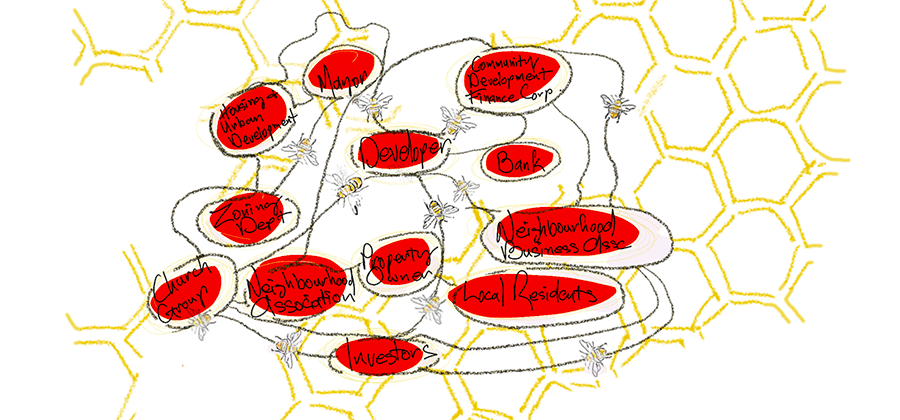
Eve: [00:31:06] And then someone else talked to me about ‘power mapping,’ which I thought was really interesting as well. An interesting idea to kind of understand where the power in a neighborhood lies and talking to those people, and really, I suppose, I’d want to say enlisting their help, but that, it’s like almost like a pyramid, reaching everyone in the neighborhood. I thought it was really fascinating.

Heather: [00:31:31] There’s ‘power mapping,’ and there’s ’em-power mapping.’ Because in the power mapping we tend to want to go to the people who hold the power to make the shifts and create the influence we need. But we also have the opportunity to figure out, well, who doesn’t have power who should.

Eve: [00:31:47] Oh, I think all of that.

Heather: [00:31:49] Yeah, yeah, it’s hard to do. All of this takes a great deal of time, and in our lives when everybody’s rushing to get things done. Like we all do …

Eve: [00:31:59] Yes.

Heather: [00:31:59] Or rushing to sort of make sure that things are going to pencil out. It’s very hard to slow down a little bit and do that, although it can really go a long way. I’m excited about the crowdfunding you’re talking about. I mean, at one level, real estate always been crowdfunded, it’s just bigger chunks and formal legal entities, and to have it available to the individuals. It sounds so neat and interesting, I can’t wait to see it where it goes. It also seems like we don’t learn about design, often, or construction, or how cities are made or all the systems that go into that, in our American school system. And so, kinda no wonder we haven’t really built up a sensibility for it. And I’m thinking that maybe through crowdfunding, people will feel more connected to whatever it is that they have invested in.

Eve: [00:32:46] Perhaps. It requires a lot of education, but I suppose everything does. So, what’s next for you? I mean, the big project, that you can talk about or anything that’s got your interest at the moment.

Heather: [00:33:00] Well, I have a team of about 15 people in the Northern California office at Enterprise. We have, typically we have a San Francisco office and a Stockton office, but right now everybody’s home. I am excited to have, to work with such a great team and we’ve organized ourselves around a couple different big principles. And so just getting to organize ourselves and be clear about that is important. And we have two things. One is strengthening community resilience, and the other is building sustainable neighborhoods. So, one is about making sure that we’re sort of holding ground in neighborhoods and help people figure out how to stay where they are, if they want to stay. That’s through renter protection work or preservation work, like we talked about earlier. And work in public housing, and then also in resilience, and by that I mean both community resilience in a cultural way but responding to all these disasters, the fires and earthquakes and all the stuff that is happening in California. So, it’s sort of having gotten clear with the team about that’s what we’re about. In that body of work it’s about strengthening community resilience in a myriad of different ways. And then the other part is creating these big new systems. Like, I’m really excited that my team and I had this idea that there really ought to be a regional housing entity, that the little city, the many cities just don’t have the bandwidth or chops and finances to execute that they mean well to do for affordable and market rate housing. But at the regional scale it makes more sense. And so feeling very, very happy that this has been accepted by the state legislature and the governor and we’re actually doing it here in this region with the Metropolitan Transportation Commission and ABAG.

Eve: [00:34:46] That’s fabulous.

Heather: [00:34:48] Yeah, it is. And it’s just a fantastic group of people who really want to see it happen. So those things are exciting for me. I also think that there’s something exciting happening, in general, which is that maybe one of the silver linings of this awful pandemic that is so awful for so many people. And it’s … going to bring down potentially our whole economy. In all of that …

Eve: [00:35:16] Yes.

Heather: [00:35:17] … we might get a chance to rethink zoning and think about how, you know, you can’t shelter in place if you don’t have shelter. Therefore, it’s in all of our self-interest to really make sure that everybody has a home. So, I’m excited that maybe this has been a real wake up call that will help my industry hurry up and figure out how to get out of our own way and make sure that people are not homeless and people have safe places for their souls to rest that they can call home.

Eve: [00:35:52] Yes, I think that’s a really exciting end, and I really enjoyed our conversation, and hope your work meets great success and I’ll, I’ll be following it.

Heather: [00:36:03] Thank you, Eve. It’s really nice to hear your story too.

Eve: [00:36:16] That was Heather Hood. She’s fully immersed in the affordable housing crisis, working to help solve it in Northern California. Heather believes that NIMBYism has failed us along with zoning, too. We need to permit higher density to fill the need, and it takes far too long to get permission to build a building. The production line needs to be sped up dramatically. Heather’s also astonished that we’ll spend a fortune visiting places like Disneyland, where we can enjoy walkability, but we won’t spend that on the places we live in. I’m right there with her. You can find out more about Impact Real estate investing and access the show notes for today’s episode at my website EvePicker.com. While you’re there, sign up for my newsletter to find out more about how to make money in real estate while building better cities.

Eve: [00:37:18] Thank you so much for spending your time with me today, and thank you for sharing your thoughts. We’ll talk again soon. But for now, this is Eve Picker signing off to go make some change.

Image courtesy of Heather Hood, Enterprise Community Partners

Power mapping and impact.

October 19, 2020

Impact investing has grown globally in both depth and sophistication and is now valued at $USD715 billion according to a 2020 study by Global Impact Investing Network (GIIN). But there are still many challenges. Here in the US, most of those funds are invested into cities and gentrifying areas, and although many low-income communities are beginning to see more capital investment, the most marginalized are still left out. For poor Black, native and other marginalized groups, opportunities to build wealth have historically been systematically denied. Redlining, made illegal in the 1970s, still occurs today and we know that all lending is not equal. Now the coronavirus pandemic is exacerbating the problem.

In recent news Netflix announced that a 2 percent share of its cash will go to financial institutions that serve Black communities and PayPal has also announced a $500 million fund to support black- and other minority-led start-ups. This is a promising start but to really effect change requires an understanding of the systems we operate in. They may have been built for everyone, but they don’t work for everyone.

Cynthia Muller, a thought leader of the impact investing ecosystem and director of Mission Driven Investment at the W.K. Kellogg Foundation, believes that power mapping is an important tool to help gain an understanding of how to structure a project that will be meaningful and beneficial to a community. The parties brought to the table for any particular project might include residents, real estate developers, planning departments, investment banks, venture capital, community development corporations and others. With a power map as a visual aid you can begin to recognize the roles and relationships of all parties and identify the decision makers with power who might be influenced to make change. Here are the steps required to make a power map:

  • Identify the people involved, the problems and the decision makers.
  • Place the person or institution that can make the decision or enact changes to fix the identified problems at the centre of the map.
  • Think about any associations or relationships. This requires thinking about any connection including family, neighborhood, religious, political or financial that might influence the central decision maker. Place these in a ring around the centre.
  • Look carefully at the mapped network to determine any connections, including secondary connections like family members. These are the relational power lines.
  • Identify the people with the most relational power lines as well as those with less and mark them differently. If there are no connections, plan to learn more about that person.
  • Make a plan of action. Using the relational power lines and work out the best way to access people or institutions.

Power mapping is a great community engagement tool which helps to conceptualize networks and spheres of influence. Listen to my interview with Cynthia Muller to learn more.

Original artwork by David J Allardice

Adaptive re-use.

October 5, 2020

To adaptively re-use a building is to re-imagine and re-purpose it. Often old, historic buildings have outlived their original purpose. They can be demolished or brought back to life and adapted to contemporary life. And there are compelling reasons to re-use historic buildings.

Sustainable

The adaptive re-use of buildings is inherently green. It’s a form of recycling which uses less energy than new construction and generates less waste than demolition or ground up new construction. The bulk of materials that give the building shape don’t need to be manufactured, procured or transported – they’re already on site and in place. Typically they are higher quality materials which would be prohibitively expensive to purchase today or, in the case of old growth forest, no longer even available. A hundred years ago building standards were also higher. A century-old building might outlast a brand new one.

Less urban sprawl

Urban sprawl can be contained by the re-use of existing old or abandoned buildings. Many older buildings are located in dense, walkable neighborhoods with good access to transit. Warehouses and factories in cities around the world have been converted to a myriad of uses, including co-working offices and some of the coolest homes. Industrial waterfronts in many cities have transformed struggling and forgotten areas into vibrant neighborhoods. And even unused railway trestles have been converted into linear parks providing much-needed outdoor space as well as pedestrian links between neighborhoods.

Lots of character

Historic buildings are a tangible part of the past, providing cultural enrichment to communities and allowing residents to take pride in the history of their place. The revival of urban downtown areas and historic buildings has often resulted in higher property values. People seem drawn to local history, to the warmth of old materials or maybe to older buildings just because they are more interesting.

As long ago as 1961, Jane Jacobs asserted that small businesses, like stores, restaurants, neighborhood pubs and small start-ups thrive in old buildings. Maybe she was right. A newer study from the Preservation Green Lab shows that cities with older, smaller buildings have higher density, a greater number of small businesses, more entrepreneurial activity, more diversity and more affordable housing.

Affordable

Avra Jain, who co-founded the Vagabond Group, is a wildly creative Miami developer, passionate about adaptive re-use projects. She has earned a reputation for identifying the next IT neighborhood. Her remake of the abandoned 195O’s Vagabond Hotel on Biscayne Boulevard in Miami changed the course of that neighborhood forever. The historic MiMo District was born. But Avra wants to push adaptive reuse even further. Her personal passion is to convert these abandoned and historic motels into reimagined, affordable housing communities. She’s tackling both the restoration of significant architecture and the making of affordable housing in a very unique way.

Listen to my interview with Avra to learn more about the importance of saving buildings.

Image by Eve Picker

« Previous Page
Next Page »

Primary Sidebar

sign up here

APPLY TO BE A PODCAST GUEST

More to See

(no title)

February 22, 2025

Bellevue Montgomery

February 11, 2025

West Lombard

January 28, 2025

FOLLOW

  • LinkedIn
  • RSS

Tag Cloud

Affordable housing Climate Community Creative economy Crowdfunding Design Development Environment Equity Finance FinTech Gentrification Impact Investing Mobility Offering Opportunity zones PropTech Technology Visionary Zoning

Footer

©rethinkrealestateforgood.co. The information contained on this website is for general information purposes only. Nothing on this website is intended as investment, legal, tax or accounting strategy or advice, or constitutes an offer to sell, solicit or buy securities.
 
Any projections discussed or made may not be accurate and do not guarantee a specific outcome. All projections or investments are subject to risk due to uncertainty and change, including the risk of loss, and past performance is not indicative of future results. You should make independent decisions and seek independent advice regarding investments or strategies mentioned on this website.

Recent

  • The Mulberry
  • Mount Vernon Plaza
  • The Seven
  • Real estate and women.
  • Oculis Domes.

Search

Categories

Climate Community Crowdfunding Development Equity Fintech Investing Mobility Proptech Visionary


Copyright © 2026 · Magazine Pro on Genesis Framework · WordPress · Log in