• Skip to main content
  • Skip to secondary menu
  • Skip to primary sidebar
  • Skip to footer
  • Home
  • About Us
  • Say hello
Rethink Real Estate. For Good.

Rethink Real Estate. For Good.

  • Podcast
  • Posts
  • In the news
  • Speaking and media
    • About Eve
    • Speaking requests
    • Speaking engagements
    • Press kit
  • Investment opportunities

PropTech

The power of modular building.

April 20, 2020

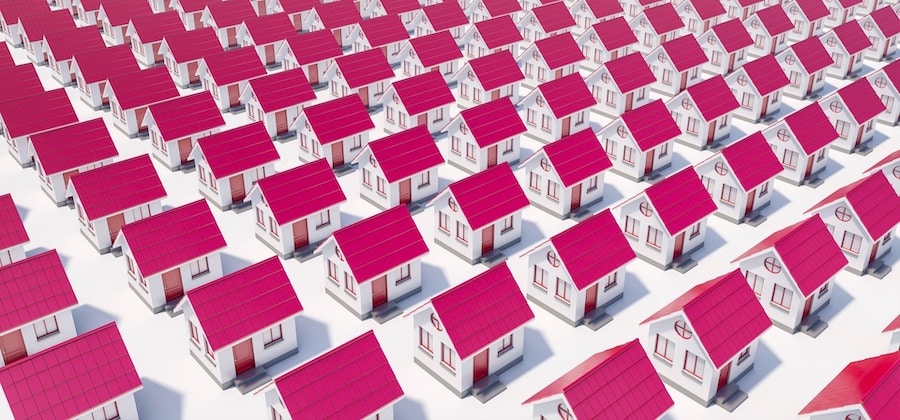
As builders, architects, urban planners all look for innovative ways to create both affordable and sustainable housing, some new homeowners have been looking to the efficiencies of modular construction as one potential solution. While pre-fab (for pre-fabrication) is a general term for building components that are created in a factory to be assembled on site, modular construction refers to pre-finished volumes, about 70 percent complete. In other words, entire rooms or floors – modules that can be set down on a property virtually ready to go except for hookups and exterior finish work.

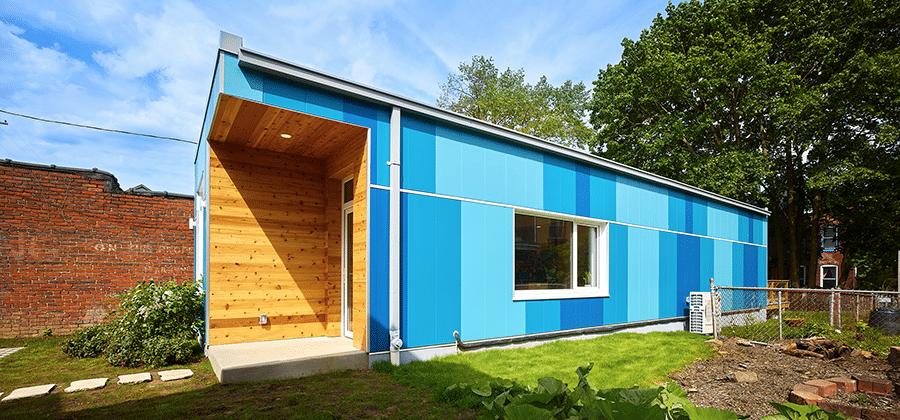
One such example is Module, based in Pittsburgh. Module was co-founded by a trio of young entrepreneurs who were inspired by the idea that everyone should have access to good design. But as opposed to the typical design-build company that gives clients the options of picking from only a few template plans, Module’s team offers turnkey design-build-develop services. They do not build the homes but work with a third-party manufacturer and a third-party contractor, managing the whole process for clients from start to finish, from design to permitting to construction.

Why build this way?

Basic modular, or even pre-fab, construction offers a variety of benefits for the homebuyer. On the one hand, as opposed to designing a home from scratch, which is time-consuming and adds additional cost, a developer or builder can offer a new homebuyer templates based on their needs and budget.

There is also the benefit of a large reduction in construction time, and when done at large scale, construction costs. Modular projects also offer high-quality, factory-based construction, often using eco-friendly materials and energy-efficient, customized designs, all with rapid on-site assembly. Already familiar in countries like Japan, this way of building housing is starting to become popular in the U.S., and most exciting, offers innovative methods for providing affordable and sustainable housing on a large scale. 

One reason for the trend towards pre-fab and modular construction is a shortage of skilled labor in many housing markets. Another is a supply shortage in boom markets, where existing developers cannot build things fast enough. In both cases, components of a building can be constructed anywhere and shipped to the site. This has long been the case, for example, with pre-fabricated roof trusses one often sees being trucked along on the highways.

Module

Brian Gaudio, the CEO of Module, created his company differently. He describes the vision of Module as more of a tech startup company than a design firm, offering their product first and foremost as a service, or process that you can literally order online. “We’re trying to redesign the customer experience,” he says, “and redesign homeownership from the ground up.”

First, Module works to understand the clients’ current needs, learning what they want in a home – everything from space and light, to aesthetics and utility. Second, for clients who already own land, Module evaluates the site location and determines what’s possible based on topography and local zoning rules. If a client needs to purchase a lot, Module offers a curated selection of available lots they know will work with their designs.

Third, the team works to design the client’s home and create a budget. Fourth, Module handles all of the permitting and manages every aspect of the building process. Because they partner with manufacturers and contractors, he says, “we don’t own those parts of the supply chain. But what we do own is the customer experience.”

Finally, and perhaps most importantly, Module plans to grow with their clients, offering the flexibility to add more space as needed with additions that are made to grow a home to order.

The future

Modular construction offers exciting solutions for both affordable and sustainable housing. There are a number of innovative options available now, and while some companies offer services nationwide, it’s also worth exploring local companies to learn about options in your area.

Listen to our interview with Module founder, Brian Gaudio, to learn more about how Module is bringing their unique modular process to the Pittsburgh area. 

Image courtesy of Module Housing
Scaling up.

March 11, 2020

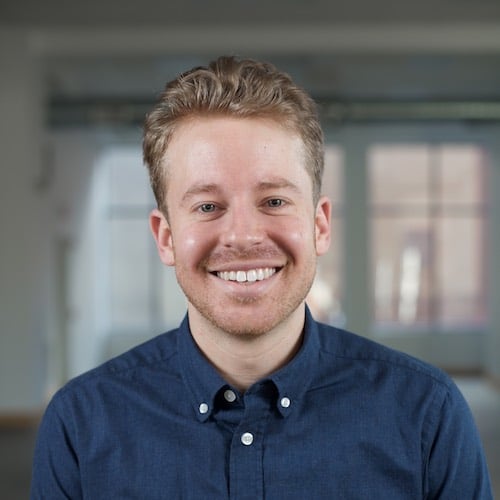
Brian Gaudio believes that everyone deserves access to good design. The inspiration for starting Module came while he was directing Within Formal Cities – a documentary about the housing crisis in South America, which debuted in 2016. Brian, then a college senior, saw the broader possibility of modular “pay-as-you-go” design. As opposed to simply designing yet another prototype for affordable housing, he decided to create a startup around it. And so Module was born.

Brian Gaudio and his team are based in Pittsburgh, Pennsylvania. The three principals bring eclectic experiences in affordable housing, urban design, theme rides, industrial product design, tiny houses and small scale interior remodeling to the table. At Module they have turned that expertise into creating perfect little housing solutions that meet zero energy standards, and are smaller and flexible so that they can grow with a family’s needs.

Module envisions houses half of the typical size of American houses being built today, working as infill and affordable housing solutions – 600 s.f. to 1,600 s.f. – the smallest model could be erected on a 20-foot wide city lot, a standard lot width in Pittsburgh. New homes reimagined for a newly reimagined city. Rooms (and floors) can be added (like Legos) as needed, a concept that has been around for a number of decades as a path to home ownership, with sustainability a critical added component. Their first house was built to Passive House standards, but they’re using the Zero Energy Ready standard now, since it is easier to work with.

Prior to starting Module, Brian was a Fulbright Scholar in Santiago, Dominican Republic, where he led an urban design research initiative. He has lectured and given presentations for the American Institute of Architects, the Rockefeller Foundation, and numerous universities in the US and abroad. Brian has design experience in both the for-profit and nonprofit world. He worked in Blue Sky Department at Walt Disney Imagineering where he helped create new ride concepts for the Disney Parks, and he served as an architectural intern at the Gulf Coast Community Design Studio. Brian graduated Summa Cum Laude from North Carolina State University with a Bachelor of Architecture where he was a Park Scholar, started a non-profit organization, and was a finalist for the Harry S Truman Scholarship.

Insights and Inspirations

  • Module wants to build 100 units in the next four years. Brian’s goal is to make change through scale.
  • Brian thinks the Friday Morning Serial at the Gulf Coast Community Design Studio is one of the most engaging and inclusive community experiences he has experienced.
  • A close second is Pittsburgh’s Open Streets.

Information and Links

  • Module sells houses that grow with their owners.
  • Module’s mixed income housing project that’s in construction on Black Street is in partnership with the Urban Redevelopment Authority of Pittsburgh and the Bloomfield Garfield Corporation.
  • Brian co-directed a documentary on the housing crisis in South America.
  • The Gulf Coast Community Design Studio is doing great place-based work in Biloxi, Mississippi.
Read the podcast transcript here

Eve: Hi there. Thanks so much for joining me today for the latest episode of Impact Real Estate Investing.

Eve: [00:00:06] My guest today is Brian Gaudio, founder of Module Housing. While working on a documentary about the housing crisis in South America, Brian, then just a college senior, saw the broader possibility of modular pay-as-you-go design. As opposed to simply designing yet another prototype for affordable housing, he decided to create a startup around it. And so Module focuses on perfect little housing solutions that meet zero-energy standards, and are smaller and flexible, so that they can grow with a family’s needs.

Eve: [00:00:53] Be sure to go to EvePicker.com to find out more about Brian on the show notes page for this episode. And be sure to sign up for my newsletter so you can access information about impact real estate investing, and get the latest news about the exciting projects on my crowdfunding platform, Small Change.

Eve: [00:01:9] Hi, Brian. Thanks for joining me today.

Brian Gaudio: [00:01:24] Hi Eve, thanks for having me.

Eve: [00:01:29] It’s a pleasure. So, I’ve been watching you build your company, Module, for a few years now, and I’m really excited to talk to you about it. You’ve decided to focus your life’s work on designing modular housing, affordable-by-design housing. And that was a pretty bold move straight out of school. So, what problem are you trying to solve?

Brian: [00:01:47] It is a big problem. And it’s a problem that, in school I was always, you know, in studios I would always be thinking about. It was something that was rattling in the back of my head, was how do we bring good design to more people, right? In architecture school we’re often told how important design is. And then we get out in the real world and we realize how the designers need to have a larger seat at the table. So, in my work after school, it was always trying to answer that question of how can we bring good design to more people. And there may be non-traditional ways to do that, is what I’ve been learning.

Eve: [00:02:20] That was the biggest problem. But I think I also read that you became very interested in affordable housing issues during your Fulbright Fellowship. You want to tell us a little bit about that?

Brian: [00:02:30] Yes. In school I actually was studying under one of the fathers of community design and participatory design, Henry Sanoff. He had founded an organization called the EDRA, the Environmental Design Research Association. So, I was sort of a student of his and a student of Brian Bell, who had started the Public Interest Design Institute, in the United States. So, it was really learning from folks who were leaders in the public interest design space. So, after school, I tried to pursue that as a career and worked at the Gulf Coast Community Design Studio doing affordable housing and disaster recovery housing, as an intern there. For those who don’t know, Biloxi, Mississippi, on the Gulf Coast, is not too far from New Orleans. And when Hurricane Katrina hit New Orleans, it also hit Biloxi. So, I spent a little bit of time on affordable housing in Biloxi, Mississippi. And then, also, after that, went to the Dominican Republic and did a Fulbright scholarship trying to understand housing affordability as it relates to disaster recovery and urban design, in general. I was working in a neighborhood that was alongside of the, a waterway that during some of the tropical storms, people would be washed away, and housing would be wiped away.

Eve: [00:03:49] Hmm, wow.

Brian: [00:03:50] So, that research was really thinking about housing from the perspective of, where is it safe to have people housed? And what do you do when a neighborhood exists in a place that is really at risk, when we think about environmental and natural disasters? So, that was some of the kind of affordable housing work and research I was doing right out of school.

Eve: [00:04:15] That’s pretty intense work. So, how does that tie into what you’re doing today? I mean, what got you from there to where you are today, building small modular homes.

Brian: [00:04:28] Being exposed to these different methods of practice … so, in Biloxi, Mississippi, I was working for a nonprofit architecture firm that was an arm of Mississippi State University. So, I was exposed to this business model of a nonprofit architecture firm. And then at the Fulbright, it was really a bit more of an academic endeavor. Technically, the Fulbright’s under the U.S. Department of State, but you work with the local university. So, again, thinking about some of these issues from a, an academic perspective, I would call it. And then after that, I had spent a little bit of time with a friend directing a documentary, again, trying to educate ourselves on the problem of housing affordability. So, in that documentary, we interviewed a lot of architects, governments, designers, businesses about the housing crisis in other countries, specifically in South America. And it was in this kind of three, four years or so of, I would call it, a research phase, of understanding what are the practices and models that other organizations and groups are taking as it relates to housing affordability and what things worked from those models and what things didn’t work. And I guess how that ties into Module, what we’re doing today was, while these nonprofit architecture centers, these design centers, can work really well at a neighborhood scale, the question I always had was how can we move beyond the neighborhood scale and effect change at a greater scale? You know, at the city scale, and at the state scale, and eventually at the scale of a, you know, a country like the United States? How do we take some of those principles that worked really well at the neighborhood scale, but may not be able to affect thousands of people?That’s really why we chose to start Module, not as an architecture practice, but as a startup company. The idea being that you could scale faster through alternative capital means and have ultimately a greater impact once we do reach that scale. So, that’s kind of how those experiences influenced starting Module.

Eve: [00:06:29] That’s a really interesting path. I know you also were a company in Alphalab, which is a, I suppose, a startup accelerator. Has that worked for you, as a startup company, rather than a building company?

Brian: [00:06:44] Yeah, it’s a very good question because we went through, so you are referring to Alphalab and for those who are not in Pittsburgh, Alphalab is a startup accelerator, kind of like TechStars or Y Combinator, where they give early stage companies, basically folks with an idea and maybe a business plan, some initial seed capital, typically 50,000 dollars and some free office space and mentorship, to basically start to try to build their own business. A lot of the businesses in that accelerator program were tech businesses. So, think about software as a service company, SaaS companies like Slack, for example, you know, being the typical type of company that’s supported by an accelerator. So, I think we learned a lot about asking questions and testing our hypothesis through that accelerator program. And we were able to raise some initial angel capital, I would call it, in the Pittsburgh startup community and get our name out there and, you know, learn how to market, create a website and things like that. I think we also learned that as we look at investors and ways to support our business, you know, a typical venture capital investor is not likely the right kind of investor for a company like Module because they look to 10x their money in five years, which, we’re building a different kind of business than that. So, those are some of the things we learned from Alphalab.

Eve: [00:07:06] Yeah, interesting. So, you don’t think you’re a unicorn, like the rest of us, right?

Brian: [00:07:07] Right. No. Not in the traditional sense, no.

Eve: [00:07:18] So, what distinguishes your product, your modular housing products, from other products in the marketplace.

Brian: [00:08:26] So, as we think about off-site construction, modular housing, prefab construction, there are many companies now who are pursuing this as a business model. And I think we identify with the overall trend. The reason why so many people are pursuing modular or prefab construction is the labor shortage is getting worse and worse. And Eve, I know in your business, you’re doing a lot of development. So, I’m sure you’re familiar with the shortage of qualified skilled labor here in Pittsburgh. But at a national scale, we have that challenge. So, the labor shortage is real. And then we have a supply shortage, as well, in certain markets. So, they can’t build things fast enough. And so that’s really why prefab or off-site construction has started to take off. So, parts of the home or the development are built in a factory environment, shipped to site, installed with a crane on a traditional foundation. So, as we think about our company, Module, and what differentiates us, we are really thinking about the entire customer experience. So, we’re offering turnkey design-build-develop services. So, we’re not a manufacturer of homes. We work with a third-party manufacturer and we work with a third-party contractor. So, we don’t own those parts of the supply chain. But what we do own is the customer experience. And we’re trying to really redesign the customer experience, and redesign homeownership from the ground up, because we think the typical way that the top ten voters in the country do it are very dated. The floorplans they are using are dated, the construction methods that they’re using are dated often times. And today’s consumer is used to the convenience of making purchases online and browsing of things online. And they want things now, and they want help. A lot of customers expect to have, kind of the user experience that they go through purchasing a computer or something, in all of the purchases in their lives. And not many builders can offer that experience. So, I’d say that’s one thing that’s really unique about us as a company is the customer experience that we’re building through our web application. If you go to our website ModuleHousing.com, you can see some of that. That’s one thing that’s unique about our product. I would say the other thing is all of our homes are certified by the U.S. Department of Energy as zero energy-ready. We build to that spec. It’s a sustainability spec. And we chose it because we believe it offers the best bang for your buck as we think about customers. So, while LEED and Passive House may be, sometimes those certification programs can be really challenging and costly to do. We feel that the Zero Energy Ready Home program offers some of the benefits of lower operating costs in your house at a much more reasonable price point.

Eve: [00:011:11] So, it’s an energy program for everyday people.

Brian: [00:11:15] Mmm hmm. Exactly.

Eve: [00:11:16] Yeah, interesting. What is your process? Can you describe that?

Brian: [00:11:19] Yes. So, we work with, I’ll call it, several types of customers. We work with individual home buyers. So, folks who want to purchase one of our homes or build a home with us. And then we will also work with real estate investors or mom-and-pop developers, I’ll call it. So, these are folks who may have purchased land recently. They may have fixed up some houses or have some rental units, but they’re not a new construction contractor. But they own land and they’re looking to do something with it. We service, I’ll call it, mom-and-pop developers and home buyers. And we’ll do two types of processes. One is, if you’re a home buyer, you come to our website and you fill out a form on our website. And on that form you’ll share here’s my current needs, my future needs, my financial health, and here’s some of the areas that I’m thinking about owning a home in the city of Pittsburgh. And we have a proprietary GIS database of every vacant lot in Allegheny County. We’re able to basically help that customer find the right lot for them, help them purchase that lot, and then help them build a home with us. So, we’ll take them through the process from zoning approval, permitting, financing, estimating, and we will basically hold their hand through the process, through construction administration, until we’ve turned over the keys to their house. So that’s really a turnkey service that we offer. And then, the other type of process we have is as a developer. So, we as a developer on spec, will go out and purchase land and build multiple units at once and then sell those units to customers. We’re working on a project right now in Garfield, in Pittsburgh, where we are building four units, it’s a mixed-income project, and we’ll be selling those, those will be on the market, those will be finished this summer. And that’s where we are going out as a company, acquiring the land, financing the project, and then customers will come in and have a traditional mortgage when they purchase the homes.

Eve: [00:13:12] And as these homes affordable compared to others? Where they sit in the marketplace?

Brian: [00:13:19] We will build for multiple income brackets. For instance, this project in Garfield is a good example, where we have a home that will be sold to a buyer making 80 percent or less of area median income. So, that home will be sold for 183,000 dollars. I believe that’s the list price right now. And that’s only for income-qualified buyers, who meet certain income limits. And we’re able to do that because we had partnered with a nonprofit community development group in the neighborhood and Urban Redevelopment Authority of Pittsburgh, and we were able to secure a subsidy to subsidize the cost of that home to a buyer in the neighborhood. So, in that case, we’re serving a kind of, for sale, affordable, 80-percent AMI customer. But our bread and butter products, our market rate product is going to be anywhere from the mid-threes to 500,000 dollars for a home. And to give listeners some context, as we track the new construction in the city of Pittsburgh, a lot of the new construction that’s going up in the East End of Pittsburgh is going to be 600 to 800,000 dollars. So, that’s kind of the going rate for a new construction builder-grade home in the East End of Pittsburgh. And because we’re building less square footage and we’re building, basically, in neighborhoods just next door to those, we’re able to provide what we believe is a better quality product at a price point, let’s call it the 400,000 dollar range, for our client.

Eve: [00:14:53] That’s somewhat affordable, and partnerships to really create serious affordability. But like everything else we’ve heard and know, it’s very difficult to build truly affordable housing without subsidies, if not impossible. This is another example of it. You really need a subsidy to make that work, right?

Brian: [00:15:11] Absolutely. I think coming out of school and you’re thinking, you know, as I am thinking about myself graduating from school, I’d be like, wow, you know, we can design anything and we’ll find a way to make naturally-occurring affordable housing with just great design. Then you realize affordable housing is really about financing, you know, and the capital stack. So, that’s one lesson we’ve learned over the past four years.

Eve: [00:15:33] Yes. And so you’ve been at this for four years. How many houses have you built now?

Brian: [00:15:38] So we’ve finished our first home for a customer last year, in 2019. It was a one bedroom, one bathroom home in Friendship. It was sort of an aging-in-place model. We built it for a clients’ parents. So, almost like an in-law suite, or an accessory dwelling unit, but on a separate property. That project is finished and we are now under construction to complete our next four homes. And those should finish in the summer of this year. And we have some other projects in the pipeline.

Eve: [00:16:08] What’s the big hairy goal for Module?

Brian: [00:16:12] The big goal is really to push the industry. I feel that the way we build homes is dated. From the types of design, to the types of families and household types that a lot builders are serving. We want to push the construction industry to really wake up and understand that there are different types of customers who need to be served and we’re ignoring those customers. So, I think that’s really the goal. Module is a  vehicle to do that. So, as we think about the young first-time homebuyers who are burdened with student loan debt, getting married later, fewer kids, they don’t need to buy the homes that their parents bought in terms of size and programming and things like that. So, we’re trying to push the industry to say, hey, there’s a huge entry level housing need in the country. And there’s also a huge need for baby boomers who are looking to downsize, and they have too much house. And we need to be thinking about these two customer types, because they’re going to be a huge component of the nation’s housing needs. That’s really the ultimate goal for Module, is how can we push the industry forward and provide a demonstration of how a development company can do that responsibly, really.

Eve: [00:17:22] What are your goals just for the next few years? You’ve built a few houses.

Brian: [00:17:26] Yeh.

Eve: [00:17:26] How quickly can you ramp up now? I know how long it takes to get to the point where you get the first one out the door, so now things should speed up a little, right?

Brian: [00:17:35] That’s right. Our goal, we talk about 100 units over the next four years, in Pittsburgh. So, that’s the goal that we’ve set out. And so for us to do that, we have to start taking on larger projects. So, I’m looking at parts of the city where we can do, I’ll call it, impact-scale projects, thinking 20 to 40 units and working with the local neighborhood groups to understand what their needs are and how we can serve them. So, we’ll be finished our first spec project in this summer and we’re looking at projects where we can build 10 or more units. And that’s really what will help us scale faster. We’ll do some of these one-off customers, you know, taking them through the process, just sort of, it’s about brand awareness and it’s about understanding the customer journey. But really, we want to be working on projects where we can assemble sites that build 10 or more units at once.

Eve: [00:18:25] And you think you’re going to stay in Pittsburgh for now.

Brian: [00:18:28] Yes, we will. Obviously, to build thousands of homes, we’re gonna have to get outside of Pittsburgh. But Pittsburgh will be the first market. It’s my hometown. I’m from here originally. And so, we thought it was a worthwhile test market. And what Pittsburgh has some other cities don’t, is we have an insane amount of vacant land that is yet to be built.

Eve: [00:18:59] We really do, don’t we?

Brian: [00:19:00] That’s one asset that we have. So.

Eve: [00:19:01] Yes. Yeah.

Brian: [00:19:05] And that’s one reason why, getting getting projects off the ground, you know, if we were in New York, for instance, getting access to land as an upstart developer might be nearly impossible. And so, there are still parts of the city of Pittsburgh where there are larger parcels of land, and we see that as one benefit of being in Pittsburgh.

Eve: [00:19:14] Great. So, I’m going to shift gears a bit and just talk to you about impact investing, socially responsible real estate. And do you think that’s necessary in today’s development landscape, thinking about the impact of what you build?

Brian: [00:19:28] Absolutely. I think, and one reason, kind of when you talk about a goal of our company or a reason that we were founded, is we feel that often times what gets built in a particular site may be really great for the bottom line of a particular limited partner or, for the preferred return of a particular investor. But that becomes the primary goal of the project. And the folks who end up living in the space, whether they’re buying it or renting it, are an afterthought. And I’m not saying that’s, by no means are all developers that way, but we’ve seen a lot of development projects that really ignore the end user. And I think why I’m excited about impact real estate investing is the ability to bring the end user back to the forefront of the conversation, because we build housing ultimately to shelter people. And I think sometimes people in this industry lose sight of that. So, I think impact investing has the ability to bring the end user back to the forefront of the conversation.

Eve: [00:20:33] Yeah. You know, when you talk about that, are there any current trends in real estate that excite you or interest you the most, that you think might have legs in the future?

Brian: [00:20:43] Trends with respect to impact investing, or just trends in general?

Eve: [00:20:46] Anything, I mean, obviously you think modular housing is important. But anything else out there? I’ve been watching, we’ve seen co-working, for example, really change the landscape. Today, I was reading along those lines about people who are starting to co-purchase homes because they can’t …

Brian: [00:21:07] Yeah.

Eve: [00:21:07] … they can’t afford them individually. So, there are some weird trends emerging in an effort to deal with this housing affordability crisis.

Brian: [00:21:17] Absolutely. Speaking of those trends, I mean, we operate in the startup world, so we do meet a lot of startup companies working on innovative finance models. And there’s a company called Divy, which again, sort of supports co-purchasing of homes. And that’s a company, you can look up Divy. And there’s another company called CoBuy. So, these are finance companies which help either friends or folks who want to purchase a house together. So, that’s one model. There’s been a couple other startups as it relates to purchasing of homes where they will buy the house for you and you will rent from them for a certain period of time, and then with the option to purchase. I don’t remember the name of the company that I was reading about the other day, but that’s another interesting finance play. And then, I follow, obviously, these smaller, you know, lot size movement. So, with what’s happening, California with ADUs really interests me. And then I think it was Minneapolis that out with the single family zoning restrictions …

Brian: [00:22:19] Yeah, that was really interesting. Yeah, they’re really interesting trends, aren’t they? People sort of really adapt to the marketplace in really fascinating ways, beyond just the companies that emerge. People are immensely creative. So. that’s kind of comforting, isn’t it?

Brian: [00:22:36] Yeah, absolutely. There’s a company that’s working on 3D printing of houses, which I am a bit skeptical, I admit, I’m a little bit skeptical of. But I think it’s amazing that we have, now, three or four startup companies that are 3D printing homes. I think of it as a fascinating R&D project. I’m not sure how commercially viable that technology is. But the idea that, you know, it sort of get to the same pain point of modular construction with regards to the labor force.

Eve: [00:23:06] Yeah. I mean, I think …

Brian: [00:23:07] Preprinting the home, that could really save some labor costs.

Eve: [00:22:12] Yeah. I mean, that seems to be the heart of it all. Because when you think about affordable housing, there’s always been the skeptics. It doesn’t really matter what city or state you’re in. There is a gap between the cost of building something and what someone can afford to pay towards that cost. There’s just this financing gap. And until we figure out new technologies in construction and ways to reduce the cost of construction, that gap just isn’t going to disappear. It’s not going to go away.  I don’t see that there’s any other way to make it go away. It’s a really big problem. Yeah, it’s a really big problem. How do you think we need to think about our cities and neighborhoods so we can build better places for everyone?

Brian: [00:23:59] As I think about a neighborhood and a city, sometimes neighborhoods are microcosms of the city. So, for instance, we’re working on a project in Garfield, which is, sits in the East End of Pittsburgh. And Garfield was a neighborhood that still has a significant amount of vacant property and blighted properties. But it’s a neighborhood that’s starting to turn the corner.

Eve: [00:25:26] A few years ago, like, 400 of the 1,700 lots were vacant. That’s a real big number.

Brian: [00:22:24] Yes. And, you know, I think there’s evidence of a neighborhood like that, that’s starting to make significant progress in reducing blight. But the question that everyone has is how do you reduce blight and promote new home ownership and things like that in a neighborhood without pricing out people who are from the neighborhood, or displacing residents. You know, like gentrification happens, it is a thing. Change happens. And managing that change, I think, is something that a neighborhood, like at the neighborhood level, can be done. But then I think there’s, we’re in the city of Pittsburgh. We have to think about managing change, encouraging growth in our city and then trying to manage that in a way. And I was just at an event yesterday with someone from the city of Pittsburgh, a representative from the city, and they talked about the number one need Pittsburgh has is turnkey new construction for people who are relocating to Pittsburgh. And I was really surprised by that statement. But I think it shows that while at a neighborhood level, there may be a particular issues that are really important, at the city level, sometimes those issues can be quite different. And so how did neighborhoods speak to cities and back and forth is a really important dialogue that has to happen.

Eve: [00:25:45] So, do you think a neighborhood like Garfield is managing the change? Because I know it’s changed a lot in the last few years. It was a very poor, underserved neighborhood, and it’s received quite a lot of attention in the last few years.

Brian: [00:25:59] I think it is a neighborhood that’s actively managing that change. There are some neighborhoods … we work with a lot of neighborhood groups, and we’re not a nonprofit. Right? We do have a mission behind us, but there are some neighborhoods in the city of Pittsburgh where you talk about development and new construction, and people will just, they don’t want even have a conversation about it. And they’re trying to prevent change from happening. And that can be really challenging for the residents, and for people who want to be working in that neighborhood or living in that neighborhood. So, I think Garfield has done a good job of … and then there’s other neighborhoods on the other side where they’re just sort of like, hey, it’s we’re open for business, you know, no rules and no regulations. So, I think Garfield has done a good job of balancing those two. And I think it’s really up to the local community development organization, because they’re looked at as the kind of voice of the neighborhood. So, how well can that director and the staff people manage those multiple voices? And they need to see, for instance, Garfield talks about, we need to see affordable new construction, but we need to see market rate new construction as well. We don’t say we don’t want that, we need that for our neighborhood. So, I think groups that realize you have to have a balance of those things are always the ones that we like to work with.

Eve: [00:25:19] Yes. So, what community engagement tools have you seen that have worked? You talk a lot about working in communities and making sure that you’re sort of representing what they want. That can be hard, right?

Brian: [00:26:11] Yeah, it can be really hard. In Biloxi, Mississippi, we had different methods for community engagement. One method I really liked was we would host, and this is at our design studio in Biloxi on the main street there, we’d host something called Friday Morning Serial, S-e-r-i-a-l, but we served cereal, so we served cold cereal and coffee. And every Friday we would invite someone from the community to come in and talk about what they’re, what they’re doing, who they are. And we would invite folks from the neighborhood to sit. And it wasn’t a long, wasn’t a TED talk. It wasn’t overly produced. It was come, talk for 15 minutes, and then we’re just gonna have cereal and chat. And honestly, that was the best community engagement I had witnessed, because it was, it was a great organic way for people to start talking to their neighbors and learning about one another. And it wasn’t like this formal presentation of the drawings, OK, here’s the development site, it was a very natural conversation. That was one piece of engagement that I participated in that I thought was really fun.

Eve: [00:27:39] That’s sounds really, that sounds charming.

Brian: [00:27:42] Yeah.

Eve: [00:27:44] We should do that here. That’s really lovely.

Brian: [00:27:47] We should. And perhaps you’ll have the, Elizabeth, she was running Friday Morning Serial at the Gulf Coast. Maybe she’ll be a podcast guest at some point.

Eve: [00:27:57] Oh, very good. Yes.

Brian: [00:27:59] But in Pittsburgh, there’s another kind of non-traditional community engagement. There’s an event every year called Open Streets, where in different neighborhoods, they will shut down the streets to vehicular traffic and let people walk and bike in the middle of the street through different neighborhoods. And we’ve participated in that several times. You know, kind of little pop up booth. And that’s a great way to talk to people and engage with folks, because they’re out there having fun. And it’s another way to get some informal community participation. So, it’s called Open Streets Pittsburgh. And I think it’s a great event.

Eve: [00:29:36] Well, I’m really delighted you mentioned that because, do you know I founded that, I  co-founded that.

Brian: [00:29:43] Oh really? Well, there you go.

Eve: [00:29:45] Yeah.

Brian: [00:29:45] So, did you found it with the intention of doing that?

Eve: [00:29:48] Founded with the intention of opening the streets to everyday people. It’s not rocket science. People were doing it all over the world. Pittsburgh’s always a little bit behind, right? But I’m really thrilled to hear you say that it’s meaningful to you. It’s a great event.

Brian: [00:30:07] And it just activates neighborhoods in a different way. When you’re walking through the streets …

[00:30:111] Amazing.

[00:30:11] … I think they’ve done a good job of putting it in neighborhoods where the folks who typically engage in Open Streets, they might be more cycling-oriented, or like transit advocates, but they’re doing it in neighborhoods now which may have seen a lot of disinvestment over the past 30, 40 years. And I think it’s a great way to get people engaged in the neighborhood.

Eve: [00:30:32] Yeah,.

Brian: [00:30:32] Non-traditional. So good job, Eve, and other co-founders.

Eve: [00:30:43] I did not do alone. But, you know, it’s interesting because streets and roads take up so much of our open space and it’s pretty wonderful to be able to, you know, use it as a park for a short time. Once a month, you know, you just open the space and get rid of the cars, let people go out there, and have exercise classes, or walk, or bike, whatever they want to do. It’s a really wonderful thing. It’s really fabulous. So, I’m glad you enjoy it. But you and I also have talked about equity crowdfunding. And I’m wondering, you know, that’s what I do. And I’m wondering, you know, if you think that would be helpful for engaging a community like Garfield. In what’s happening there?

Brian: [00:31:15] Yeah. Yeah. As I think about equity crowdfunding, or just crowdfunding, in general, you know, part of the model opens up the company to a broader audience. Right? Not as many people participate in real estate deals as to equity crowdfunding deals. And then when you add the marketing component to it, you’re really telling a story. I’ve saw some of the projects that you’ve had on your platform. And Jonathan Tate, he and I have spoken together at a couple of events, and I really think it’s an opportunity to tell the story of a particular project really well. So, in addition to funding the project, I think the narrative that you create and the engagement that you can have in an open, a more open platform, is exciting. That’s when I think about equity crowdfunding.

Eve: [00:32:05] Yeah. I think for me is, my hope had always been that it would be a way to let communities invest in what’s happening around them. And I don’t think it’s working too well for that yet. I think there’s just a very nascent industry and people don’t know very much about it. And I think that maybe investing is a pretty threatening activity for most people who’ve never done it before. So, I hope that over time we can educate people and they understand that investing in their own community could be a really great thing. But that’s down the road, right?

Brian: [00:32:38] Yeah.

Eve: [00:32:38] So, I’m going to wrap up with one question that I really want to ask you, and that is if there was one thing that you could change about real estate development in this country, what would it be?

Brian: [00:32:50] I would change … the people who are thought of as developers, the type, you know … like I am late 20’s white male. Right? So, I may not be like a slicked back hair, like 50s suit-wearing 55-year old guy, who’s a real estate developer. But I think there are many other people who don’t think of real estate development as a career, a path. Whether it’s particular minorities or gender types. I would love to see more diversity in the world of real estate development, because I think the more people that are able to see that as a career and engage in it, then will bring fresh perspectives to the projects that we see developed around our country. And when it’s this, you know, when it’s kind of the majority of folks working in that field or who are perceived as successful in that field, fit one type of persona, then it limits the quality of projects that are going to be executed. So, I’d love to see many more types of people become developers then kind of what we think traditionally of as a developer.

Eve: [00:34:03] Well, I completely agree. And I want to thank you very much for spending your time with me today. It’s fascinating. And I’m sure we’re going to be talking again soon.

Brian: [00:34:12] Absolutely. Thank you very much, Eve. I’ve really enjoyed it.

Eve: [00:34:13] That was Brian Gaudio. As a young student, Brian absorbed ideas from many places. Both Elemental’s incremental housing in Chile, and the 100,000 Houses Project by the Philly-based firm Interface Studio Architects, have influenced his thinking along with the housing crisis in South America which he was exposed to during the filming of his documentary. It’s fascinating how new ideas are developed out of such varied influences.

Eve: [00:34:45] You can find out more about impact real estate investing and access the show notes for today’s episode at my website, EvePicker.com. While you’re there, sign up for my newsletter to find out more about how to make money in real estate while building better cities. Thank you so much for spending your time with me today. And thank you, Brian, for sharing your thoughts. We’ll talk again soon. But for now, this is Eve Picker, signing off to go make some change.

Image courtesy of Brian Gaudio

Superlofts. Super fantastic.

February 5, 2020

Marc Koehler is the founder of Marc Koehler Architects (MKA) and the creator of the fabulous Superlofts project. The studio is located in Amsterdam, the Netherlands. While his firm works on many architectural projects, with Superlofts, Marc is stretching his role as an architect.

For 15 years, MKA has developed an analytically innovative, research-by-doing approach to ambitious, original ideas directed at the future of sustainable urban living.

The Superlofts project pursues the idea of community first, building second. Rather than design and build a condominium project in the hope that the market will follow, MKA are creating curated living experiences and providing highly-flexible living spaces set in urban sites, all the while building with carbon neutrality in the foreground. Superlofts accomplishes this through a customizable co-living and development model which allows people to design their own living spaces from scratch and lets new homeowners co-create their shared spaces, all in service of building a sustainable co-living community. Every aspect of each project is thoughtfully designed – from the exterior facade, to the number of families in each “pod”, to the shared amenities that will encourage community, to the extreme flexibility of the living arrangements.

Having started as a local project, Superlofts is growing into an international movement. Five Superlofts have been completed in Amsterdam and Utrecht, and projects in Groningen, Amsterdam and Delft are under construction. Sites in other international cities are also being researched.

Marc’s studio, MKA, practices a full range of design disciplines from start to finish: concept, architecture & urban design. with a team that includes four core associates and 29 architects, designers and engineers. Their work has been recognized with the World Architecture Festival Housing Award (Completed Buildings) and Director’s Special Award in 2017, World Architecture News Award for Best Housing Project in Europe 2017, Best Dutch Building of the Year (Housing) in 2018, architectenweb award in 2018 and Dutch Building Award in 2015. Recently, MKA won design bids for ambitious new developments such as Poppies, Bosrijk, KBF-Dock, Peak and commissions such as Republica Circular City and MARK that promote the transition towards a circular economy and inclusively built environment.

Marc Koehler (1977) grew up in a Dutch Portuguese family in the northern Dutch town of Naarden. He holds a Masters in Architecture from the Technical University of Delft (TU Delft). Since 2017 he has an advisory role at the municipality of Amsterdam as a member of the Spatial Quality Committee. The committee reviews planning permits in light of the city’s urban design ambitions across themes such as densification, urban renewal, sustainability and cooperative developments.

I can’t wait to visit a Superloft.

Insights and Inspirations

  • We already live in the future if successful urban housing can be modular, co-living villages, co-created by their inhabitants.
  • Building community should be the primary goal of any urban design process.
  • Sustainability is just as much about people as it is about resources.

Information and Links

  • On the Superlofts website you can explore the tools that MKA uses to help home owners, real estate pioneers and architectural partners create buildings for the future.
  • MKA has also launched the Superliving community. Here you can see residents in their dream home and meet MKA’s interior design partners.
  • Open Building is an emerging group of Dutch architects and engineers who are devoted to radically changing the building industry and the built environment to enable a sustainable and personalized way of living.
Read the podcast transcript here

Eve Picker: [00:00:00] Hi there. Thanks so much for joining me today for the latest episode of Impact Real Estate Investing.

My guest today is Marc Koehler, the founder of Marc Koehler Architects and the fabulous Superlofts. His studio is located in Amsterdam, the Netherlands. While the studio works on many architectural projects, Superlofts is perhaps the most exciting project that you will want to hear more about. With Superlofts, Marc is tapping the desire for city living and combining it artfully with flexible living opportunities, carbon-neutral living and community consciousness.

Be sure to go to EvePicker.com to find out more about Marc Koehler on the show notes page for this episode, and be sure to sign up for my newsletter so you can access information about impact real estate investing and get the latest news about the exciting projects on my crowdfunding platform, Small Change.

Marc Koehler: [00:01:09] Hi, Eve.

Eve: [00:01:10] Hi, Mark. Thank you very much for joining me today.

Marc: [00:01:13] Yeah. Nice to be here. Thank you.

Eve: [00:01:15] Yes. So, you know, I wanted to talk to you today about the very fascinating work that you’re doing in your studio, Marc Koehler Architects. And, you know, I was especially fascinated by a statement on your web site that says you are in the business of bringing people together and that you build the new ways that people want to live. And that’s a pretty unusual set of statements for an architect. Architects usually focus on buildings, not people. So, I’d love you to tell me what you mean by “the business of bringing people together.”

Marc: [00:01:51] Yeah. Well, our company started 15 years ago. Small architects, boutique design agency, doing private houses, transformations of apartments and so on. And we really had to listen to what people wanted, and how they would like to live. So, what we developed is a methodology which we called ‘The Ideal Day,’ in which we ask people to write down their ideal dream day in their ideal future home … as a film script, starting in the morning, ending in the evening. And then, it’s about how do you want to wake up, or how do you want to come home after work? So, it’s not about how big is this? How many square meters do you need in your bedroom, or in your entrance hallway, but what is coming home for you? What do, what is the routine, the ritual of coming home or going to bed or waking up or cooking or showering? And by describing this as scenes, as, let’s say, scripted scenes of a movie of your ideal future life, people start to imagine the power of change, of possibility. And that’s the real quality of architecture and interior design, is that it can really change your life if you take the opportunity and really think of what you want to achieve with your new space.

Marc: [00:03:13] This is something that grew out into several projects, beautiful houses we did for different people. And then in the middle of the financial crisis, when nobody wanted to invest into, let’s say, apartment buildings in the Netherlands, the only sector of the building industry that continued was private housing. So, townhouses, family houses in the suburbs. And there was a lot of land available around the city center of Amsterdam that wasn’t developed. Banks wouldn’t give anyone a loan because it was a very, very deep financial and real estate crisis, from 2008 to 2015. We, though, had this network of private individuals that did want to develop their dream home. They didn’t want to live in the suburbs, though. So what we created was a framework. Basically an apartment building existing out of concrete frame, with double-high spaces of five or six meters tall, and invited people to design their dream house within that framework. And this is what became Superlofts.

Marc: [00:04:22] And Superlofts basically allows private individuals to design with us their dream home in a vertical kind of village, in the sense that we have multiple floors on top of each other, with collective facilities and a strong community that actually then is the result of this. Because people become engaged, in the process of design and also in the process of, let’s say, co-owning a project with other neighbors. And we manage this whole process. And this is when we discovered that the sense of community, something that was really missing in the city. So, we started to also select people for these projects that actually match with each other, and organized, let’s say … co-creation sessions, in which these future homeowners decided together upon what kind of parking situation they wanted for their cars? Did they want electrical charging points? Did they want a shared car? Or maybe they wanted a roof terrace with a barbecue pit or a shared garden for the kids to play. And we really became real estate developers focusing on how people want to live together in the future. And this is what made us stand out to other real estate and architectural concepts in housing. Superloft is really based on individual freedom and, let’s say, the power of doing things together with your co-owners in the building, and developing shared spaces. And it creates very successful building complexes with a lot of happy people that have a very strong social cohesion, do things together, take care of each other, like in a village, but then in the middle of the city.

Eve: [00:06:21] Wow, so that’s a pretty powerful concept, and it must be very different from, you know, where you started 15 years ago. I’m wondering what sort of shifts in lifestyle you’re responding to.

Marc: [00:06:36] Ah, well, there’s many global trends that also resonate in the Netherlands, which is the shift from suburbs towards living in the city centers, or around the city centers, so people are moving back into town. People are moving closer to the facilities that the city offers. They don’t want to sit in their cars, in traffic jams, bringing their children to horse-riding classes and ballet classes and football class the whole day. So, they choose to move back into the areas where they can have everything close by. So, they don’t lose valuable time in the car.

Marc: [00:07:14] So, that’s one thing. So, in Holland, you see that, all this in … also in London and many other cities. Also in the U.S., you see that former industrial areas are gentrificating into mixed-use residential zones close to the city hubs. And this is kind of, let’s say, a potential area for a new kind of mixed and diverse city where working and living and leisure and mobility – all these aspects are kind of like combined in a new way, a lot of potential for new experiments. The old city centers are, of course, overprotected and with all kind of building codes and historic preservation codes, but especially these zones in this transition zones like called old harbor districts and light industrial areas. They are potentially the new cities where the middle class moves too. And, yeah, Superlofts is often used as a catalyst in these kind of areas. So, we are hired to bring an area that is now underused and mono-functional into movement with maybe 20- to 100-apartment building with shared facilities. This attracts pioneers that … often creators, designers, makers, thinkers and marketers, real estate developers that think, hey, I have an idea of how I want to live, and I think I can develop my ideal home within this Superlofts framework.

Eve: [00:08:49] Well, I want to move in.

Marc: [00:08:52] And then you see that these pioneers are often rewarded with a very strong increase of value of the property over the years, and then surrounding properties profit from that Superlofts has had … let’s say, a function of putting the area on the map, showing as a proven concept that it’s a nice place to live. And this is then where more commercial housing projects are being developed around it. So that’s one an important trend.

Marc: [00:09:22] But I think the second one is that we are moving towards more compact and smart living so that the apartments are becoming smaller but more smartly designed with less space for owning things, more for sharing space, collective sharing services. So, we don’t need our CD collection anymore in the house. We have it on our phone. So, we don’t need all this space to own things. And you see that also in Superlofts. They are becoming more and more compact and therefore also more affordable to broader groups of people.

Marc: [00:09:57] And the third trend, I would say, is sustainability. Climate, positive approach in which we use all these different aspects from water retention to natural cooling in nature, inclusive façades, smart energy and heating concepts to make a real circular approach to how we deal with energy and materials. In the sense that we tried to create closed cycles and loops in which energy is not being used for … spoiled, or wasted. And the same in terms of net nature and water. And yeah, that’s how … we achieve, to make, let’s say, projects with this positive climate, positive footprint in which we we store CO2 in the buildings rather than that the buildings produce CO2.

Marc: [00:10:48] And yeah, and the fourth trend is the one that I described in the beginning, the search for community. People are looking for a sense of belonging, of social interaction.

Eve: [00:11:02] You know what I’m hearing is that you must have a lot of people who are interested in what you’re doing. I’m hearing first you curate the people that are going to live in the next building, whether it’s 20 or 30 or 40 people. And you essentially address the way they want to live rather than create an apartment building with two bedrooms and two bathrooms and some of them with a den, and hoping that you can find people who want to live like that.

Marc: [00:11:26] Exactly.

Eve: [00:11:28] Wow.

Marc: [00:11:28] Yeah. So, what we do is we propose through social media and a website, a proposition for a building that is still very open in terms of offer. So we provide a menu of housing types, very diverse, from apartments on one level to duplex apartments, to work/home combinations, to apartments for seniors with everything on one level with all kinds of facilities or with a little elevator connecting two floors. And then we see how the market responds. So, we do market research and see how, what people’s interests are. And then we make the, based on that, the ideal mix of apartments. And allow people to get an option, like, to take an option, or, how to call that, to reserve an apartment for an amount of money so that we are sure that they are serious in wanting to join the community. And then we kind of puzzle with these people so that everyone gets their ideal type of apartment on the floor they want. And then we’ll have a second round to fill up, let’s say, the empty spaces within the building. And we do this all based on online communication, but as well through interactive meetings, live meetings, let’s say, group meetings in … we rent a place where we invite future homeowners to come together so they can get to know each other and see if they really like each other. And then you still see that people are still moving to the building, because they see, oh, there are these other two families with kids. Well, that would be nice to live together on one floor and share this large roof terrace together, for instance. So, you … meetups create all kinds of social interaction that leads then to a strong community.

Eve: [00:13:34] How fascinating. And then how long does this whole process take from when you sort of make the offer online and start to organize people until when they move in?

Marc: [00:13:45] Well, I mean, the last project we’re now doing … within Hoorn, in the north of the Netherlands. It has 45 apartments, large ones, a tower of 50 meters. And we started six months ago. Now we are offering the website of going live within a month and we will start construction in one year. And then it’s about a year to build it.

Eve: [00:14:12] About two and a half years.

Marc: [00:14:13] So, let’s see. That is one, two and a half years. Yeah, it’s about two and a half years from beginning to end.

Eve: [00:14:20] And do you find that a lot of people drop out if they commit like the half year point and they have to wait two years. Are they happy to wait?

Marc: [00:14:29] No, because this is almost common in The Netherlands, because the difference between how we built in the Netherlands or develop in the U.S., is that people … we don’t we don’t start to build before the apartments are sold. So, the project first needs to be designed. Then it’s, 70 percent needs to be sold before the developer and construction company will actually start constructing the building. So, people are used to have, to wait two years before they are actually moving in. If they are first buyers, in the beginning of the process, of course, you start later. The last 30 percent of the project is always sold in the latest stage.

Eve: [00:15:15] Right. It’s not that different because for condominium projects, which this would be in the States, you would have to have pre-sales in order to get financing. For an apartment rental building, you would build it before …

Marc: [00:15:31] Ah.

Eve: [00:15:31] … but if, yeah, but condominiums are a little bit riskier and I think banks on the whole want to see pre-sales. I am not sure they want to see 70 percent, but it’s a similar process.

Marc: [00:15:42] Ok. And that will also then take about two and a half years?

Eve: [00:15:46] Well, I don’t know. It depends on the project. You know, it depends on what sort of permits you get. It could take a lot longer in a place like San Francisco with, where permitting is really, really slow …

Marc: [00:15:55] Yeah.

Eve: [00:15:55] … versus a smaller place where permitting is faster. So, it depends.

Marc: [00:16:01] Right.

Eve: [00:16:03] So, yeah.

Marc: [00:16:04] Here, by the way, we had our buildings also can be larger than just 20 to 40 apartments. We are now also working on, like, complexes with hundreds of apartments. I don’t think that this way of developing is just possible only in a niche market, tailor-made situation. I think it actually can be done better, when you have a larger scale and more apartments. So, we are, in this sense, also talking to developers abroad, like in London and in Bremen, in Germany, for really large-scale projects. Because the return on the investment is more interesting in terms of software development that is tailor-made for this project. And you can make a much more smooth process really working on, let’s say, online customer journey that done with an interface that is really allowing the future homeowners to customize their homes on their iPad. But the investment of this is so large that it actually pays back only on a larger scale.

Eve: [00:17:11] But how do you keep community in a very big scale project? I know I talked to Jeremy in Australia about, sort of, the ideal size of a community. And I think when you have hundreds of units …

Marc: [00:17:23] I think ideal would be 20 people. 20 apartments, for me, is an ideal size of, let’s say, a basic cell. And then if you do hundreds of houses, you build it up with several cells. So, every entrance and elevator is then one unit of about 20 apartments. And it has its own homeowner association, so they can make decisions with a small, trusted group of people. They share their roof terrace and they make their choices together. It can also be 30 apartments. It’s not, or even more. But, ideally, let’s say, between 20 and 30. And then in a neighborhood development, you just built several of these blocks and then they again communicate on a higher level about how do we deal with the street?What do we want the municipality to offer in terms of bicycle parking in the street, garbage and waste recycling facilities? What do we do in terms of architectural co-ordination so that different blocks actually create a nice ensemble? How do we deal with sun and shading and wind and sound issues that … we can discuss that on a larger neighborhood scale with different communities.

Eve: [00:18:49] Right. So what does a Superloft actually look like?

Marc: [00:18:53] Well, that is very diverse, but we like to see it in the basis as a stripped down core and cell building in which we expose the concrete structure that has a very beautiful, deep facade made out of timber on the inside. I think it’s important that this is something that is very beautifully designed, like we are using like a very deep 40 centimeter, deep timber frame on the inside that allows you to sit in it and to put books or plants in it. And then the rest of the space is very stripped to concrete. And then people are able to customize that space with interior design elements. It can be a mezzanine floor, can be staircases, kitchens, bathrooms, walls, etc. And, in that way, can give their own expression to the space. The facade zone is something we like to control because it’s very important how the building looks to the outside. The building should stand there for hundreds of years and we don’t want to make something that looks cheap or unattractive over time. So we spend a lot of quality time on how the facades are designed.

Eve: [00:20:15] And the building facade is, you know, the wall of an open space that’s shared by everyone. So that’s really appropriate.

Marc: [00:20:22] Each unit, its apartment is then sold as as an open space, but then filled in … with a specific layout of the inner walls, and so on, by each client. They can then choose to do this themselves as a do-it-yourself project. But most of them, they choose from a palette of standard options that we are offering, and we still offer them all kind of finishing options that to customize the space in the way that they really like. Everyone has the feeling that they are part of a creative process, even if you don’t have much time for it. And you choose a basic layout. There is still a lot of nice decisions you can make about how to give expression to your space, and not everyone has time and the creativity to do so. So we offer a whole spectrum of, let’s say, paths, routes more or less intense to make your ideal home. Then, in terms of rental apartments, which we also do, we give these choices to the developer and the real estate agent to together customize the building in the way they think would work best. And then we still try to make the layouts in a way that people have several options in how to place their furniture in this space so that they can decide to put the sofa in at least three positions. So that there is really a choice to make even if you cannot design the layout of the apartment, you can design the layout in a way that you can customize the seating area, and even the kitchen that we’re designing now – a hotel co-living brand with a kitchen that is kitchen island on wheels, so that you can really customize the space to your taste, even if you don’t own the space.

Eve: [00:22:12] Very nice. So, you know, the world has a huge affordable housing crisis. And I’m wondering, I don’t know if the Netherlands has an affordable housing crisis.

Marc: [00:22:23] Yes. Yes.

Eve: [00:22:24] What … who is addressing that in any way?

Marc: [00:22:27] Definitely. And Dezeen maand Business Insider and The Independent newspaper have written all about Superlofts in the light of housing crisis and affordability. And basically what they were analyzing is that Superlofts allows starters, first buyers, an affordable home, because, let’s say, 20 to 30 percent of the value or price of an apartment is in the finishing of the apartment. And often this is too expensive for first-time buyers. And this is what makes them move to rental. However, if you buy the apartment in a core/shell way and it’s already attractive to start living there just with minimum investments, which is basically what Superlofts does, because the basic quality of the empty, open space is already does, so nice that you can just put a bed, kitchen and a bathtub and you can live there in a very nice way. And then in that way, phase your investment over time. So, then you don’t need to invest that 30 percent upfront. But you can wait until you find a better job or your fixed contract. So, it allows younger people to enter the housing market and save their investment in the apartment.

Eve: [00:23:53] And shared amenities also must reduce the cost. I mean, do you have shared laundry rooms? Are you able to limit parking areas?

Marc: [00:24:02] Exactly. And then also the larger apartments are actually a solution to the housing crisis, because what happens is that they are built in a way that they have multiple front doors, they have two front doors. So, you can split each larger apartment into two smaller ones, which results in, people rent out part of their house as a unit, as a rental unit. So, they buy an apartment and rent out part of it to two young people that need a 30 square meter studio, or something. And so it also, in this way, contributes to at least a diversity of housing types in an area, and also affordable rental apartments within a condominium.

Eve: [00:24:47] Interesting. So how Superlofts evolving, then? What do you see in five or 10 years?

Marc: [00:24:53] Well, I think that, several things. One is that we are really moving to timber construction and we are developing our first timber project at the moment in the Netherlands, which is six stories, mass timber. Still, there are smaller units that you can connect into larger ones on top of each other or next to each other. That creates kind of infinite possibilities to make floorplans and adapt them over time to changing lifestyles or market demands. So, when this mid-segment rental project, in 20 years, is released by the government, because there is a 20-year, let’s say, deal on the land-lease that needs to be respected before you can alter the configuration. In 20 years, the owner of the building can reconfigure it without, with minimal costs, because it’s already built in a very flexible, adaptable way. The timber construction is helping a lot. If you make things in concrete, it is more hard to connect units on top or next to each other. You have flexibility within the unit, but not between them. When we move to timber we can make this kind of Tetris game much more flexible and allow in 20 years from now a much higher, let’s say, rest value or repurpose value for the owner of the building. And he can then or she can then transform it into another second market segment. Maybe make smaller units, maybe sell part of it without having to demolish anything. So it actually allows a much more healthy and sustainable way of building if you build in a flexible, adaptable way in timber, because you don’t produce waste. And secondly, you store CO2 in the building because each tree that you, let’s say, take out of the forest and put into your building is a lot of CO2 that you take out of the air and store in the building – as long as you replant the tree, of course …

Eve: [00:24:53] Yes.

Marc: [00:27:09] … which is the case in Europe, in all the forests that you are allowed to take wood from. So, we are really believing that this is going to be a huge solution, or help, a contribution to solving climate crisis, is to mass build, massively in timber. Secondly, we are moving into diversifying our products, into rental, into co-living. And we’d like to partner with developers and real estate pioneers to, let’s say, create a global brand for Superlofts that connects all these different projects both in condominiums and rental into one strong brand that the Superloft members identify with, that activates the community, that offers all kinds of services, such as if you want to rent or sell your apartment, you can do that through our platform. If you want to share services or start a community event, we will allow that. And we offer all kinds of inspiration, creative inspiration on how to decorate your home or a platform of preferred suppliers where you can get design advice or buy really cool stuff for your house. So, there’s a lot of opportunity still to activate a community and to develop Superlofts further into a global brand. And we are looking for partners in different countries at the moment to produce to do so.

Eve: [00:28:42] Fabulous. That’s pretty exciting.

Marc: [00:28:44] Yeah … I don’t know if it’s gonna work, but it isn’t really … my dream already for five years is to actually connect now to different buildings. We have built eight in the Netherlands. I know these people are super-excited to tell about what they are, about their lives and how they are using the building and how they decorated their homes. And we have photographed twenty five of them, interviewed to them, and we are now starting to post that on the website, on what’s called Superlofts.co with ‘co.’ And then there is the Superliving page. And that’s the blog where we are kind of like starting to share this inspiration.

Eve: [00:29:27] That’s wonderful. Are real estate investors in the Netherlands interested in your work?

[00:29:32] Yeah, in general. Well, it’s … In MKA, definitely, in our architect firm, for sure. So, there’s a lot of spin-off for my architect firm because of Superlofts. So, we being hired, as I said, to to design a new co-living hospitality brand that is going to operate globally. So, these kind of people see that energy and creativity that we put in Superlofts can also be put into new housing concepts, that we are being approached by different investors and developers to start new specific concepts for their own properties or investments. And about Superlofts to find partners. It is. Yeah. Actually, when I am thinking, yeah, actually it is going quite well.

Marc: [00:30:19] So, there are there is different developers in both the Netherlands and abroad that would like to do Superlofts projects with us, and I think that in a couple of years from now we will we have projects in London and Germany and maybe the U.S.

Eve: [00:30:37] That’s pretty fabulous. Do you know where in the U.S.?

Marc: [00:30:41] Well, we’ve been looking in Newark. We’ve been looking in Brooklyn, in San Francisco. And the thing is that all these developments, they kind of stalled because of the complexity of legal issues in condominiums. So, this kind of development of Superlofts in the States that, where we were like one and a half years ago, which was really still focusing on condominiums, not so much on rental and co-living, but in that phase when we were in the U.S., we discovered that there was a lot of fear of people suing each other in condominiums …

Eve: [00:31:25] Yes.

[00:31:28] … and that this is what stalled the developments and what made it more difficult to pull it off. But I think that in terms of rental, when we customize the building, not with the end users, but just with the developer and the local design team, that this is actually going to be a much more interesting approach for the U.S., which means we’ll make rental buildings with shared facilities with a lot of diversity and types of lofts, in which the people can actually still belong, become a member of the Superlofts community, and enjoy the creative energy that that we are spreading. But then not in co-designing their building, but more in, let’s say, customizing their apartment decoration or, let’s say, configuring their, the furniture settings of their apartments, the types of furnishings that they choose. This is something we are now looking into, but our focus is really now in London and Germany.

Eve: [00:32:41] Okay, cool. So, I have some final questions for you. And I want to know whether you think socially responsible real estate is necessary in today’s development landscape. Because not everyone thinks about it the way you do, right?

Marc: [00:32:56] Yeah, I think it’s it’s just it’s crucial for two reasons. One, is that we are having a climate crisis that really demands for people that have power to change things, to really step up. And I think real estate pioneers are having a great responsibility and potential to show that we can do things in a radically different way. It doesn’t cost much more. It’s not so much more complicated. It just needs a little bit more time to do the right thing. You need more attention. Slow down a little bit the process so that we have time to really think things through in a more original and sustainable way than just choosing for the standard options. But I think we all know that the world deserves this attention. Right? This is just there would be a kind of crazy not to take the time to really do the right thing at the moment. And secondly, I think in terms of social sustainability, we see that our societies are polarizing a lot. Societies are falling apart in different groups that are standing more and more opposite to each other, even within families. Well, this is partly the result of that we have created cities with a huge segregation between different groups and that we allow ourselves to just go from place to place with our car or on public transport with our headphones on, not talking to the so-called other. We’re not meeting others really anymore. And we’re meeting the same kind of people in this, in the gym as in the offices and in the members club. And that’s, and so on.

[00:34:45] So what is really important is that we create communities around the home so that the home sphere, let’s say that what we in Germany called the meinschaft sphere is, let’s say, a local area network around your home includes maybe the school for your children, your local shops, but also places where you meet your neighbors, that we really start to revalue the neighborhood and the street and the building block as a social structure that allows you to get to know people from your own kind and tribe, but also from others. And that your children, our children aren’t that they become used to the fact that the world is very diverse and that there is diverse ideas and diverse kind of people, and that that is actually enriching our lives and our potential as open societies to survive in this competitive world against other continents in which there is much less freedom and much less diversity. I think the strong potential of the United States, of Europe, is that we can be proud of having these open societies that are diverse and inclusive, and that we really need to revalue the position of the home and the neighborhood in this city as important social catalysts. And I think that community-based residential developments that are not gated communities, but that are designed to interact with their surroundings and that are diverse socially and economically. Small and large, rich and poor apartments, everything mixed. That is the responsibility we have as real estate pioneers to create, let’s say, a better world.

Eve: [00:36:40] So, in a sense, I think, I feel like we’re going backwards. When I first moved to Pittsburgh, I lived in a neighborhood of houses built around 1900 and they all had front porches, and that’s where people congregated in the evening …

Marc: [00:36:55] Exactly.

Eve: [00:36:56] … talked to their neighbors. And then, you know, TV came along and everyone went inside. And the front porch was no longer used in that way. And I think it was sort of replaced all the time in apartment buildings with individual small balconies, but without really sort of understanding the …

Marc: [00:37:14] Yeah.

Eve: [00:37:14] … the loss of that place. Right?

[00:37:16] I so agree. And, you know, it’s so simple to solve this. If you look at an entrance lobby of an apartment building or a condominium, maybe it’s three meters wide. That’s 30 feet wide, a hundred feet long and you just have mailboxes. But if you would make it a little bit bigger and you put a large table there for where you can sit with 10 people, you put the newspaper, you put some flowers. You have Internet. Then suddenly you have an office space or flex-office place in your apartment building. People will start to use it as a place to work. Of course, you need to have a little bit nice design of the space and of the facade and good light and a nice carpet and so on. But it’s a little bit of effort, and then suddenly people that have that are independent workers that work from their home or their apartment can use that space as their meeting room as their, you know? It doesn’t cost anything extra and you have a fantastic social interaction space where you meet your neighbors, where you talk to each other. The same for children. You can they can do their homework with one parent together in that space rather than that every parent has to do their homework with their children separately in their homes. What we see in our buildings is that parents share this responsibility, and say, ok, one of us stays at home every afternoon to take care of the kids coming home after school, because they’re playing in the street around the house. And then at least one parent is there working in the space for something when something happens or if they need some guidance with their homework. This is what my ideal world looks like. Basically, you know, where people choose to live together because they see the advantage of sharing things.

Eve: [00:39:08] What wonderful ideals. Thank you very, very much for joining me. I thoroughly enjoyed the conversation. And I want to come and look at your Superlofts sometime very soon.

Marc: [00:39:17] You’re very welcome. And let’s find a nice spot in the U.S. to do a Superlofts U.S. prototype with a very nice lobby space where people can work on the ground floor. And with all these dreams that we have just discussed, maybe we all we can find an interesting opportunity in the future. I’m sure that there is a lot of interesting developments in American cities at the moment, like in Europe, that really are very interesting to work within. And when you come to the Netherlands, I would love to show you around. We have another website that I would like to tell you about, which has an audio tour along all these kind of community buildings in Amsterdam. So it’s nice for you and for any of the listeners. It’s called the Open Building Audio Tour. And you’ll find it on openbuilding.co, ‘co’ again, which is a platform that I’ve created with 15 Dutch architects with all kind of, everyone showcasing buildings similar to Superlofts which the architect has created, let’s say, community buildings, flexible and adaptable over time, often very sustainably built and, that’s really worth doing when you come to visit Amsterdam.

Eve: [00:40:47] Absolutely. I’m going to, I’m going to get there. Thank you very much, Marc, and enjoy the rest of the day.

Marc: [00:40:53] Thank you. Bye bye.

Eve: [00:40:55] That was Marc Koehler of Marc Koehler Architects and Superlofts. This architect is thoughtfully pursuing the idea of community first, building second, rather than design and build a project and hope the market will come. Instead, his team design their Superlofts around a curated community of people. Every aspect of each Superloft project is thoughtfully designed, from the exterior facades to the number of families in each pod, to the shared amenities to encourage community, to the extreme flexibility of the housing units. I can’t wait to visit a Superloft. You can find out more about impact real estate investing and access the show notes for today’s episode at my web site, EvePicker.com. While you’re there, sign up for my newsletter to find out more about how to make money in real estate while building better cities. Thank you so much for spending your time with me today. And thank you, Marc, for sharing your thoughts with me. We’ll talk again soon. But for now, this is Eve Picker signing off to go make some change.

Image of Marc Koehler by Jordi Huisman.

Digital twins in real estate.

November 20, 2019

Sandy Selman is a roll-up-the-sleeves, highly strategic and hands-on kind of guy with “big picture” vision and an on-the-ground approach. He’s had plenty of operational experience as an investor, advisor and founder as well as CEO, CFO and Board oversight.

He’s not a star-struck young thing wading into the next best technology because it’s cool. His experience has led him to believe that blockchain has enormous value for real estate in the future.  And so Sandy co-founded CPROP in early 2017 to develop blockchain-enabled data solutions across the real estate value chain. CPROP has emerged as an industry thought leader on practical implementations of blockchain for mainstream businesses in brokerage, insurance, title, finance and investment management. CPROP is partnering with these businesses to develop proprietary and white-labeled solutions that reduce costs, capture new revenue and/or reduce risk.

Sandy previously co-founded an Internet of Things (IoT) and data science company, where his team designed and launched a powerful new business solution for a global property management business to help asset managers allocate capital with improved financial outcomes. And earlier in his career, Sandy managed an early-stage venture fund that deployed over $100 million to disruptive clean technology businesses in North America and Europe, helping its portfolio companies transition from pre-revenue experiments into global, profitable enterprises.

Sandy holds a BS in Mechanical Engineering (with Distinction) from Worcester Polytechnic Institute and a MBA in Finance and Investments from The George Washington University.

So if you want to learn a little about block chain, here’s your chance.

Insights and Inspirations

  • Blockchain is simply a distributed ledger technology.
  • Blockchain is not crypto currency. Crypto currency is just one application of the blockchain.
  • Every bank is quietly focused on digital securities.
  • Digitizing currency makes it easier to democratize investment.
  • Blockchain would make complicated transactions, accounting and auditing a breeze in the real estate world.
Read the podcast transcript here

Eve Picker: Hey everyone, this is Eve Picker, and if you listen to this podcast series, you’re going to learn how to make some change.

Eve Picker: Hi there. Thanks so much for joining me today for the latest episode of Impact Real Estate Investing. My guest today is Sandy Selman, co-founder of CPROP. CPROP is a young blockchain real estate technology company. They are focused on creating blockchain-enabled data applications in the real estate and fintech sectors. I’m interested in how blockchain might impact real estate and, of course, my crowdfunding platform.

Eve Picker: Sandy is a roll-up-the-sleeves, highly strategic, and hands-on kind of guy with big-picture vision and an on-the-ground approach. He’s had plenty of operational experience as an investor, advisor, and founder, as well as CEO, CFO, and board oversight. He’s not a starstruck young thing wading into the next best technology because it’s cool. His experience has led him to believe that blockchain has enormous value for real estate in the future, so this is worth listening to.

Eve Picker: Be sure to go to EvePicker.com to find out more about Sandy on the Show Notes page for this episode and be sure to sign up for my newsletter, so you can access information about impact real estate investing and get the latest news about the exciting projects on my crowdfunding platform, Small Change.

Eve Picker: Hi, Sandy. How are you this morning?

Sandy Selman: Great. How are you?

Eve Picker: I’m very good. You have had an extensive career in a variety of industries, and you’ve founded three companies, so I think you could be called a serial entrepreneur. Am I counting right?

Sandy Selman: There was probably some additional ones in there that I just care not tell anyone about, but let’s go with three.

Eve Picker: So, really a serial entrepreneur, okay. I want to talk to you today about your latest venture, which is CPROP. It’s a company focused on blockchain and its application, in particular, to the real estate industry, which I find really interesting because I think that we’re all going to hear a lot more about that in the future. First, I want to ask you, what’s your background, and what led you to CPROP?

Sandy Selman: It’s been a long kind of twisty, windy road, but I started out my professional life as an engineer and quickly realized, within the first two weeks of getting on the job, that wasn’t what I wanted to do. I went into investment banking, specializing in the financing of infrastructure like power plants, and wastewater treatment plants, and the big infrastructure. I just became fascinated with the way the world worked from an infrastructure standpoint.

Sandy Selman: Around the mid-’90s, I was working for a big global company financing projects in the Pacific region, specifically China, and I became very disenchanted with that work, for its lack of social and environmental purpose. I jumped ship, and I founded an early-stage clean technology venture fund, which I thought would combine the best of my financial and technical skills, but also my desire to work on things that had more than just a financial return to them. That was a very, very interesting journey.

Sandy Selman: After my fund wound down, which, coincidentally, was at the start of the Great Recession – bad timing – that’s what sort of drove me to be an entrepreneur. The startup that actually led to the founding of CPROP was an IOT – Internet of Things – and data science company that I founded with a partner, focusing on … We initially started the business to bring smart building solutions to the commercial and government sector in the Middle East but eventually, we pivoted it back to the U.S., and we ended up getting this massive contract with a big, global property management firm.

Sandy Selman: We worked on a project there to develop a product that had to do with more effective capture and management of data to inform big capital decisions, particularly the capital-planning process in very, very large commercial properties. It was amazing to us that this big, global company, given their resources and sophistication, just how inefficiently the data was managed throughout the value chain inside the workflows of this enterprise and how that led to, potentially, misallocations of capital in the hundreds of millions of dollars. That was kind of a ringside seat.

Sandy Selman: It’s about the time we were wrapping up that project, we became interested in blockchain. My partners who were younger than me started trading crypto, and that led us to getting deeply involved in blockchain and realizing that blockchain could actually address many of the industry ills that we saw in that project, and that’s what led to the founding of it. It’s a long answer to your question but that’s how we got going.

Eve Picker: Wow. Are you suggesting that golden oldies aren’t interested in crypto?

Sandy Selman: No, I don’t want to suggest that, but let’s just say it wasn’t for me.

Eve Picker: Just wondering … No, it’s interesting. Blockchain, this is actually the thing that most people pretend that they understand, and I could be one of them. So, I think it would be really worth hearing a plain-English explanation of what blockchain is and what it does.

Sandy Selman: It’s a common question I answer probably 10 times a week. So, blockchain is nothing more than a data architecture. It’s not a lot of the things that you hear about it. It is not cryptocurrency. Cryptocurrency is just one application for blockchain. Blockchain, itself, is a platform technology, which is known as a distributed-ledger technology. All that means, in plain English, is that data is stored on multiple computers that are part of the network. It’s a network that is, once data is placed onto it, you cannot erase data that was put on; you can only append to it. It’s very, very difficult to get data on the network. There is a protocol as to how data gets written onto the network.

Sandy Selman: What it does is … The practical use case for it is, again, in plain English, it provides an external data architecture, external to, say, a company’s enterprise servers, for example, that allows you to validate content and timestamps of data. It allows you to determine with 100-percent accuracy whether specific data existed on or before a certain point in time. That’s its central utility. Now, the applications of that range from – in real estate – range from things like automating compliance to the creation of digital currencies that can be used in the financing of real estate, which I’m sure we’ll talk about in a few minutes. Does that help?

Eve Picker: Yeah, yeah … It’s still a little bit hard to understand because probably most people got … Well, not most, but probably some people got stuck on distributed ledger, if they’ve never really heard that term before. What’s a real-world example of someone using blockchain, right now, that is digestible, do you think?

Sandy Selman: I’d say the blockchain applications that are in commercial practice today are a little bit esoteric, and they have to do with the creation of digital currencies in the financial system. So, companies like J.P. Morgan have created an internal coin; it’s a digital currency that they call the JPM coin, which they use to more effectively execute wholesale market transactions between different parts of the world of their operation. As opposed to sending money through the Swiss system, they can do it much more efficiently and quickly with this digital currency.

Sandy Selman: But in the data world, there are applications that are quickly catching up. The accounting profession, the insurance profession, any kind of audit and compliance – there are applications galore in the works … Actually, I was just talking to a friend of mine this morning about this, about how broker-dealers and compliance departments are … Those functions are going to be fundamentally changed by this technology because, essentially, blockchains can be structured so that they are immutable – we’ll talk about the security aspects in a second, I’m sure – they provide this independent reference point that has heretofore been provided by auditors and broker-dealers. There are some pretty exciting developments on the horizon, across multiple industry sectors.

Eve Picker: So, you really are at the cutting edge. It’s really not- it’s not found a path yet in the everyday world, except as cryptocurrencies, which are kind of a little bit of a gold rush, I think, right?

Sandy Selman: Cryptocurrencies were a big gold rush and, unfortunately, a huge distraction for government and the public to understand what blockchain really is. Fortunately, that gold rush ended in what they call the Crypto Winter of 2017 and ’18, and things kind of came back down to earth. Projects like the JPM coin, although you could call the JPM coin a cryptocurrency, I prefer to call it a digital currency, because it doesn’t have that tarnish of the whole crypto thing that went on; the craziness in 2017. Actually, it bears mentioning – why do they call them cryptocurrencies to begin with? Because blockchain technology is underpinned by cryptography, the science of cryptography. So, that’s probably where crypto came into play here.

Eve Picker: Interesting, interesting.

Eve Picker: Be sure to go to EvePicker.com and sign up for my free educational newsletter about impact real estate investing. You’ll be among the first to hear about new projects you can invest in. That’s EvePicker.com. Thanks so much.

Eve Picker: You told us about insurance, and securities, and all sorts of ways that it might be applied to real estate. Can you tell us about a project that you’re tackling right now at CPROP that we can sort of walk through and see how it works?

Sandy Selman: Yeah, no question. So, I think the one, probably, that’s the most relevant to the impact-investing space is we are preparing to launch a platform that will be a specialized platform for the listing, and the posting, and eventually the trading of – and every word here is important – real estate-backed security tokens. Why are all those words important, I guess, is the question.

Sandy Selman: So, in general, blockchain has two kind of broad uses. One has to do with the validation and time-stamping of data to create audit trails, and the other broad application is in the creation of digital currencies, which are essentially like digital twins of what they initially called fiat. So, fiat currencies would be dollars, euros, what have you.

Sandy Selman: The world of real estate finance is on – I believe, personally – is on the precipice of a sea change in the way properties will be financed because the efficiencies and the cost drivers for transacting, and fundraising, and such, through the use of digital currencies, are so incredibly significant that it’s creating this sort of persistent pressure for companies and regulators to work out how to bring these business models into existence to unleash the power of the onset of this digital-financing world that we’re now stepping into.

Sandy Selman: The project that I wanted to talk about is really kind of at the forefront of that transformation. Hopefully, we’re on the leading edge and not the bleeding edge. The bleeding edge is not a good place to be … We’re not the very first company to try this, but we’re going to try and come to market with a practical implementation that falls well within existing securities regulations that has a user interface and a user experience that is going to be very comfortable for mainstream retail institutional investors. We’re going to try and have our cake and eat it, too, here, with this project.

Eve Picker: Wow, interesting. You know that I’m really interested in impact in the real estate world, and I’m wondering how you think blockchain, or even cryptocurrencies could be best deployed, I suppose, to make impact investing easier?

Sandy Selman: Well, to provide … I guess the sort of broader question is what can projects like this do to support impact investing, and intelligent real estate investing, which is, I know, near and dear to your heart, and near and dear to my heart, as well? Here’s the answer to that question. The answer is that once you make the transition into the digital world of finance, one of the immediate benefits is democratization; meaning that you can make that asset class – commercial-property investing, or whatever type of property investing – you can make it accessible to a much wider range of investors.

Sandy Selman: I’ll give you two specific examples. One is that when you work in the digital world, being able to interact with investors globally becomes greatly facilitated. Essentially, any investor with an internet connection that qualifies to invest in whatever it is that you’re doing can now participate; whereas, when you’re working in the fiat world, in the conventional world, it’s just a lot more cumbersome. There’s paperwork; there’s a lot of friction associated with getting an investor [cross talk]

Eve Picker: Yeah, there’s a lot of … It’s not even the paperwork; it’s actually the banking systems. It’s very difficult coming up with a solution for sending money back and forth to an investor who might be in Italy-

Sandy Selman: Correct.

Eve Picker: -which is very difficult.

Sandy Selman: Yeah, it’s clunky. When you’re operating in the digital world, if that Italian investor can get their euros- deposit their euros into a bank that is connected with a secondary trading platform, it’s very easy, at that point of deposit, to essentially create a digital twin of that euro deposit. That becomes, essentially, their currency with which they- or the medium by which they can then acquire security tokens that represent undivided interest in property, or within fund, or however they’re structured-

Eve Picker: Even better, the developer, or the issuer can then, when they make distributions … Let’s say it’s a quarterly distribution that they need to make, if they can very simply send the funds back to that investor by the same platform-

Sandy Selman: That’s exactly right.

Eve Picker: Yeah, and that’s really probably one of the most difficult things.

Sandy Selman: Yeah. So, these are the sorts of cost drivers that are creating the pressure to move this- to sort of push this digital phenomenon forward. The other aspect of democratization, in my view, is that- there was something like … According to this report I read this morning, there was over $900 billion in assets under management in U.S. private equity funds that were focused on the real estate at the end of last year; almost a trillion dollars. By and large, those funds are accessible only to investors that have the ability to put up pretty high minimum investments.

Sandy Selman: In the world of digital finance, because the costs are so much lower, these security token offerings … And I keep saying security tokens, because these undivided interests represented by digital currency that we’re calling a token, for the lack of a better term, are securities by any sort of assessment of U.S. securities law. They fall squarely under the Securities Act, that’s why we call them security tokens. If we have time, I want to talk about another topic related to that, about utility tokens. But sticking on security tokens for a second, because the costs of issuance are so much lower, and the cost of transacting is so much lower, an issuer of a security token can structure their offering so that it’s accessible to investors with much lower minimums; thereby sort of promoting democratization.

Sandy Selman: A good application of this, in the impact world, is supposing you’re involved in a development in Pittsburgh that’s an impact type of a project, and you want to attract capital from local investors in the community who really want to be supportive of that project, it’s therefore possible … You’re doing this, I know, with your Small Change platform. It then becomes efficient to be able to allow those investors in, provided they qualify with whatever part of the securities regulations the security tokens are issued under. It provides a very easy and low-cost way to allow those investors in, without requiring them to be subjected to a $250,000 minimum, for example, in a PE fund.

Eve Picker: Right. I have to be convinced, because we’ve got a pretty easy way for them to get in, using ACH, right now. I think, for me, I’m going to push you a little bit on this. I think the beauty of it is in foreign transactions, which are really difficult, and the ability to be able to tie information about each investor together, so that you don’t lose it, right? You might have W9 information, and you have to issue a K-1; you need to keep track of the percentage of the total investment pool that they have invested, so you can distribute the correct amount to them. Those things are really super-time-consuming and require someone with quite a lot of skill to keep track of them and make sure everything is correct. That’s what I’m hoping that blockchain can solve. Am I wrong?

Sandy Selman: Yeah, the distributed ledger … No, no, you’re not wrong at all. The distributed ledger does that, by definition. It captures every element of that workflow that you just mentioned – keeping track of people’s respective ownerships; keeping track of the way that dividends should be apportioned. I think, to your point on the ACH, yes, you can allow people in – send $1,000 by ACH – but now, you’ve got this $1,000 investor in, and there’s this carrying cost of making those distributions, importing, and so on. When you’re operating in the digital world-

Eve Picker: That’s the expensive part; it’s the carrying cost-

Sandy Selman: Right. Exactly.

Eve Picker: Our issuers are always thinking about the lowest minimum they can allow, because we can accept $10 by ACH, but then they have to manage that $10 investment, and that’s pretty excruciating, so-

Sandy Selman: So, in the digital world, if that administration of that $10 investor can be automated, then it doesn’t become so out of reach.

Eve Picker: That’s right. Okay, now you’ve convinced me.

Sandy Selman: Okay, good.

Eve Picker: So, that’s how it might be applied. Let’s look at Small Change. We are a funding portal, at least for one of our offerings; so regulation crowdfunding. We have to abide by many different rules, in order to let people invest small amounts; fractional investments. We sort of put the whole securities package together. Right now, we are accepting investments by ACH, and some bigger ones by check and wire. What would it look like to convert an offering on our platform to blockchain, or cryptocurrency, instead of accepting ACH?

Sandy Selman: In the ideal world … I’m going to talk about the ideal world, and then I want to dial it back to the practical. In the ideal world, Small Change would be a what’s known as an ATS -an alternative trading system – which is a form of exchange. It’s a term of art within the securities world. Investors would deposit their U.S. dollars into a bank that will be part of this ATS, or a settlement agent; again, fully regulated. The depositing of those dollars would result in the creation of sort of a digital equivalent on your digital platform which, again, would be the medium with which those investors could acquire security tokens representing undivided interest in the [subject] properties or portfolios.

Sandy Selman: Then, whenever there’s a dividend that’s to be distributed with any of those income-producing properties, the blockchain provides you with a perfect record of who owns what, so that the dividend can be readily distributed digitally to those accounts on a pro rata basis, according to each investor’s ownership in that particular security token. Then, when an investor wants to withdraw, they can simply- their holdings in their portfolio of security tokens are then correlated with the U.S. dollar account that resides with that custodian banker or settlement agent.

Eve Picker: Okay, that’s pretty easy.

Sandy Selman: So, at any time, they’d have a way to withdraw cash if they needed to or deposit more cash if they want to. There’s this dividing line between the fiat world and the digital world that remains very, very distinct. All the transacting occurs on the digital side, but the cash in and out still occurs the way it does today on the fiat side.

Eve Picker: Okay. Well, you, and I are going to have to talk about this outside the podcast, all right?

Sandy Selman: Yes. But I mentioned, that’s in the ideal world, so I just want to dial it back to the practical world … There are still a number of important operational details that need to be worked through with the SEC. The SEC- the state of regulation at the SEC is still at a fairly early stage regarding how the treatment of these digital platforms will exist. They’ve issued some guidance on it. It’s not super-specific, and there are series of no-action letters and things of the like that are being issued or will be issued in the future that will provide more, and more specificity as to how to structure these things so that, from a regulatory standpoint, everything is compliant.

Eve Picker: Yeah. I’ve been watching that. That’s why I’ve been staying away from it.

Sandy Selman: Yeah, but I think our goal is to try and sacrifice functionality, and operability for speed to market. What we’re trying to do, and working through it with the SEC, right now, is we’re trying to touch bottom on how do we bring to market a system that is compliant, even if we have to sacrifice … We’re not going to be an ATS, obviously, out of the gate – the bar for that is pretty high, in terms of cost and time to get that approval – but we’re looking to touch bottom with them, early on, as to how we can come to market with what would be known as a bulletin board for this sort of special-purpose platform that’s focused specifically on real estate.

Sandy Selman: Now, like I said, we don’t want to be on the bleeding edge; we want to be on the leading edge. There are companies that have gone before us and have gotten the approval to operate as an ATS from the SEC and have digital currencies on their platform. They’re not specific to real estate, but they have been approved, so there are go-bys that are out there, and that’s a very, very important thing to consider. It’s what gives us confidence that the path that we’re on is going to ultimately bear fruit.

Eve Picker: Interesting.

Sandy Selman: We’re not the first.

Eve Picker: What do you think all of this is going to look like in five to 10 years from now?

Sandy Selman: Wow, that’s a really good question. I can tell you that every money-centered bank that I’ve spoken to has an internal department that is focused on digital securities and blockchain applications. They don’t talk much about it. My personal view is, I think five years is probably a good number, but I don’t have a crystal ball, obviously. But I think that a greater proportion … You’re going to start to see platforms pop up all around the world that are these digital platforms that create this paradigm that I was just describing, where there’s a portal for getting fiat currencies into a system – whatever that fiat currency might be – and then, a digital equivalent which is where all the transacting and the reporting takes place.

Eve Picker: Do you think this is really going to impact the way our banks look? Are banks going to become a ATSs?

Sandy Selman: You could … Yes, you can rest assured that banks, and the investment banks, they’re not going to let this opportunity go by and have new entrants step in there, and not participate in it … I think you can be confident in assuming that the traditional financial system players are going to be front and center in all this [cross talk]

Eve Picker: I mean, that’s a good thing because they have a reputation and have been in business for a long time, so that means that the general public will become more, and more aware.

Sandy Selman: Yes. It’s sort of the next evolution in the way the financial markets operate. It’s good in the sense that it lends itself to greater efficiency, which is obviously more cost efficiency, and greater transparency, and greater security.

Eve Picker: Yeah. Interesting. You talked about the regulatory hurdles. What are the perception hurdles?

Sandy Selman: The perception hurdles, that’s another really good question. The perception hurdle is that people hear crypto, and they run from the room screaming, with their hair on fire, because of all the well-publicized hacking incidents. People hear bitcoin, and they just shudder and this kind of stuff. There’s kind of two issues here, I think, that are uppermost in most people’s minds.

Sandy Selman: On the hacking, the items that are hacked, and the famous hacking incidents tend to be the wallets rather than the blockchains, themselves. I’m not going to say that there’s never been a blockchain successfully attacked, because that’s not the case, but there are ways to structure blockchains to make them virtually impossible to hack. I would like to say impossible, but I’ve been told many times never say anything is impossible.

Sandy Selman: Wallets, where tokens are often held, are vectors for attack. Think of it like this – an electronic wallet is nothing more than sort of like a file folder, in a sense, on your computer, that you keep on your computer, or you keep on an exchange, or you keep on an external device. If you are sloppy with the private key, which is just a fancy password, then anybody can …

Sandy Selman: If someone is able to get your private key because you’re sloppy with the way you keep it … Let’s say that you store your private key in an Excel file that’s on your computer, and your computer gets attacked, and someone finds that file, and they’ll have your private key, you’re done for. Once that private key is compromised, people can get access to your wallet. They can take your tokens out of it and send them into the ether, and you’ll never find them again, because even though you can see where all the transactions are on the blockchain, the wallet ownership is anonymous; it’s anonymized, so you don’t know who owns the wallet.

Eve Picker: But that’s personal security. That’s like deciding whether to leave your front door unlocked or not. That’s not so much an issue of blockchain as it is of people’s behavior, right?

Sandy Selman: That’s correct, and I think that … Again, my personal view is that, in the future, institutional investors … By the way, this is anathema to institutional investors because they’re used to dealing with banks and other depository institutions where, if something … If the bank gets hacked, there’s insurance, and the money can be recovered, and so on, so forth. In the digital world if a wallet gets hacked, good luck. It’s the Wild Wild West.

Sandy Selman: My personal view is that the way this is going to get worked out is that there won’t be wallets, and there won’t be tokens to worry about that because of [attack]. The blockchain is really just being used as a method of accounting more than sending tokens from one place to another … This is a nuance that’s lost on, I think, on most people that I speak with. It’s a distributed-ledger technology, as I said before, that provides this accounting mechanism. So, you can make adjustments to the accounting based upon how transactions … The accounting is automatically adjusted as transactions occur. Depending upon how the platforms are structured, you don’t necessarily need to have wallets with tokens sitting in them. It can be just a method of accounting.

Eve Picker: Yeah, I mean, I can really see the value for … If you have 1,000 investors, that could be enormously useful.

Sandy Selman: Yes. That’s one big perception problem. The other big perception problem is people hear cryptocurrency, and they think of Bitcoin, and the wild price fluctuations of Bitcoin. The price of Bitcoin- ask 10 people what moves the price of Bitcoin, and you’ll get 10 different answers. It’s kind of nuts. It’s not correlated to anything. The same is true for all the other cryptocoins that are out there.

Sandy Selman: In this world, this world of digitized real estate finance, we’re not subject to those same … That whole paradigm just doesn’t even … It’s not even relevant because the digital currencies that are used to mirror an investor’s fiat deposit are not going to be … It’s not going to be Bitcoin, or Ethereum. They’re going to be special-purpose utility tokens that are just there as a marker to mark the accounting of what that investor’s entitlement to those fiat deposits with that custodian, or that settlement agent are. They don’t have a price attached to them. They’re just there as a marker, if that makes any sense-

Eve Picker: I think your description as digital twins of actual fiat money is really a great way to think about it. It’s just a little clone of the actual cash, right?

Sandy Selman: It’s a digital clone, exactly.

Eve Picker: Whatever the cash is worth, that little clone is worth the same amount.

Sandy Selman: Exactly.

Eve Picker: Yeah, I like that. There’s another coin out there, stablecoin. I don’t know if that follows the same principles?

Sandy Selman: No …. Yes, and no [cross talk]

Eve Picker: Maybe I shouldn’t have asked.

Sandy Selman: There’s a class of coins that are called stablecoins. Tether, for example, is one of the more well-known ones … There is a token out there called the USDT, which is a Tether coin which is pegged to the U.S. dollar.

Eve Picker: Right.

Sandy Selman: But … All right … And Facebook, with their Libra project; they want to come out with … Libra is going to be tied to … I’m not 100-percent familiar with the Libra project, but as I recall, it’s tied to a basket of currencies. The problem, or the potential fly in the ointment with those stablecoins is that the coin needs to be backed by something. If there’s a run on USDT, for whatever reason, then it needs to be backed by enough U.S. dollars so that the correlation stays intact.

Eve Picker: Right.

Sandy Selman: That’s sort of the chink in the armor there.

Eve Picker: Interesting.

Sandy Selman: When we started ideating on our platform, initially we thought maybe USDT’s something that we could use. Then, we quickly realized that that wasn’t going to work, because any stablecoin that isn’t backed by the full faith and credit of a government issuer, like the U.S. dollar, potentially has that flaw.

Eve Picker: Yeah, that’s interesting … This has been really fascinating, and I have three sign-off questions, but I think you said you wanted to talk about one other thing.

Sandy Selman: Yeah, I wanted to talk about one other thing and that is I wanted to touch very quickly on utility tokens and their use in this space of impact investing, and affordable housing. So, we’re working on a couple of projects now where, again, we take advantage of the accounting aspects of blockchain to create some value within this- let’s call it the affordable housing space.

Sandy Selman: One sort of obvious application is in the rent-to-own industry, which is an industry that is not known for … Well, let’s put it this way. There have been a lot of instances where the accounting is between landlords/property owners, and the tenants have kind of gone astray. Blockchain provides a superb solution to ensuring that the accounting on a tenant’s journey from renting to owning is well-documented and is cast in concrete. You can’t mess with it. You can do this with simply just using utility tokens, which are not a security and therefore, can be implemented without having to file a registration statement, or anything like that.

Sandy Selman: The other application for utility tokens, which I think is really interesting, in the affordable housing space is the ability to create reward systems that incentivize tenant behaviors that are favorable to ownership; for example, paying your rent on time; paying utility bills on time; for master-metered buildings, keeping your utility consumption below a certain level; things along these lines … The utility token, again … Do you need blockchain absolutely to implement those systems? Maybe not, but blockchain makes the implementation of those systems super-easy, super-transparent, and secure, and therefore, trustworthy because the data is held in an architecture that’s outside the control of the ownership of the property, and therefore, it’s more trusted. I just wanted to throw those out there real quick-

Eve Picker: In other words, pay your rent on time, and you get a token, which you can put towards something else or-

Sandy Selman: Yes, exactly.

Eve Picker: That’s really interesting. Are you working with anyone on a project like this?

Sandy Selman: Yes we are. We’re actually in discussions with two different large companies about this. They both have their own views as to how they want to utilize those … How they’re going to be … What the reward is for accumulating the tokens. You’ve got to be careful to steer around them and not make the reward systems such that it turns that utility token into a security, but I think that’s pretty easy to do, as long as you’re mindful of it, where the trip wires are.

Sandy Selman: It’s, again, something that I think you’ll start to see pop up. These two companies that we’re working with are pretty serious about implementing this, and I don’t see any technical reasons why it couldn’t be implemented. So, as long as we structure it so that we don’t hit those regulatory trip wires, I don’t see any reason why it won’t be implemented, so, I guess, stay tuned on that.

Eve Picker: Wow. So, it’s a brave new world when it comes to banking now.

Sandy Selman: Yeah, yeah. I feel like I’m 20 years old again. It’s great.

Eve Picker: Well, it sounds like fun, Sandy. So, I need to ask you three sign-off questions, which are probably not exactly what you think about all day, but I ask them of everyone, so I’m going to ask them of you. I want to know what you think is the key factor that makes a real estate project impactful to you.

Sandy Selman: I can answer that by relaying an experience that I had last year. The company that’s redeveloping the Tampa waterfront is a company called Strategic Property Partners – SPP. Their head of development, I had a conversation with her that really kind of struck me. In redeveloping this waterfront area, downtown Tampa, which should be a great … The natural attributes of that real estate are such that … It’s proximate to the downtown core; it’s got water around it; there’s an island; there’s all kinds of natural attributes … There’s a highway that goes straight to it.

Sandy Selman: What they’re trying to do is they’re trying to create a development, which, it’s a huge mixed-use property development, and they’re trying to design it with livability in mind, where people can feel connected to the spaces the open spaces that are created. The emphasis really is on the experience more than the … Or of the priority of functionality, which I think is a really interesting approach to development. These urban and semi-urban developments, which I think are lacking, there’s the high demand for because of commute times, which is an incessant problem.

Sandy Selman: I mean, I live in a New York suburb, and we deal with this every day. It’s just kind of absurd the extent to which it degrades the quality of life having to sit in traffic for hours on end each day. It’s very frustrating, and unproductive, and expensive. Creating these communities that are urban and semi-urban, where people can work, and they can live, and they can have a quality of life, and feel connected to the community and, therefore, to one another, I think is … To me, this is something really, really important.

Eve Picker: Yes.

Sandy Selman: By contrast, not to pick on it, but I used to work in a place in Stanford, Connecticut, which, to me, was sort of the antithesis of this. It’s not walkable; you’re constantly having to cross major boulevards. There just was no sense of community, at least at the time that I worked there. I thought, gosh, this place could really stand a makeover to make this a more comfortable place to be. It was a place I dreaded going.

Eve Picker: Yeah, yeah. I just actually read an article about the suburbs starting to become little transportation nodes around railway stations and reinventing those places for remote workers. They’re kind of new little towns that are popping up. It’s fascinating what’s going on at the moment.

Sandy Selman: Yeah.

Eve Picker: Other than raising money, in what ways do you think involving investors through crowdfunding can benefit impact real estate development?

Sandy Selman: It kind of goes back to my democratization comments. Finding a way to reach that target audience and reducing the friction as much as possible, and the costs in interacting with them, to me, is the pathway to liberating more capital. I’m constantly amazed, actually, at how successful a lot of these GoFundMe campaigns are for causes, like someone has a terrible health problem in a family, or an accidental death, or some family tragedy; how quickly I’ve seen families, through GoFundMe campaigns, raise copious amounts of capital to deal with medical expenses and the like. If it works for that, it should be able to work for impact investment.

Sandy Selman: I think that the more the local community to an impact- a development can be tapped for capital, it creates more stickiness and a higher likelihood of success for whatever that local development is going to be. I think in this strange point in U.S. history, where we’re more divided than we ever have been, as far as I know, I think these political divides are tearing at the threads of community cohesiveness. I think this is one small way that can sort of fight back against the tendency to become separated from one another, if we can remain connected to our communities because we’re both living there; we’re working there; we’re playing there, and we’re invested there. That’s a very interesting paradigm, at least from my standpoint.

Eve Picker: Yeah, that’s true. You got me all excited. Then, finally, what is the one thing about real estate development in the U.S. that you would like to see improved?

Sandy Selman: More mindful development. Again, the comments from this development professional in SPP really run true with me. I travel quite extensively, and I see things going up … Take my hometown of New York City – I see high rises going up there, left, right, and center, with total disregard, in my view – I’m not involved in them, so it’s easy for me to throw rocks at them, I guess – but, in my view, total disregard to the impact on the community, particularly around transportation.

Sandy Selman: I thought that this whole brouhaha over Amazon and them not going into Long Island City, for example … Long Island City is an area that is massively under construction and has been, now, for the last couple of years. Consequently, the traffic around getting through and around Long Island City has become absurd, and the public infrastructure, transportation infrastructure, has not been touched – the subways the trains, and such.

Sandy Selman: They’re still the same subways and trains that existed before- when this land was brownfields. That kind of development just- it just makes me crazy, and I just don’t understand how urban planners and city planners can engage with these developers developing these massive developments that are going to bring literally millions of people to live and to work in these very, very congested areas without, at the same time, addressing the ripple effects, particularly on public transportation.

Eve Picker: I think this may be your next calling.

Sandy Selman: Yeah, maybe. Like I said, I was an infrastructure junkie, earlier in my career, so this is something that particularly gets me going.

Eve Picker: Well, Sandy, thank you very much for joining me. I really enjoyed chatting with you. We’ll sign off, and I’ll talk to you soon.

Sandy Selman: Yeah. Thank you very much.

Eve Picker: That was Sandy Selman, founder of the startup, CPROP. I learned about the power of the blockchain and how it might be unleashed on real estate. Accounting and auditing trails would be handled fluidly, and blockchain would support fractional investment, which is dear to my heart. But I also learned that blockchain is a nascent industry, and it’s too early to point to some really purposeful applications.

Eve Picker: You can find out more about impact real estate investing and access the show notes for today’s episode at my website, EvePicker.com. While you’re there, sign up for my newsletter to find out more about how to make money in real estate, while building better cities. Thank you so much for spending your time with me today, and thank you, Sandy, for sharing your thoughts with me. We’ll talk again soon, nut for now, this is Eve Picker signing off to go make some change.

Image courtesy of Sandy Selman

Innovation in real estate. An inevitability.

November 15, 2019

In order to keep a-pace with the quickly changing world, the real estate development industry needs to change. One way is to focus on strategies for business model innovation. Let’s take a look at a few forward-thinking real estate development and investment firms that are leveraging technology and modern business strategies to create sustainable development projects.

Machine learning

Some early-stage companies are using machine learning to identify optimal opportunities to build housing. CityBldr, for example, have positioned themselves as the first “Smart Brokerage.” They use AI and machine learning to determine the market value of a property. And they connect those property owners with buyers willing to pay the market price. This is a win for the property owner who may not have known the value of their property. At the same time, they are providing previously unrecognized (and unavailable) property opportunities to developers. Property owners can see if a builder or developer would pay more for their property in thirty seconds by visiting CityBldr.

CityBldr’s solution could help to build more by-right housing which conforms to local zoning codes. By aggregating potential development parcels and providing developers with access to their advanced software tools that model potential development, they are impacting both the supply and the demand side. The supply side is represented by current landowners, who hold rights to any potential project on the site. The demand side is represented by developers or other stakeholders who are intent on revitalizing a given neighborhood or geographic area.

Analytics systems like those offered by CityBldr and other similar data companies have the potential to take the guesswork out of development and facilitate projects that would be otherwise overlooked due to financial constraints and the time cost of negotiating with landowners.

Unlocking credit opportunities

Many hopeful homeowners are locked out of traditional home financing solutions. Credit problems, bankruptcies, alternative income streams, and lack of credit history all prevent many people from buying a house. This is especially true for low-income Americans and those with little history of homeownership in their family. In the mortgage lending arena, renters that have troubled credit histories are known as no-file or thin-file. These individuals, like many others, experience issues related to cash flow. This is where payday and short-term lenders come into play- these lenders often prey on lower-income or cash insolvent individuals with high-interest rate loans with terrible terms. And so the cycle of credit and other financial problems begins.

Many companies and nonprofits are working to serve these consumers with housing-related credit, offering opportunity without the onerous loan terms. They act as go-betweens for landlords and renters – the renter pays the company directly, and the company pays the landlord. They can provide bridge financing when times are tough, thus ensuring people stay in their homes. Landlords work with these companies due to the guarantee of rent coming in on time, every month, regardless of the financial circumstances of tenants.

In many ways, the housing and rental credit industries are among those most in need of disruption. Increasing access to mortgage loans and other housing-related finance will reduce housing insecurity, while also providing the industry with much needed growth from customers they would traditionally not be able to serve. This means more transactions, more filled properties with rent-paying tenants, and an overall boost to the real estate industry and the companies that work with real estate professionals.

_

When we think about business technology, we’ve been programmed to think about gleaming data centers, mobile apps, and other common examples of tech-driven solutions. But new business and development models are also a form of technology. They can disrupt and improve the industry just as much as (if not more than) any technical solution. Companies and investors who embrace these new methods will find that they’ve provided more housing, to more people, while improving their overall profitability at the same time. It’s a win-win for everyone.

Image by Gino Crescoli from Pixabay

« Previous Page
Next Page »

Primary Sidebar

sign up here

APPLY TO BE A PODCAST GUEST

More to See

(no title)

February 22, 2025

Bellevue Montgomery

February 11, 2025

West Lombard

January 28, 2025

FOLLOW

  • LinkedIn
  • RSS

Tag Cloud

Affordable housing Climate Community Creative economy Crowdfunding Design Development Environment Equity Finance FinTech Gentrification Impact Investing Mobility Offering Opportunity zones PropTech Technology Visionary Zoning

Footer

©rethinkrealestateforgood.co. The information contained on this website is for general information purposes only. Nothing on this website is intended as investment, legal, tax or accounting strategy or advice, or constitutes an offer to sell, solicit or buy securities.
 
Any projections discussed or made may not be accurate and do not guarantee a specific outcome. All projections or investments are subject to risk due to uncertainty and change, including the risk of loss, and past performance is not indicative of future results. You should make independent decisions and seek independent advice regarding investments or strategies mentioned on this website.

Recent

  • The Mulberry
  • Mount Vernon Plaza
  • The Seven
  • Real estate and women.
  • Oculis Domes.

Search

Categories

Climate Community Crowdfunding Development Equity Fintech Investing Mobility Proptech Visionary


Copyright © 2026 · Magazine Pro on Genesis Framework · WordPress · Log in