• Skip to main content
  • Skip to secondary menu
  • Skip to primary sidebar
  • Skip to footer
  • Home
  • About Us
  • Say hello
Rethink Real Estate. For Good.

Rethink Real Estate. For Good.

  • Podcast
  • Posts
  • In the news
  • Speaking and media
    • About Eve
    • Speaking requests
    • Speaking engagements
    • Press kit
  • Investment opportunities

Development

Public space. The heart of the city.

March 30, 2020

There are numerous factors that city planners, politicians, developers and designers consider when planning cities; from infrastructure to transit to the creation of residential, commercial and retail space, all to draw new businesses and residents. But often the last thing to be considered, and yet perhaps the most critical component in any city neighborhood, is public space. Parks, plazas, walking and bike paths and even wide, strollable sidewalks all play an integral role in connecting communities and giving people a sense of belonging.

In a recent podcast interview with Eve, former Pittsburgh Mayor, Tom Murphy, reflected on some of his administration’s big wins in revitalizing the city of Pittsburgh, as well as some missed opportunities. In his post-mayoral career, Mayor Murphy regrets not putting public space front and center.

Turnaround mayor

Tom Murphy served as Pittsburgh’s major from 1994 to 2006, a turbulent and transformative time for the city. He took over the reins of the city when it was decimated by a loss of the steel industry and out-migration of over 50% of its population. During his tenure Tom created a $60 million development fund to jump-start development in abandoned neighborhoods, built two new waterfront stadiums, and developed many miles of river trails. At the end of his tenure, he had presided over a remarkable urban comeback story, and the city has been transformed in a myriad of ways.

At the heart of Murphy’s plan to revive Pittsburgh was the purchase of 1,500 acres of land for new development. This gave the city a chance to create effective public-private partnerships with developers to restore struggling parts of the city, all the while luring new businesses to the region and encouraging others to stay and grow.    

Planning for public spaces

Murphy strongly believes that a sense of “place is everything,” and can have a huge impact on the quality of peoples’ lives. He notes that in addition to the large-scale developments his administration sponsored, they were also able to also rebuild all of the city’s 100 or so neighborhood parks, both small and large, all while involving the local communities. But he is quick to add, that although their instinct was right, they should have gone further, expanding the city’s park system instead of just rebuilding it. Some neighborhoods that have long lacked communal gathering places would have benefitted from the creation of wonderful new plazas.

Reflecting on his experiences in Pittsburgh, and as a frequent visitor to cities all over the world in his role as a Senior Fellow at the Urban Land Institute, Tom has come to believe that an even a stronger sense of community can be encouraged through the use of public space, whether it’s a playground or a park. He wonders how you can thoughtfully connect people in a neighborhood so that they feel a sense of belonging to the place. He believes that “if people feel rooted in their neighborhood, … they’re willing to put up with a lot of problems if they see themselves and others committed to wanting to making it better.”    

Getting communities invested

Public spaces are crucial for building successful cities. They help to bring communities together and invest people in their neighborhoods, regardless of background or income. Amidst lucrative development plans, it can be easy to overlook the importance of public space, but as Murphy notes, city government and local communities can and should work in partnership with developers to make sure public space is at the forefront of every new development and planning project.      

Listen to the full interview with Tom Murphy to hear more about his vision for public spaces and the role that public space plays in building better cities.      

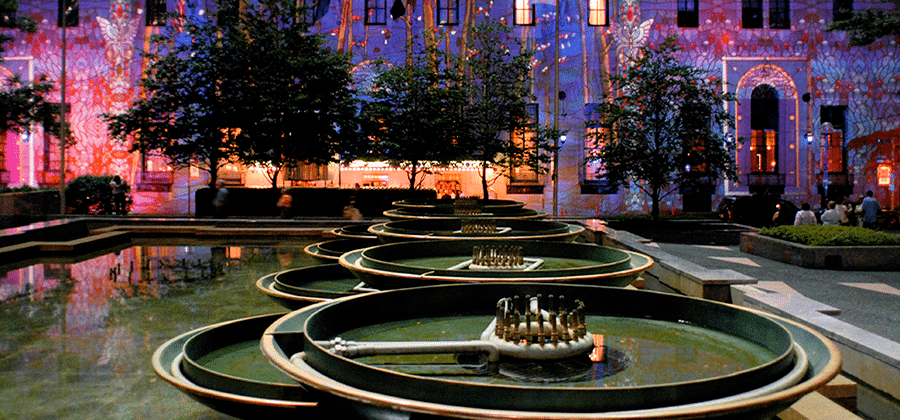
Artlumiere light projections ’09 courtesy of Jonathan Greene
A bold experiment in coal country.

March 18, 2020

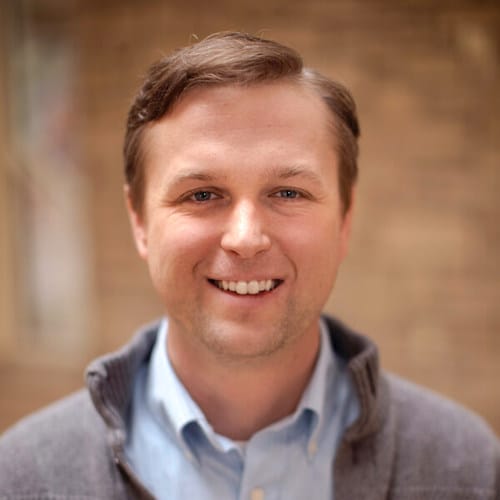
Brandon Dennison founded Coalfield Development in 2011 to offer a unique workforce approach focused on transforming communities – a bold experiment in tackling the generational poverty West Virginia has long wrestled with.

This experiment grew out of his early memories while growing up in a comfortable middle-class family in West Virginia. Others were not so fortunate. West Virginia’s jobless rate is high. But Brandon noticed that people wanted to find work, even if only through odd jobs, and this memory stayed with him. While still at school, Brandon developed a business plan for Coalfield Development, the first step towards launching the nonprofit which is focused on countering the generational poverty and lack of economic opportunities in West Virginia.

Coalfield’s workforce model is called 33-6-3: 33 hours a week are spent in on-the-job training, along with participation in training workshops; six hours a week are devoted to community college and business classes for an associate degree in applied sciences; and three hours a week are committed to personal development coaching and life skills. 

Coalfield has since expanded into a family of small, social enterprises. Revitalize Appalachia is developing a green-collar workforce deployed on projects that include rejuvenating empty buildings, and which was pivotal to starting Solar Holler, southern West Virginia’s first solar installation company. Refresh Appalachia produces fresh, healthy, local food. Reintegrate Appalachia is part of a region-wide coalition to support people in recovery from drug addiction on the path to finding employment. And Reclaiming Appalachia Coalition is a multi-state network exploring more innovative, sustainable approaches to mine-land reclamation.

On the development side, since 2013, Coalfield Development has incubated two wood shops, a coffee shop and an antique mall. In addition to a 2019 Heinz Award, Coalfield was recognized in 2018 with a $1 million grant from the Rockefeller Foundation/Chan Zuckerberg Initiative to replicate their model in Appalachia. 

Insights and Inspirations

  • Brandon believes that the American small town is poised for a comeback.
  • He is most proud of the deep human development his programs deliver, where participants move from hopelessness to optimism and confidence.
  • Real estate projects tackled by Coalfield Development do much more than deliver a building. They house new enterprises, create jobs, and train people in a multitude of skills.

Information and Links

  • Refresh Appalachia is turning coal mines into farms.
  • Solar Holler is pursuing innovative approaches to bring solar within reach of people and places who have always been left out.
  • Revitalize Appalachia builds community-based construction projects along with on-the-job training. Crews are local and projects are green.
Read the podcast transcript here

Eve Picker: [00:00:08] Hi there. Thanks so much for joining me today for the latest episode of Impact Real Estate Investing.

[00:00:15] My guest today is Brandon Dennison, a young creative powerhouse working to bring an economy to mid-Appalachia. As a young adult, Brandon noticed the poverty and lack of jobs in the town he grew up in. That early memory stayed with him through his college years. While still at school, he launched Coalfield Development, which is focused on workforce development to counter the generational poverty and lack of economic opportunities in Western Virginia. While workforce development is the center of Brandon’s focus, that has also spilled over into creative, sustainable and community-centric real estate development. Brandon’s work has been recognized with a Heinz Award, and a $1 million grant from the Rockefeller Foundation/Chan Zuckerberg Initiative. You are going to want to hear all about it.

[00:01:24] Be sure to go to EvePicker.com to find out more about Brandon on the show notes page for this episode. And be sure to sign up for my newsletter so you can access information about impact real estate investing and get the latest news about the exciting projects on my crowdfunding platform, Small Change.

Eve: [00:01:58] Thanks so much for joining me today, Brandon.

Brandon Dennison: [00:02:01] Happy to be here. Thanks for having me.

Eve: [00:02:03] So, we are rebuilding the Appalachian economy from the ground up. That statement is front and center on the home page of Coalfield Development, the organization you founded and lead. Well, I’d love you to tell me exactly what that means.

Brandon: [00:02:20] Well, it is a bold statement. There’s no doubt about that. And we are trying to model and pioneer what a whole new and better and fairer and more sustainable economy can look like for our region. This is a region that’s been overdependent on coal for far too long and that overdependence has left us economically vulnerable. It’s also left our environment in a difficult situation, not as clean as it should be and it’s hurt, it’s ultimately hurt the fabric of our societies and our communities, as you can see with the growing opioid and addiction crisis that we’re in. So, at Coalfield, we know that we can’t re-employ every single unemployed person that’s out there in Appalachia, but we can model what a newer and better way of doing things can look like.

Eve: [00:03:13] So, you know, what does that modeling look like? Have you developed programs? What are you working on?

Brandon: [00:03:18] Yeah. So, we incubate, mostly from scratch, but also in partnership with other entrepreneurs, we incubate what we call social enterprises. These are business models that blend the compassion of the nonprofit world with the efficiencies of the for-profit world. And the enterprises are in new sectors of the economy where we can innovate and show what a more sustainable economy can look like. So, for example, we’ve helped start the first solar installation company in southern West Virginia. We have an organic agriculture company. We make t-shirts out of recycled plastics. We make wood furniture out of reclaimed lumber from dilapidated buildings, some very innovative businesses. And we use those businesses to put people back to work, and then to support their lifelong learning and development.

Eve: [00:04:06] And so how many businesses like that have you developed to date?

Brandon: [00:04:09] From scratch, we’ve helped start 11 new social enterprises that we own and operate. And then we’ve also invested in more than 50 other social enterprises throughout the region.

Eve: [00:04:21] That’s a lot. That’s over 60, already.

Brandon: [00:04:25] Yeah.

Eve: [00:04:26] And so that creates a lot of jobs. How many jobs have those enterprises created?

Brandon: [00:04:32] We’ve created more than 250 new jobs. And those are permanent positions. And we’ve trained over 1,000 people through our training programs.

Eve: [00:04:41] That’s that’s pretty amazing. So, tell me a little bit about the programs that you’ve developed, as well.

Brandon: [00:04:47] When we hire a person onto these social enterprises, we hire them according to what we call our 33, 6 and 3 model. This is how we organize the work week, 33 hours of paid work each week, six hours of classroom time. All of our crew members are working towards an associates degree at the local community college. And three hours a week of personal development, which is, essentially, it’s life stuff …

Eve: [00:05:15] Yeh.

Brandon: [00:05:15] … to help our people overcome the challenges that are getting in the way of their quality of life. So, it’s a very holistic model. And what we found is, whether it’s in agriculture or construction or manufacturing, the model’s replicable across different sectors of the economy.

Eve: [00:05:31] So, you’re also providing, I think, a lot of support services in a variety of programs, like you, you say you train people. How do you do that? What resources you provide them with?

Brandon: [00:05:43] So, this is a paid experience. The 33 hours, it’s paid work, it’s a real job. And then we do a scholarship for the “6” and the “3,” so none of our college students have student debt. And then we layer on some additional life support. We have a zero interest emergency loan program that folks can tap if they have an unexpected emergency. And we facilitate a personal development program, which is really its reflection, where part of those three hours we’re creating time for folks to really evaluate where they’re at in life, and sometimes for the first time, assess a future and how to attain that future.

Eve: [00:06:22] So, it sounds like you have a huge amount of support, I think you’re just probably telling me little pieces of it, for a lot of people. And what impact has that had? I mean, how are you measuring success? What does that look like to you?

Brandon: [00:06:40] Well, there are some easy ways to do that. And then there are some deeper ways to do that. What excites us is really the deep human development. When we see a person who’s been able to calm chaos in their life, and they’re now able to develop a life plan and goals and start to achieve those goals, and start to have a quality of life they never thought attainable. That’s why this organization really exists. So, we measure our success by jobs created, and businesses created, and people trained. But then we also, internally, every crew member has a monthly evaluation by which we track their professional development. And then every week we also have a personal reflection which actually monitors and tracks the improvements in the well-being of the person themselves. So, we can measure this through peer-reviewed surveys on things such as optimism and self-confidence and sense of self-agency and self-worth. And that’s harder to measure. but that’s really the magic of this organization, I think, are those deeper human, really, transformation is not too strong a word for what we see happen in people’s lives. We’ve seen people go from struggling with addiction to, all the way to becoming entrepreneurs. Folks who have been couch surfing and homeless to first time homeowners and opening savings accounts. So, I don’t think transformation would be too dramatic a word.

Eve: [00:08:10] No, absolutely not. That’s pretty remarkable. Tell me, how does real estate development fit into your model?

Brandon: [00:08:19] Yep. So, we have a niche with real estate where we take on older historic buildings. We use our locally hired construction crews to revitalize those buildings into mixed use, mixed income hubs for economic development. So, what I mean by mixed use, there’s usually an affordable housing component. We do the housing green and sustainable upstairs, and then downstairs there’s usually a small business component where we’re creating new space for new businesses to come into the communities. New social enterprises to open up shop. And then by mixed income, you know, we’re creating assets that are really accessible for people of all different incomes. And so, the real estate component really supports the personal development and the enterprise development strategies that we’ve already talked about. And it’s important for gaining community trust because it’s so tangible. I think sometimes there is a lot of cynicism down in southern West Virginia. There’ve been so many government programs and mission trips and charitable efforts that folks have become really skeptical about what it actually means for their lives. I think part of the reason our real estate component is so popular is it’s tangible. People see an empty building coming back to life. They see their neighbors moving in there, having a great place to live. They see new businesses opening and putting people to work. And it’s hard to deny that positive momentum.

Eve: [00:09:44] Yeah, that’s true. I think real estate is pretty fabulous that way. It’s sort of visible proof of change, right?

Brandon: [00:09:50] Yup, exactly.

Eve: [00:09:51] Yeah. How many projects have you completed?

Brandon: [00:09:55] I would have to add that up, exactly, but I’d say at least about a dozen. We have another three or four in our in our pipeline, right now.

Eve: [00:10:03] And your role in these projects, are you the developer, or do you help someone else who’s developing the project?

Brandon: [00:10:11] We are almost always the developer. So, we have the competency as an organization to put the finances together, to lead the community engagement, the community visioning. We’re usually the contractor. We’re a licensed general contractor. So, that creates local jobs through which we can use that 33, 6 and 3 model that I referenced earlier. Sometimes we’re the owner and manager, but not always.

Eve: [00:10:35] So, I have to ask if there’s something you don’t do?

Brandon: [00:10:40] (Laughter) That’s a fair question.

Eve: [00:10:41] Because you’re rattling off, like, an extraordinary number of accomplishments, and I’m sure there’s more tucked away that you’re not talking about.

Brandon: [00:10:48] So, I studied nonprofit management in graduate school, so I know the term “mission drift” and it’s always a concern. But kind of our theory of change for southern West Virginia is that things had gotten so stagnant and so, sometimes hopeless feeling, that what was needed were really were some bold experiments. And that it wasn’t enough to just pick one area and say, this is what we do and this is all we do. And so, we are into a lot of different things, but it’s actually kind of on purpose.

Eve: [00:11:19] Yeah, it sounds like you’re pretty happy about it, too, Brandon.

Brandon: [00:11:23] Yes. Because of those transformations, that I realize, it’s hard not to wake up excited about what we’re doing. This is where I’m born and raised. So, I love this place. I’m committed to this place. And to get to see people transform their lives and communities transform, you know, literally empty buildings transformed into new places of business. It’s inspiring to be a part of it.

Eve: [00:11:46] So, let me let me ask you, are you working in one town, city, or are you working all over the state?

Brandon: [00:11:55] We have partnerships all over the state now, and even a few outside of our state borders. But most of our work is focused in southern West Virginia, kind of near the Kentucky border.

Eve: [00:12:07] Okay. And tell me again what sort of problems? You, I know, there’s an opioid crisis, I mean, what sort of unemployment are you dealing with there? What’s happening economically in that part of the state?

Brandon: [00:12:21] Well, I’ve had to learn the hard way the difference between generational poverty and circumstantial poverty.

Eve: [00:12:28] Yeh.

Brandon: [00:12:28] Circumstantial poverty, you have folks who have had stable income, have had good jobs and lose those jobs, and it is very scary. But there’s kind of a base or a foundation for them to rebuild off of. Whereas, with generational poverty, you’ve got several generations gone by without wealth and assets accumulating. And it’s just a deeper, more complex sort of challenge. And that’s the kind of challenge we’re facing in Central Appalachia and have been for generations. And so, that’s why our work goes so deep and long. You know, we’re creating actual jobs. These are two and a half year contracts. We’re sticking with people all the way through the end of their associates degree, which is, usually takes two and a half years. So, it’s more expensive, it takes longer, but it’s what’s required, given the complex generational challenges we’re staring down.

Eve: [00:13:20] What is unemployment like there?

Brandon: [00:13:23] Unemployment is, it’s always above the national average. But what actually stresses me out even more is the labor participation rate. Unemployment measures people who are out of the workforce, but are actively trying to get back into it.

Eve: [00:13:36] Right.

Brandon: [00:13:36] Whereas labor participation, that measures the number of folks who are trying to be in the workforce versus those who have totally given up. And we have a lot of counties where less than 50 percent of the working age population is in, actively in the workforce. And that, frightening. You can’t build a modern, healthy economy with a number like that.

Eve: [00:13:56] No. So, then what is your and your organization’s long term goal? What do you hope things will look like in 10 years?

Brandon: [00:14:03] This is why we’re so committed to starting new businesses ourselves. It’s not enough to just train a workforce for the businesses that exist because there’s just not enough economic activity happening right now to really build an economy for the future. And so, this is why the startup component of our work is so important.

Eve: [00:14:24] Yes. So, out of everything you’ve done, what do you think’s been most successful and perhaps what’s been least successful?

Brandon: [00:14:32] Well, one of our social enterprises was a coffee shop in a small town in southern West Virginia that we were very proud of. It was in a formerly vacant building. It was a beautiful project. It filled a need and a gap that wasn’t being met in the community. The idea for the coffee shop came out of community charrettes, But ultimately the coffee shop, it just didn’t make it financially. And I think what that reinforced for me, you know, retail businesses are going to struggle until we’ve rebuilt that economy to have outside investment coming in, to have businesses, like manufacturers or construction companies that really generate a multiplier effect, it’s gonna be tough for a retailer-type businesses to take hold. So, it was so sad to close the coffee shop, but we learned so much from that. And on the success side, I mean, I think of the human beings whose lives have transformed, the 250 new jobs that we’ve created. And ultimately, what those people as part of social enterprises have achieved, is they’ve modeled what a whole new and better economy can look like, especially when you think about that solar company.

Eve: [00:15:41] Yes.

Brandon: [00:15:41] To think that we’ve grown a solar installation company. It’s totally for-profit now. No grant money needed. We did that right in the heart of coal country. That’s a pretty bold accomplishment.

Eve: [00:15:51] That’s pretty bold. Yeah. Just going back to real estate a little bit.

Brandon: [00:15:56] Sure.

Eve: [00:15:57] I’ve done this sort of real estate project myself, and I’m wondering how you fund your projects.

Brandon: [00:16:03] It’s always a mix. We never like to do a project that can’t sustain at least some debt. You know, we feel like if it has to be 100 percent grant-funded, that’s probably not a good sign that it’s viable. And yet in our distressed communities, to expect a property to handle 100 percent debt service is not fair either.

Eve: [00:16:23] I don’t think you can expect that in too many places anymore, so, especially if you’re trying to build affordable housing where, you know, affordability depends on keeping debt down. So, it’s very tough. Yeah.

Brandon: [00:16:36] So, we almost always have a bank loan that, anywhere between 10 to 20 percent of the projects, sometimes more. And then we fundraise. And for the housing piece, the Federal Home Loan Bank of Pittsburgh has been a fantastic funding partner for us. And on the commercial side, we’ve had some good luck with the United States Economic Development Administration.

Eve: [00:16:59] Ok, creeping up to 40 percent would be a good thing, right?

Brandon: [00:17:03] Yeah.

Eve: [00:17:04] Yeah. I think given in Pittsburgh, projects that are in underserved neighborhoods typically need, maybe 40 percent of subsidy, and the market’s gotten pretty strong here. So, it’s very difficult. What you’re doing is very, very difficult. And what role does the community around you play in the funding of these projects?

Brandon: [00:17:24] Part of the problem with the generational breakdowns that I was referencing earlier, that means there’s not been an accumulation of wealth over the generations. And so we do not have a philanthropic base like what many urban areas have.

Eve: [00:17:40] Right.

Brandon: [00:17:41] Our local community foundation can really only do grants of five to ten thousand a pop. One in Charleston that can do a little bit better. So, we are really forced to look to the public sector for funding help and we’re forced to look outside of our region for folks who understand the oppression and the divestment that’s happened here, and are willing to help us try and rebuild a stronger base.

Eve: [00:18:06] Yes. So, that brings me to the question. You know, I have an equity crowdfunding platform. Do you think that could play a role in building communities for everyone where you work?

Brandon: [00:18:16] I think so. I think it’s a brilliant model. And I think, you know, to answer your question more directly from before, about the role of the community, what makes our projects really go is this the sense of community ownership. So, we start every project with multiple community town halls, and charrettes, and the community members actually sit down with the architects and help design these projects. So, we often times, even though Coalfield is technically the owner and the developer, there is a wide sense of connection and ownership to these buildings from community members themselves. And so I think that sort of approach that we take might very well make us a good fit for your crowdfunding approach.

Eve: [00:19:00] What community engagement tools have you use that have worked best?

Brandon: [00:19:05] We used to start with a charrette right out of the gate. We realized the charrettes go better when there’s more knowledge built up of the history of the building, and what’s possible and what’s not, given the funding source. And so, we start with the town hall, sometimes two or three, just to build the awareness of the history of the building and the funding sources at play.

Brandon: [00:19:26] Then we have a charrette, and sometimes more than one charrette, to actually let the community members sit down with the architects and have their fingerprints on the actual blueprints for these projects. And then we continue to engage the community once the properties are up and running. We hire local community members to staff these facilities. And we continue to lead community engagement efforts well into the future operations of the buildings.

Eve: [00:19:52] So, community engagement from beginning to end, right?

Brandon: [00:19:56] Yeah, absolutely.

Eve: [00:19:58] Going back to you. I’m just wondering what your background has been that’s led you down this path, creating this pretty amazing organization.

Brandon: [00:20:06] I was born and raised in southern West Virginia. I had a happy middle-class upbringing, but I knew all around me there was a lot of pain and suffering. I went away to school about six hours east of here, and I got very involved with a progressive Presbyterian church. I loved the youth group and I would take the group on service trips, all over, mainly to learn and to do a little bit of service. And I had some amazing experiences, but everywhere I went, I felt like, where I belong was back home in my own backyard because I knew that’s where I could probably have the biggest impact. I understood that place the most. And then the very last service trip I led was to Mingo County right back in southern West Virginia. And we had this experience where we were doing service work on a house. And these two young guys approached us and they had tool belts slung over their shoulders, and they asked us if we have work available. And I explained we were volunteers, and they went on their way, and it was just a brief, brief interaction. But I felt like that brief moment really summed up the situation in southern West Virginia, which is, we have people who want to work and want to learn and want to be a part of something, but our economies stagnated so badly that there’s nowhere for that gumption to really be applied. So, that was the seed that really started me thinking about Coalfield Development.

Eve: [00:21:30] And then after that, how did you get it off the ground?

Brandon: [00:21:33] I went to graduate school to study nonprofit management with the Indiana University. I knew that I wanted to move back home but Indiana had a great program. And while I was there, the business school actually was helping start this new program in social entrepreneurship. And that was a phrase I’d never heard before, but it really caught my attention. The more I learned, the more I felt like, here was something different, and new and potentially more effective than some of the other public and nonprofit programs that have been tried back home. I had an internship in the summer of 2010 to kind of listen and learn. And then I took the whole second year of graduate school and just threw myself into the business plan for Coalfield Development. And then I, when I was done with school, I moved back in with Mom and Dad and they gave me financial cover and shelter to make a try at this thing.

Eve: [00:22:26] (Laughter) Very good. Have you moved out? I have to ask.

Brandon: [00:22:30] (Laughter) I did finally make it out. I’m married and we have two boys now.

Eve: [00:22:34] Thank goodness. Your parents are probably saying thank goodness too. Right?

Brandon: [00:22:38] Yeah, probably so. It’s kind of, like, the millennial thing to do, you know. (Laughter)

Eve: [00:22:42] It’s a very millennial thing to do. Really. It’s been a tough 10 years, right?

Brandon: [00:22:49] It has been.

Eve: [00:22:49] So, then, do you think socially responsible real estate is necessary in today’s development landscape?

Brandon: [00:22:56] I think it’s critical and I think it’s too often overlooked. You know, we organize our organization by what we call three core capabilities. It’s the personal professional development. It’s the incubating of the social enterprises. And then it’s the community based real estate. And the community based real estate in many instances is what’s making the first two possible. You know, it can be complex. There’s many different funding sources. It takes years for these projects to get pulled off. And so sometimes it’s not the easiest … kind of sexiest piece of our work to talk about. But it’s a critical component.

Eve: [00:23:31] Yes. Yep. And are there any current trends in real estate development that interest you the most that you think could be relevant, too?

Brandon: [00:23:39] Well, I think the American small town is poised for a comeback. Rural has challenges, but I think more and more, people are looking for a good quality of life. They’re looking for outdoor recreation opportunities and clean air and clean water and peace and quiet. And with some historic buildings. When you think about sustainability, I think, historic preservation gets overlooked. But one of the best things we can do to build new housing in a sustainable manner is to preserve our current building stock rather than knock it over and put it all in a landfill. So, I think there, the future of the market might be good for rural small towns. I hope so.

Eve: [00:24:18] Yeah, I think you’re probably right. I was in Australia recently and I travelled to Hobart, which is in Tasmania, to the south of it. And it was fascinating because Melbourne is the closest city to the north and it’s one of the most expensive cities in the world and growing really, really quickly. But it was this tiny little city. I hesitate to call it a city, it’s very small. And it had really had a huge influx of young people who were experimenting, and building businesses in exactly the way you’ve described. Just trying to, kind of, build up a new place for themselves where they could afford it. It was pretty dramatic.

Brandon: [00:24:59] Very cool.

Eve: [00:24:59] Yeah, very cool. Yeah.

Brandon: [00:25:00] I think that’s the future.

Eve: [00:25:01] Yeah. I think, you know, people have to find their way out of some of our cities which have become just too expensive for most people. How do we think about our cities, towns and neighborhoods so that we can build better places for everyone?

Brandon: [00:25:17] I think historic preservation, again, is a key part of that conversation. I think that mixed use, mixed income projects are important. The reason the mixed income, you know, if you look at affordable housing development in years past, it’s often, it’s taken low-income people and shoved them in a corner of the city and kind of consolidated all the challenges that come with poverty. It really cut people out of pathways and avenues and access to opportunity. The mixed income is important, and the mixed use is important as well, so that we’re not just creating affordable housing, but really, we’re building up communities that include small businesses and recreation opportunities and community engagement opportunities that contribute to a whole quality of life.

Eve: [00:26:07] So, I think basically you’re saying we should just keep mixing it up, right?

Brandon: [00:26:11] I think so.

Eve: [00:26:12] Just mix it up. Well, thank you very, very much for your time. I really enjoyed talking with you and all the best for this pretty fabulous organization that you’ve built.

Brandon: [00:26:22] This was a great conversation. I love the work that you’re doing as well. And I hope we can find a way to work together.

Eve: [00:26:28] Absolutely.

That was Brandon Dennison of Coalfield Development. Brandon measures success in the lives he helps to transform, from poverty stricken and jobless to optimistic and confident. Each participant in the 33-6-3 program that he developed works for 33 hours, studies towards an educational degree for six hours, and works on personal development for three hours, each and every week. While workforce development is the center of Brandon’s focus, that has spilled over into creative, sustainable and community-centric real estate development as well. Historic preservation, community engagement and job creation all come together in a very holistic real estate development program.

Eve: [00:27:30] You can find out more about impact real estate investing and access the show notes for today’s episode at my website, Eve.Picker.com. While you’re there, sign up for my newsletter to find out more about how to make money in real estate while building better cities. Thank you so much for spending your time with me today. And thank you, Brandon, for sharing your thoughts with me. We’ll talk again soon, but for now, this is Eve Picker signing off to go make some change.

Images courtesy Brandon Dennison, Coalfield Development.

Back to wood construction.

March 16, 2020

As the creation of affordable and sustainable housing becomes increasingly urgent, focus has shifted to innovative ways to meet these goals. I found one such example in Amsterdam where Marc Koehler and his design team develop creative solutions for urban living through their Superlofts Project. Broadly speaking, a Superlofts project starts with the bare structural frame of the building. Each future resident designs her own home, which is then inserted into that framework, making a vertical village. This interactive process is a rather wonderful flexible and community-centric model for the creation of urban co-living.

Not satisfied with creating just a flexible living model, Marc’s team also strives to improve the sustainability of each of their projects. One way they are considering this it to move towards heavy timber construction. Their first timber project is already under development – a six-story building in the Netherlands. This push highlights the growing awareness of the benefits of engineered wood materials even for large-scale projects.

The benefit of using timber

For Marc, the two primary benefits of building with timber are flexibility and sustainability. The Superlofts vision is intended to offer flexibility in the design and configurations of buildings. Using timber adds to that goal, since timber construction makes it far easier to alter the configuration of a building. Wood is easily adaptable and can be reconfigured with minimal costs.

By contrast, concrete structures limit changes in unit and building configurations, making it more difficult to offer changes to living arrangements as families grow (or contract). By transitioning from concrete to timber, Marc believes his projects will become more like a Tetris game, with living spaces that can easily be connected and reconnected in a multitude of ways. This flexibility reduces waste and makes future adjustments far more efficient.

Simply put, building with timber is a sustainable practice. First, unlike many building materials, wood is organic – a natural material. This means that it is non-toxic and ages naturally. Second, it’s a renewable building material. As long as more trees are planted to replace those that are used, it serves as a renewable resource. Third, wood stores carbon dioxide, which otherwise would be released into the atmosphere. This means that as long as the timber is being used, it’s retaining that carbon dioxide, stopping it from being added to the atmosphere. Lastly, because wood is a good insulator, using it leads to more energy efficient buildings.

How tall can timber buildings be?

It has long been imagined that wood construction was limited to just a few stories. It’s so light and flexible that it’s generally not considered for taller buildings, which are more typically constructed of steel and concrete. However, engineering innovations are quickly producing wood products that have greater structural integrity, leading to a wave of new, tall heavy timber designs.

On the other side of the world, in Toronto, Sidewalk Labs has developed a digital proof-of-concept for a 35-story all-wood building. The design incorporates cross-brace frames, a technique often used in high-rise construction, along with cross-laminated timber beams. By using structural, diamond-shaped supports on the exterior, additional space is freed up on the interior. To keep the building from rocking, the design does have a steel mass damper, but this is the only non-wood component used in the structure.

Superlofts’ vision for mass timber is all-embracing.  Marc and his team realize that timber today not only has the structural integrity needed to build larger structures along with its important sustainability features, but it also provides the potential to easily adapt a building during its lifetime.  And that is something they are interested in exploring.

To learn more about why and how Marc is using timber in his new project, listen to our podcast interview here.

Image by PIRO4D from Pixabay

The importance of community.

March 9, 2020

When we think about housing, especially in urban areas, we’re not just thinking about a place to rest our head. Instead, housing must include some broader amenities, such as access to transportation, services and jobs. And even more importantly, as more and more people move back from the suburbs to urban neighborhoods, there is an increased focus on finding community. Today, city planners, developers and architects are paying attention to the role of community in the planning and building of urban spaces.

One notable example which goes even further, by creating spaces fully centered on the people who will occupy them, is the Superlofts project.

Background

Superlofts was founded and grew out of the architectural studio Marc Koehler Architects by Marc Koehler. Superlofts combine some extraordinary features to create amazing and unique buildings, with flexible housing layouts, carbon neutral living and curated communities.

The vision behind Superlofts is rooted in a process that Marc and his team developed in Amsterdam. Fifteen years ago, the studio was a boutique design agency, primarily focused on designing houses and renovating apartments. They learned the importance of listening to what people wanted in a home.

The ideal day

Over time Marc’s team developed methodology known as “The Ideal Day.” Rather than asking clients what about their physical space needs, they asked them to describe their daily routine. Their clients scripted out an ideal day in their life, how they imagined an ideal day, from waking until bedtime. Using these scripts, Marc and his team designed spaces that responded to the way their clients wanted to live, not to the spaces they thought they should have.

This exercise helped people to imagine the possibilities for themselves, and for change and improvement in their lives. Marc believes this is the fundamental purpose of his work – to find ways that architecture and design “can really change your life if you take the opportunity and really think of what you want to achieve in your new space.”

The business of bringing people together

Marc describes Marc Koehler Architects as being “in the business of bringing people together.”  This is a unique role for an architect to assume. They are generally focused on buildings and spaces, not on people. Superlofts is the culmination of this idea. Superlofts is “a system for living that puts people in control with a flexible, modular, co-creation approach to the ultimate urban space: the loft.”

The first Superlofts project began with a simple concrete frame structure. Future homeowners were able to build their dream space in a “vertical village.” The process involved co-creation sessions which brought together the future residents of the building and provided them with the opportunity to plan how they wanted to live together. This filled an important need for many people by introducing them to the community of people they would be living with and providing them with the powerful opportunity of developing shared spaces. Ultimately, Superlofts aims to create urban villages with buildings where people’s daily lives intersect, allowing them to be responsible for one another.

The Superlofts concept flips the normal planning and design process on its head. Rather than starting with the building, planning and design starts with the people. The resulting spaces are functional and sustainable, communities with happy people that are well-connected and supported. This a new way of thinking about how to create ideal living environments in cities.

Listen to the full interview with Marc Koehler to learn more about Superlofts and the business he has built himself, bringing people together.

Image courtesy of John D Norton

Learning by doing.

March 2, 2020

With any project, learning from success and failure is important. In real estate, paying attention to and making adjustments based on what works and what doesn’t can have a major impact on the success of both current and future projects. This is especially true for projects that involve unique problems or complex issues that lack clear solutions. In these cases, the ability to learn by doing, and to effectively and quickly implement new knowledge, is crucial.

The affordable housing crisis is an example of one such problem. It is becoming an increasingly urgent issue in urban areas throughout the country. It has put millions at risk of losing their homes and their quality of life. Many different factors have had an impact on the current housing crisis over the last few decades and as a result it’s become an increasingly complicated issue with no simple answers.

Innovative financial tools

The good news is that many people are working to find ways to address it. As different communities, organizations and individuals work to preserve and create affordable housing in their own unique neighborhood, we can learn from their experiences. Leveraging the successes (and failures) of different affordable housing solutions is one of the most effective ways for communities to learn multiple and comprehensive solutions to this crisis.

One solution is to address financial issues in building affordable housing.  Rebecca Foster, the CEO of the San Francisco Housing Accelerator Fund, is a great example of this. Her fund focuses on this specific issue – how to innovate financial tools to ensure that affordable housing is produced in the face of a competitive real estate market.

The Accelerator Fund has two primary programs: bridge loans and providing homeless housing.

Bridge programs are supported through a mix of private, public and philanthropic funds. Rebecca’s team understands that public funding is necessary to fund affordable housing in the long-term. At the same time, they appreciate the fact that the private sector’s speed, flexibility and comfort level with risk is needed for the acquisition and development of those projects. By combining private and public funds they can act quickly in order to more effectively preserve and create affordable housing in the Bay Area. Private funds go in first, to acquire properties quickly, and once stabilized public funds provide long term loans so that private investors can be repaid.

Just as with bridge loans, Homes for the Homeless, uses philanthropic capital to create housing for the homeless community. The Accelerator Fund is currently working on a 146-unit project in San Francisco’s Fillmore neighborhood. The project aims to build each unit well-below the market costs in the neighborhood, and on a tight timeline.

Always learning and getting better

At the heart of all of their work, the Accelerator Fund’s focus is first and foremost on how they can help their partners. They have some big hairy goals which include how they can help to get a project completed, how to make sure that a building isn’t lost, and how to make sure that homes aren’t left vacant.

At the same time as they see project success, they remain laser-focused on how they can do better on the next one. They must remain vigilant about lowering costs, reducing the amount of time that it takes to build or rehab housing, and finding better ways to use capital to complete projects. Foster and her team understand that small differences can make a big impact on their ability to fund and complete projects. Thus, learning from successes and failures is a critical part of their process.

The Accelerator Fund’s current goal is to preserve 15,000 units in the Bay Area and to build 30,000 new ones. As Foster and others work to close the gap on affordable housing in the Bay Area, their constant progress and improvement in both funding and building techniques is something that others can learn from and build off of. Listen to our full interview with Rebecca Foster to learn more about what the Accelerator Fund is doing in San Francisco and how this model can be applied to other communities.

Image courtesy of Jonathan Greene

« Previous Page
Next Page »

Primary Sidebar

sign up here

APPLY TO BE A PODCAST GUEST

More to See

(no title)

February 22, 2025

Bellevue Montgomery

February 11, 2025

West Lombard

January 28, 2025

FOLLOW

  • LinkedIn
  • RSS

Tag Cloud

Affordable housing Climate Community Creative economy Crowdfunding Design Development Environment Equity Finance FinTech Gentrification Impact Investing Mobility Offering Opportunity zones PropTech Technology Visionary Zoning

Footer

©rethinkrealestateforgood.co. The information contained on this website is for general information purposes only. Nothing on this website is intended as investment, legal, tax or accounting strategy or advice, or constitutes an offer to sell, solicit or buy securities.
 
Any projections discussed or made may not be accurate and do not guarantee a specific outcome. All projections or investments are subject to risk due to uncertainty and change, including the risk of loss, and past performance is not indicative of future results. You should make independent decisions and seek independent advice regarding investments or strategies mentioned on this website.

Recent

  • The Mulberry
  • Mount Vernon Plaza
  • The Seven
  • Real estate and women.
  • Oculis Domes.

Search

Categories

Climate Community Crowdfunding Development Equity Fintech Investing Mobility Proptech Visionary


Copyright © 2026 · Magazine Pro on Genesis Framework · WordPress · Log in