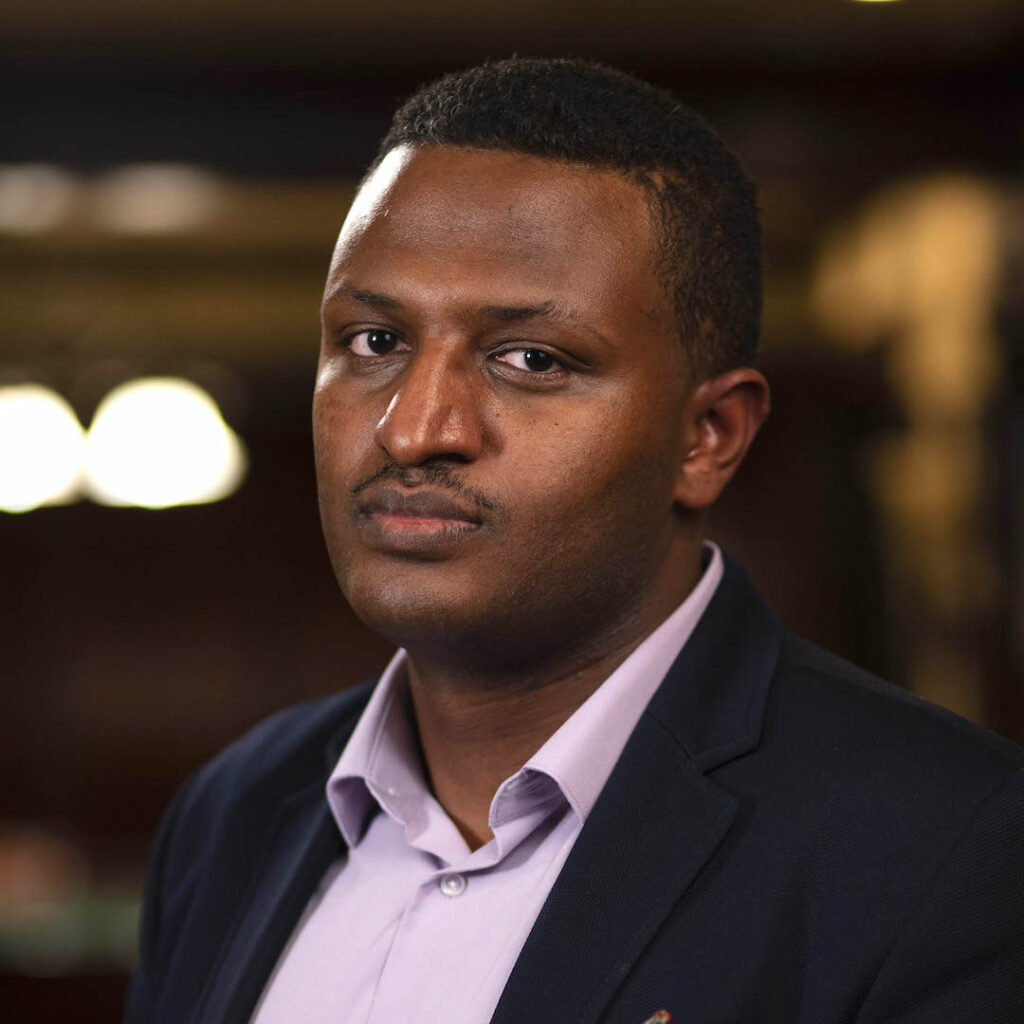
Samuel Alemayehu is an experienced global serial entrepreneur and active angel investor. His work in the
past two decades has been guided with an obsession to empower the individual and sustain the village.
His current focus is running Frontier Resilient Capital (FRC) to incubate or invest in companies who are
developing or commercializing breakthrough technologies that empower the individual (personalized
web) and sustain the village (biomanufacturing, renewable energy, carbon capture and circular
economy).
Sam started his career in Silicon Valley as a serial entrepreneur launching two companies from his college dorm room. He first got introduced to venture capital at Venrock Associates, where he focused on consumer media investments. He then moved to Africa, founding and investing in numerous companies across the continent and in a range of industries through Cambridge Investment Group and most recently FRC. Sam incubated 4AFRI at Venrock before growing the platform in 12 African countries with over 25m customers. He then built a mobile gaming platform, LotoPhone, in 18 countries with millions of customers before exiting the startup in 2013. He also created Sen Sante in partnership with leading investment banks to help develop large health infrastructures in Africa with a mobile based universal health insurance. Sam created mobile solutions aimed at empowering the individual.
Over the next decade Sam incubated Cambridge Industries Ltd, East Africa Electric Ltd, and Contingent Technologies Inc. to accelerate the implementation of pioneering infrastructure projects in emerging cities. He set up the first locally manufactured wind study program in over two dozen sites throughout East Africa. He oversaw the planning, design and construction of the first municipal waste-to-energy facility in Africa, located in Addis Ababa, Ethiopia, as part of a pan-African sustainability city park project to industrialize the circular economy with the initial facility built at a cost of USD120m. The full project has created over 20,000 jobs and aims to employ over 250,000 before the end of 2030 in ten cities. Each facility is designed as a multi-purpose plant with numerous functions, including metal recycling, brick production, industrial steam, producing biodegradable plastic, and modern insect farming. Sam has recently invested in commercializing breakthrough technologies through projects in Uganda, Kenya, Cameroon, Nigeria, Ghana, Senegal, DRC, Somaliland, Djibouti, Botswana, Angola, Namibia, and South Africa.
Sam is an active angel investor globally and sits on the board of numerous companies as an investor. He also sits on three non-profit boards: the Ron Brown Scholars Program, KID Museum, and VC Include. Sam is a founding partner at Pitch and Flow, an innovative storytelling platform that uses the global appeal and power of hip-hop to showcase and celebrate the next generation of entrepreneurs. He is a graduate of Stanford University School of Engineering and a World Economic Forum Young Global Leader.
Read the podcast transcript here
Eve: [00:00:14] Hi there. Thanks for joining me on Rethink Real Estate. For Good. I’m Eve Picker and I’m on a mission to make real estate work for everyone. I love real estate. Real estate makes places good or bad, rich or poor, beautiful or not. In this show, I’m interviewing the disruptors, those creative thinkers and doers that are shrugging off the status quo in order to build better for everyone.
Eve: [00:00:54] Today I’m talking with Samuel Alemayehu, born in Ethiopia and educated in the US, Samuel is a serial entrepreneur and investor focused on deploying technology as an equalizing force. “Let’s change the world to technology and products that empower the individual and sustain the village” says Samuel. Through his work with Cambridge Industries, Samuel is revolutionizing the way we think about sustainable energy and infrastructure. He built the first waste to energy plant customized for sub-Saharan Africa in Ethiopia, the Reppie Waste to Energy project. The project takes 80% of the city’s garbage and turns it into 25% of its electricity. Samuel has boundless energy and a lot to tell. So, listen in.
Eve: [00:01:53] If you’d like to join me in my quest to rethink real estate, there are two simple things you can do. Share this podcast and go to RethinkRealEstateforGood.co where you can subscribe to be the first to hear about my podcasts, blog posts, and other goodies.
Eve: [00:02:24] Hello, Samuel. Thanks so much for joining me today.
Samuel Alemayehu: [00:02:28] Thank you for having me. Excited to be here.
Eve: [00:02:30] Very excited. So, you have said “let’s change the world through technology and products that empower the individual and sustain the village”. And I’m just wondering how you’re tackling that?
Sam: [00:02:44] Exactly. So that has been our mantra as long as I remember. And whenever you’re building any kind of product and services, it has to focus on the individual, kind of be usable. Does it improve our life? And most importantly, does it improve the community that we live in sustaining our village? And at the end of the day, this is a global village and we’re doing it one waste trash at a time and starting in emerging markets. And we have evolved to do many things right now. Um, but our focus has been how can we take something that has been a headache, a nuisance and convert it into a treasure, convert it into something of value and do it in a way that really addresses water treatment, sanitation, and most importantly, a vibrant circular economy in every city.
Eve: [00:03:42] So this you’re referring to the Reppie waste to energy plant, I think first and foremost, right?
Sam: [00:03:48] That’s the first facility we’ve done.
Eve: [00:03:50] And that was, where is that located?
Sam: [00:03:53] That is located in Addis Ababa, Ethiopia.
Eve: [00:03:56] And that’s where you were born, right?
Sam: [00:03:59] I was born and raised there, and I left when I was 14.
Eve: [00:04:02] So what goes around comes around, I think. So, tell me tell me why. Why did you start this waste to energy plant?
Sam: [00:04:12] So, a lot of people start projects or entrepreneurial endeavors for something they love. A labor of love. For me, it was a labor of hate. Hated the garbage in Addis Ababa. I, it’s just, it’s everywhere. Um, you know, you would think if you live in a wealthy neighborhood, it’s collected and taken out, out of sight, out of mind. But no, not for me. Not where I grew up. Like I remembered the garbage was everywhere. We picked around, it really annoyed you. And even in the area where it’s being dumped, it used to be the outskirts, but it’s smack in the center. It is not a modern, even, you know, landfill site, but it is something where we’re digging the ground and throwing this garbage. And it’s in a country that imports metal, that imports plastic, and we’re not recycling it, we’re not reusing it. And we’re not trying to come up with a way, want to address the health impact, the direct sanitation impact of the garbage, but also when this could be an opportunity to create something of value. And I, you know, I left Ethiopia when I was 14, did my high school in the D.C. area and then went to Stanford and then was a software engineer, did a bunch of different companies around software. So, when I came back to Ethiopia, I was like, okay, we need to do something about this and it needs to happen, and started working with those that have addressed it in Europe. But we wanted to create something unique for Africa because the waste was unique, the challenge was unique, the community was unique.
Eve: [00:05:54] So how does the plant work?
Sam: [00:05:58] So the first facility, because the overall concept is how do you build a facility that takes in garbage and creates value? That’s a purpose. And have minimal garbage out of it as possible? The very first facility that we built in Ethiopia, does combustion, but with a flue gas treatment, the same flue gas treatment that allows you to capture the nasty gases that would come out from burning it, because that allows you to reduce the significant amount of the waste and capture those gas through flue gas treatment as per the EU standard that allows you to be located within 100-meter radius of residential areas all over the EU. So that’s the standard that we followed. Then over time, when we’ve been implementing other projects, we started to add, hold on, for the food waste, how can we separate the food waste and what is the optimum value we could get out of food waste? And that was doing insect farming and that is taking the food waste, separating it and feeding it to black soldier flies that grow 230 times their weight within ten days.
Eve: [00:07:06] Whoa.
Sam: [00:07:07] And making that into chicken feed and fish feed and organic fertilizers.
Eve: [00:07:12] Whoa.
Sam: [00:07:13] So it becomes really, really incredible value-add. And then for the waste and then we say, ooh, what about the plastic waste? How can we separate plastic waste and recycle it in the most exciting way possible? So, we started working with scientists around the world that have been using new type of enzymes that break down the plastic, and that allows you to filter it and separate them. And then you say, what about once it has gone through the system? And if you are to use combustion and you’ve burned it, the ash that comes out, we could turn the ash into bricks. What about the metal that is in there? We use super magnets to separate out the metal. This facility in Addis right now alone is separating 3.8 million kilograms of metal every single year.
Eve: [00:08:02] Wow! So, this plant does a lot more than one thing.
Sam: [00:08:08] It does a lot of things within one facility. It is how do you take garbage, but how do you turn it into value? And one of those values is electricity. So, it is able to generate 185,000,000 kilowatt hours of electricity, which is the equivalent of about 20% of the household energy generated in a city of 5 million people.
Eve: [00:08:31] Wow.
Sam: [00:08:33] And then you have other byproducts, be it making interlocking bricks, recycling plastic, being able to create food waste and converting that into chicken feed, fish feed and other. So, currently, we’re in the process of building a new facility in Kinshasa, which is a city of 18 million people. It’s actually the largest French-speaking city in the world, double the size of Paris.
Eve: [00:09:01] Wow. All these things I didn’t know.
Sam: [00:09:05] You never know. And Kinshasa is this vibrant place. But we’re not using incineration and with the flue gas treatment, but instead, it’s fully entirely set up with what’s called anaerobic digesters. And we’re able to capture the gas and use the gas for energy generation as well as to replace household charcoal usage.
Eve: [00:09:26] So what’s the… It’s a lot. So, what’s the long-term plan? I mean, how many plants, how much garbage are you tackling? I mean, how much more is there to tackle in Ethiopia? Are you seeing cleaner streets? I have lots of questions.
Sam: [00:09:42] We are. We have seen cleaner streets, one, in the program that we implemented in order to collect garbage better. But most importantly, the challenge has always been disposal. So, our core goal is to continuously evolve and change with advances in technology so that, how can we create the maximum value from the resource? To us, the waste is not garbage or a waste. We like to call it feedstock. So, to us it’s a raw material that comes in and we say, how can we maximize the highest amount of value from this garbage and, or from this waste, from this feedstock? And the goal is to be left with almost no waste whatsoever. Right now, we still send about 2% of the garbage back into landfills, but everything else gets to be used to different values, but within one central facility. So, in Addis, it’s a city of 5 million people, it’s processes 500,000,000kg of garbage a year. And that’s the only facility we want to add other additional facilities next to it.
Sam: [00:10:52] We partner with others as well. And it is a facility that we’ve built in partnership with the Ethiopian government. In Kinshasa, we’re fully owning the facility and we will be processing 3,000,000,000kg of garbage a year and really creating over 35,000 jobs in collection as well as disposal and, and other projects. But there are other cities, so we have feasibility studies in Gabon. We’re also working in places like Guatemala, Honduras, Nicaragua are the three places that we’re exploring in Latin America. We have a partner we’re working with in Bangladesh. We think the technology that we’ve put together, the system and it’s allowing even other innovators and entrepreneurs to plug in, into our existing infrastructure because we have the waste, if they come up with a better way to deal with, let’s say, battery waste or another type of waste, they could easily plug into our platform and be able to service and provide a circular economy solution.
Eve: [00:11:57] So any plan for the US?
Sam: [00:12:01] Uh, Eve, that is a good and interesting question. We do think we have come up with even better solution that could work for the US. But the US is tough. The US, because it really is bureaucratic. You have two companies that totally dominate anything that has to do, to be done with waste. That is Waste Management and Republica. If they want it done, it will be done. If they want to block it, they will block.
Eve: [00:12:28] And if they want to hike up prices, they hike up prices. I bet they do that. Yeah.
Sam: [00:12:32] Look at their stock! Their stock, for the past 20 years, they’ve performed better than many companies.
Eve: [00:12:38] Oh, yes.
Sam: [00:12:40] It’s a multi-billion-dollar enterprise.
Eve: [00:12:40] I fired them on my little buildings because it was so expensive. It was outrageous. And…
Sam: [00:12:47] I mean, one of the challenges there is the US is on track to have landfill that is the size of the state of Rhode Island. Throughout the US. And this is land we’re never going to get back. This is land where, you know, it’s just continuing. And they talk about, oh, we have landed the right way or the different… But this is a permanently wasted land. If you want to re-mine it, it is really challenging. But instead of coming up with newer solutions, they’re continuously rebuilding more landfill. But all is not lost. There are some companies that are doing some exciting projects, specifically around anaerobic digesters and the recycling of plastic waste.
Eve: [00:13:32] I’m actually, I’m a little shocked to hear that, you know, that the management of waste is actually controlled by two companies in the US.
Sam: [00:13:42] A supermajority of it. That’s correct.
Eve: [00:13:45] That’s kind of crazy.
Sam: [00:13:47] Well, a lot of things in the US are either a monopoly or a quadropoly. I mean, be it…
Eve: [00:13:53] That’s a monopoly, isn’t it? That’s…
Sam: [00:13:56] Yeah, that’s a duopoly. You know, and you look at grain supply. You have four companies, the ABCDs, you know, Archer Daniels, Cargill, and a few others that dominate, like there’s various sectors.
Eve: [00:14:14] But if you were to go to a particular region or a city and say, we want to try this in your city, could those monopolies stop you?
Sam: [00:14:28] If, because it’s long-term contracts. So, when it comes to the waste collection, they have a long-term contract.
Eve: [00:14:36] I know, I fought with them about that. That’s actually why I fired them because I refused to sign long term contracts. Interesting.
Sam: [00:14:44] There are places where the cities, because it’s regional, you don’t need something that needs to be done fully. Vermont, New Hampshire. California has put in requirements. So, EU does a lot of innovative work because regions make a requirement saying you cannot throw to a landfill, or the amount of money we give you is not going to be as much. Like if you pay less, it will actually will lead to more innovation. Because if they pay them enough, they can just throw it in there and they don’t have to worry about monetizing it in order to be competitive. In Ethiopia, we have to come up with all these monetization schemes because we are not making that much money. Like they would make about $100 per ton of waste, on average, it really does vary in different places. So, they don’t have to worry about it, but we do because we make less than $2 per ton of waste. So, we have to come up with as many ways as possible to generate revenue from the waste, and that is recycling it, that is putting it through a circular system.
Eve: [00:15:44] That’s innovation, right? You get complacent when you make too much money.
Sam: [00:15:49] Necessity is the mother of innovation.
Eve: [00:15:51] Yes, I know. That’s exactly right. The city that, what city is this first plant in?
Sam: [00:16:00] The one that we’ve done is in Addis Ababa, Ethiopia. Okay.
Eve: [00:16:03] So what do the people who live there think?
Sam: [00:16:07] That’s a good question. So, as the main facility, we do have great support because one of the things, Eve, is building the very first facility of its kind in Africa. I have as much challenges, I don’t think we have enough time on the podcast of the challenges that we have faced as implementing projects.
Eve: [00:16:26] I’d love to hear about them.
Sam: [00:16:28] But a lot of it is artificial challenges, as bureaucracies and when governments change, you know, they make it very, very, very tough. But what it has done is it has been able to remove garbage from just piling up in landfills. Landfills take a large amount of land, usually for a city of this size, it would be around 200 hectares every 20 years, every 25 years that you have to dedicate for that. And it needs to be within close proximity of the city or it’s going to cost you quite a lot to transport that garbage. So, with the city, we have gotten incredible support, but when bureaucratic changes happen, we have to continuously provide support and program for the community. So, those are some of the challenges that we’ve faced, is bureaucracy and government changing rules on you. But right now, it is going in the right direction. We’ve gotten a whole lot of support because at the end of the day it is providing much needed electricity, significant amount of job creation, but also turning something that was, you know, a problem into a significant amount of a solution and a treasure.
Eve: [00:17:47] How many jobs have you created?
Sam: [00:17:50] So when it comes to waste collection, in a distributed way, it’s 11,000 jobs have been created in Addis Ababa. 11,000. And then with the waste disposal system and the ancillary works, it’s about 850 jobs.
Eve: [00:18:05] That’s quite a lot. So how quickly do you think, you know, the others that are in planning will emerge?
Sam: [00:18:13] We do see half of those facilities up and running.
Eve: [00:18:17] Okay. This is amazing. I’m sort of stumped for asking questions. So, what were some of the most unusual challenges that you’ve had? So, we all know about bureaucracy and you know that rules changing.
Sam: [00:18:31] Let me give you a couple. One was initially. So, when we started operating the facility, a lot of the waste collection that was done, we implemented a per kilogram. That’s the international standard for waste collectors. And what we realized was as soon as we implemented that system, initially it was used to be just a monthly fee. A lot of the waste collectors would fill up the weight, so the weight all of a sudden increased. Oh, and it was a bit suspicious. And within a week we had to shut down the facility because half of the waste that we’re collecting was rock and dirt that have been dug up on the ground.
Eve: [00:19:11] So those are all the entrepreneurs out there being entrepreneurial.
Sam: [00:19:15] You do the incentive this way. So, we had to bring them back in and create a different set of incentives that really aligned with all of us and that had a trust-based system and a support system. So that was one of them that happened with waste collection. And another one that you face is there’s a lot of misconception around waste to energy. So, the typical incinerator of the past is not good for the environment at all because anybody could start a fire. Burning waste by itself is the worst thing you could do to the waste. But a modern flue gas treatment, the flue gas treatment alone costs us about $40 million of capex. And you see them all over Europe. There are over 400 of these facilities in Europe. In Denmark, over 95% of all the waste is processed through these facilities. But what they do with the flue gas treatment is a modern facility that is able to capture what would have been emitted and convert it. And so, educating that part was quite important. But the more work that we continue to do, we even found more innovative solutions that were way more superior, both financially and environmentally, to even the combustion process that even Europe uses right now. Which is being able to separate the waste as much as possible, using enzymes to break down those wastes to their individual values, to include projects like insect farming. That allowed us to really maximize the value of every single bit of that waste. And so those were some of the innovative projects that came out from the challenge of this legacy brand that incineration had addressing that, but also really growing away from it because of a lot of the innovations that are out there.
Eve: [00:21:18] So when you separate out the trash, how do you do that? And I’m asking because I interviewed someone in Norway who had created these robot waste pickers that were just fascinating for large objects and small ones.
Sam: [00:21:35] So, we use humans and kind of separation systems because we need to employ. You could use robots, we have systems, we can employ robots as well. But in Africa we need as much of the jobs as we could get. We provide safe environments and usually we do it three ways. One is to separate them at source as much as possible. Two, once they have arrived on site conveyor belts and to be able to separate them. The first facility that we did is bulk, so we didn’t need to do the separation and the separation is done using super magnets or other parts at the end, but earlier is using as much of human power as possible. But when it comes to, for example, metal, we use super magnets. For non-ferrous metals we use eddy current technologies. With plastic, once we have plastic waste, we actually have, you’ll like this. So global plastic recycling in the world is abysmal. It’s 8/10% maximum. A lot of the waste makes it to landfills and waste disposal sites. The reason that Europe and US have a higher calorific value, meaning its ability to generate energy is higher, is mainly because of the amount of plastic and paper that makes it to those waste to energy facilities as well as disposal facilities. A huge number. Because it doesn’t get recycled and it’s a shame that it doesn’t get recycled. It makes it to waterways as well. It’s a detriment for different things. So, what we have done is we take out plastic waste separately together and then all of the plastic, we don’t separate the plastics. We introduce an enzyme. This is a technology that was developed in University of Texas Austin and a team out of University of Nottingham. And this enzyme that they have breaks down the plastics to its individual components and then we’re able to use a specialized membranes that allow us to filter the different chemical compounds of the plastic individually, separately. And you can maximize the recycling process to up to 80/85%.
Eve: [00:23:49] Wow.That’s a big difference.
Sam: [00:23:51] And something, once it’s scaled, could be a game-changer.
Eve: [00:23:54] Yes. So you must have a lot of scientists and software engineers and other people involved in this project.
Sam: [00:24:03] We do. We work with scientists both as subject matter experts that advise us, but also in our team. We’ve also been early adopters for a lot of scientists that are working in the waste sector, because one of the advantages of emerging markets compared to Europe or US, usually is, when you want something to be adopted in the US, you go head-on into legacy companies that are usually well capitalized and very powerful. So very hard to change it. Or as a legacy infrastructure that is already a sunken cost that somebody will lose money to adopt a new technology. So there quite a lot of hesitation. But for us in an emerging market, that infrastructure hasn’t been built yet. So, when somebody comes up and say, I have the solution, it’s new. It’s like, we raise our hands quickly and say we will adopt. Can we work? So, we have been early adopters to a lot of this technologies that allows us to start working with them to even invest in them. So, when they come back into Europe, US, we’ve had an opportunity to really have a seat and be a player in a lot of these emerging technologies.
Eve: [00:25:17] It’s really fascinating. It makes me want to go to Africa.
Sam: [00:25:21] You’re welcome. We would love to host you.
Eve: [00:25:25] So, yeah, it’s very difficult when you’re up against a system, right? And you’ve probably seen that in your other work as a VC because, you know, I’m the 1.9% that you would invest in, a female, right? And then if I were black, I’d be the 1%, right? And that’s just, you know, that’s a system that’s very difficult to break through to. There’s so many of them.
Sam: [00:25:52] Oh, absolutely. Yeah.
Eve: [00:25:54] And zoning, like in my world, in real estate, you know, zoning has really shaped the physical landscape in the US and not always, sometimes in a good way, sometimes in a very bad way. Right now, it’s a detriment to really building new affordable housing quickly. But breaking through it, there’s so many layers, there’s so much to go up against so I totally get it. But you’ve also been, you’re also part of something called the Power Africa Initiative, which was set forth by the Obama administration to work on large-scale wind farms in Africa. Can you tell us about that?
Sam: [00:26:30] Yeah, so the Power Africa Initiative was something, as you said, that the Obama administration spearheaded, and it’s to support and assist renewable energy adoption throughout the continent of Africa. So, our collaboration with them is in the support of wind farms in a place called Aysha, and different parts of Ethiopia. But we’ve also worked with them in putting up wind mass to select and identify the best wind locations. So wind is one of those renewable energy technologies where location matters, just like real estate, location, location, location. And if you have the right type of location, the investment return on it, as well as its impact, its ability to generate electricity, you can go to a site where it’s generating maybe 15% of the time effectively, or you could have some of the sites that we’ve worked with in Aysha and another site called Lake Turkana in Kenya, on the border of Kenya and Ethiopia, they have plant factors as much as 65 to 70%.
Eve: [00:27:38] Interesting.
Sam: [00:27:38] That means for the same one wind farm that you have in there, it is operating and generating electricity at full capacity for 65% of the time.
Eve: [00:27:48] That’s amazing.
Sam: [00:27:50] That’s a significant amount of return. So, it’s identifying those sites where what we’ve worked on and what we have realized is, you know, especially with climate change and climate adaption, it has to be incorporated with where humans are located. Where are the load zones, how can we get them, how can we help them with energy transition? How can we use waste problem as a means of addressing the environment problem? Because one of the things is, you know, the same way you could emit a significant amount of carbon dioxide through gas fired power plants or, you know, diesel fired power plants, you also generate a significant amount of greenhouse gases in a landfill. Landfills around the world are responsible for that. So, the way we looked at it was energy transition, circular economy, they’re all very similar in addressing climate change. And if you are to do it where the development is happening, so that when energy, when new housing is built, you plug in. Hey, it needs to have a waste solution. If you have a good waste solution, if you have a reliable energy source, then the quality of living in those new housing projects becomes very attractive. So, we work with developers very closely to make sure that we are their partners, both for recycling and circular economy waste management as well as renewable energy supply.
Eve: [00:29:17] I was going to ask you how could your model be improved? But it sounds to me like you’re thinking about that every moment.
Sam: [00:29:24] No, because you can always improve. You know, Eve, the one thing that just heartens me right now, given all of the challenges that are out there, is advances in science and technology. Everybody’s talking about AI, ChatGPT, but what AI has done to plastic recycling, to the way we’ve been able to create a lot of these enzymes is because of AI. The ability to simulate the right type of wind locations, steady multiple sites at the same time. So, a lot of technological advances have made it very, very attractive to start addressing things. So, what we do is, we always have our ears, so as you alluded, my day job now, I’m still on the board and a majority owner of Cambridge, is in a new VC fund called C1 Ventures. Our work is, how do you continuously find, identify and collaborate with entrepreneurs and scientists that come from different environments? Because a lot of solutions, as you said, women get less than 2% of the global VC funding, minorities because… But at the end of the day, female entrepreneurs have performed better than any other entrepreneur out there. But if we want to find a solution, so how do we use the technologies? How do we bring individuals from different fields and put them in the right location, connect them with implementation projects, connect them with the right services? And if you could do that, innovative solutions are going to come up. Some of them, they use technology, some of them they’re going to innovate socially, business model innovation. But you need the diversity of thoughts. You need the diversity of experience.
Eve: [00:31:14] Yeah, I agree. So, tell me what’s going on with real estate in Africa?
Sam: [00:31:20] I am glad you asked that. Let me give you two stats to just show how real estate is extremely important in Africa and very dynamic. One is, for the next 15 years, the top ten fastest growing cities in the world are all in Africa.
Eve: [00:31:37] Oh, interesting.
Sam: [00:31:39] We have…
Eve: [00:31:40] Except for Melbourne, Australia.
Sam: [00:31:43] Well, no, as a city it doesn’t even come close.
Eve: [00:31:46] Oh, I think it ranks, it’s really. No, I read somewhere it was the second fastest growing city in the world, so I’m not sure…
Sam: [00:31:52] For the next 15 years – I’ll share with you the UN study.
Eve: [00:31:55] Okay.
Sam: [00:31:56] Exactly. And I want everybody to take a look at that. But it is, it’s incredible.
Eve: [00:32:02] It’s exploding.
Sam: [00:32:04] It’s a young population, but a lot of the cities have the infrastructure and the housing. So, for example, take Addis Ababa. It is, it has the infrastructure and the housing made for 500,000 people. But it’s a city of 5 million. It is growing at a much faster pace than the city was ever designed for because we’re talking about Ethiopia as a country in 1990 had a population of 42 million. Right now, we’re a population of 120 million.
Eve: [00:32:33] Wow.
Sam: [00:32:34] So, a much, much faster growth where infrastructure hasn’t kept up. So, there’s a huge demand for housing. And the more housing you just patch in, that is a strain on the infrastructure because the infrastructure needs to also be designed for that. So, you have an opportunity to build smart cities, to build self-sufficient communities. You’re starting to see innovative solutions that are trying to adapt local building materials instead of importing building materials or using traditionally Western building materials and steel or cement. There are modern mud houses that are incredibly beautiful and well designed for insulation, in country. You will see adoption for modular construction. You’re starting to see, and we have supported and funded a project, for example, in Nigeria, a project called Butterfly Island.
Eve: [00:33:33] I’ve talked to him, yeah.
Sam: [00:33:35] Yeah, a small city where they’re building really exciting communities of, a community of 100,000, a community of 50,000. But anybody that is working on modern building technologies, brand new way of building, building materials, they need to go to Africa. We have more cement factories, more building material factories being built every day. You have companies like, Brimstone Energy that have reinvented the way we make cement. So, Brimstone is, has designed, and this is a couple of scientists from Caltech, that have taken instead of having limestone, because when you want to make Portland cement, limestone is your raw material. Limestone, you heat it up, it automatically generates calcium oxide, which is what you need for, Portland cement, but also carbon dioxide. But they replaced it with calcium silicate, which is black rocks. And they’re are 200 times more abundant than limestone. But when you process calcium silicate, you’re able to produce Portland cement and silica, but in a carbon negative process.
Eve: [00:34:46] Interesting.
Sam: [00:34:46] We’re starting to see more of those type of cement facilities that are entirely reimagining, again, the same identical Portland cement, but reimagining the way it’s made. They will get adoption in Africa. The housing demand in Africa is high. Every government, every government that is going through an election, the one thing that they’re asked, the one thing that they keep on promising, is affordable housing, affordable housing, affordable housing. Jobs and affordable housing are the bottlenecks but they could also be an innovative linchpin for some of the most exciting business models, some of the most exciting building materials companies to come up and build housing the right way.
Eve: [00:35:29] So, for a real estate entrepreneur like myself, I love seeing new things. I’ve never been to Africa. I’ve traveled all over the world, but not Africa. What would be the first place you’d suggest I go? I love cities.
Sam: [00:35:41] I’m biased, of course I’d like you to go to Ethiopia first. Ethiopia, Addis Ababa and explore what Addis Ababa has done. I mean, this is an open invitation. We would love for you to also go to Kigali. They’ve done a really good job of being a welcoming environment, specifically for housing entrepreneurs. You get tax benefit, tax holidays like ten, 15 years, tax holidays. Gabon is another really exciting place, Senegal. And we could share information around, kind of, the governments that are being quite open to attract investment, to attract entrepreneurs to come and build their creative solutions. I’ll be remiss not to mention, for example, what Habitat for Humanity is doing, Jonathan’s leadership there with innovative platforms to attract and bring in building technology innovators together and accelerate them, but also collaborate with them to build. So, it’s an incredible place. Africa is very, very beautiful and welcoming, and we would love for you to come there.
Eve: [00:36:52] Well, it’s risen to the top of my list after this conversation.
Sam: [00:36:56] We need, yeah, we need to get you out there quickly.
Eve: [00:37:00] So I’m going to go back to your background. You were born in Ethiopia and you emigrated to the US. I watched the little video clip when you were accepted to, I don’t know how many universities just four years after you arrived. That was pretty amazing. So, what took you from that early beginning to where you are today and the path you’ve chosen in your life?
Sam: [00:37:24] Oh, that’s a really good question. You know, one thing I would say is, for me personally I have been the beneficiary of the generosity of strangers. I have asked for help. It’s just all of us need luck. My story would not have been possible if I had stayed just in Ethiopia. The American opportunity was incredible. But even my opportunity in the US would not have been possible if it wasn’t for individuals that are just asked and that have transformed my life. So let me give you just a couple of examples. One was, so when we came to the US, my dad used to be minister, uh, head of transportation in Ethiopia, and he was a prisoner there as well, a political prisoner and came here and was driving a taxi in DC.
Eve: [00:38:17] Oh.
Sam: [00:38:18] And he was also a Parliament member. From being a Parliament member and as minister to being a taxi driver. But but one thing he wanted for us is to get a good education. He was like, I’ll do my work and my mom as well. When my mom was a teacher in Ethiopia, became a parking attendant. But when he was driving his taxis one day and this was like six months after we have arrived, this was in 2000, I was 13 turning 14 in 2000. And a passenger in his taxi, a random white guy, was having a conversation with him. And and my dad was like, I want my kids to go to the best schools. He didn’t even know which one was the best schools. And this guy said oh, that’s wonderful, like, does he like engineering? And he was like, yes, yes, yes, he does. And he was like, oh, I read in my alma mater at MIT, there’s this Ethiopian kid that did his undergrad at MIT. Now he’s about to do his PhD. His name is Solomon Assefa. You should reach out to him. And my Dad writes the name, comes home to me. He’s like, you need to call this guy. So, I went to the MIT database, found his name, send him a random email saying, oh, you don’t know me, just arrived in the US but would love to go to this place called MIT.
Sam: [00:39:31] I wasn’t even sure. And guess what? 24 hours later I get this two-page, like detailed, what became my blueprint of like, good thing. If you’re very serious, this is what you need to do. Take the most challenging classes. These are the various things that you need to do – da, da, da, da, da. Boom, printed it, put it on my wall, and that was my blueprint. And the fast forward, four years later or three and a half years later, I was fortunate enough, and there are so many others, my teachers at my high school and others I said, I want to do this, can you help me? Boom, they were there. After school. Then, became valedictorian of my school and got accepted to all of the top schools and then I reached out to him saying, you don’t remember me, but three and a half years ago, you really changed my life. You told me it was possible and that I could do it. I followed that blueprint. It worked, and I’m about to come for an admit weekend at MIT, would love to meet you. Then the guy goes oh, my God, [inaudible] I’m so glad. So, we met and we’ve been kind of really good friends ever since. And he’s…
Eve: [00:40:40] That’s wonderful.
Sam: [00:40:41] Yeah. My partner in our venture fund now, again, the generosity. Going out there and asking. He had, for the projects that I did when I was at Stanford. Nobel Prize winner Dagga Shroff, who won the Nobel Prize in 1992 for Superfluidity of Helium, became my partner in a project that we did where we helped kids. In East Palo Alto, learn science and technology by transforming golf carts.
Eve: [00:41:08] Right.
Sam [00:41:09] And so a lot of time the key thing is going out there and asking has been has been the thing for me and giving back.
Eve: [00:41:16] Do you think that generosity is unique to America.
Sam: [00:41:21] From strangers? No, it’s not. But America, the opportunity merged with the generosity to help. Unlocks incredible opportunities.
Eve: [00:41:31] But speaking to you, Samuel, I’m sure they got a lot out of it, too. It wasn’t just generosity. So, but…
Sam: [00:41:39] But for most of them, it came out with no currying favor, or looking ahead. Yes, they really wanted to help. And yes, like, we became great friends and we’ve invested together and we’ve done stuff. And, you know, a good mentorship is rewarding for the mentor as well as the mentee, the sponsor. And we all need to do that out there. But in the US, the opportunity, taking advantage of those really generous connections and supports have been very, very helpful for me.
Eve: [00:42:14] A couple more questions. What’s the entrepreneurial space like in Africa?
Sam [00:42:18] Again, another really good question and want to be careful in how I answer it because everybody, like a majority of Africans, are entrepreneurs by necessity. Every subsistence farmer is an entrepreneur, that owns his own little land. You go to the city, be it the shoeshine boy or others, they’re all entrepreneurs. There’s a difference between entrepreneurial by necessity, because there are a lot of them that will tell you, I won’t trade that for a steady job and for a predictable way that could support my family. But it’s built that entrepreneurial spirit. It’s about survival. Life is challenging in many parts, but there is ingenuity.
Sam: [00:43:02] Incredible ingenuity, sadly, is not met with resources. So they are not able to scale up what they could do. But recently you’ve also seen entrepreneurial spirits flourishing in the tech sector, in the mobile sector. Where, you know, the best mobile money project came out of Africa with M-Pesa out of Kenya. You have a lot of innovative solutions from farm tech, agritech and insurance tech that are just flourishing all over the continent. And it makes the continent have a very dynamic path, and it’s entrepreneurship that will take it to the next level. But what it lacks is the resources, funding, mentorship from other businesses. There’s angel investment and risk capital from those that have done it. It’s not there as much. It’s still family and friends, and it’s very, very challenging expecting somebody to be able to do that.
Eve: [00:44:03] Yes, it is.
Sam: [00:44:03] Structures need to be in place, but that, it’s there. It’s the entrepreneurial and it’s a young, young continent. More than 50% of Ethiopians are under the age of 15.
Eve: [00:44:16] That’s really interesting because, you know, necessity is the mother of invention. I grew up in Australia when it was, I think, much more entrepreneurial, now Australia has become very wealthy. It’s an amazing place, absolutely gorgeous. But I think with wealth comes complacency and less entrepreneurship. And that’s, there’s this is wonderful sort of balance, right, you’ve got to get to to keep new things happening, I think.
Sam: [00:44:45] No, you’re absolutely right because I mean, take the US, you have places like Silicon Valley and Austin and parts of pockets of the US that have been quite entrepreneurial in the tech sector. But we need entrepreneurship everywhere. We need, and you’re right, like, it does breed complacency and we’re starting to see climate change is really putting a bit of a fire on many people. You know, scientists that would have been comfortable working in a big company are very much demanding to go out there, and they’re quitting to start their own companies.
Sam: [00:45:29] So I think we want innovation to happen in every sector. You know, sadly a lot of Internet based or software-based innovation limits itself in a few sectors, but we want to transform the way cement is made. We want to transform the way steel is made. Agriculture has been stuck. It’s a 10,000-year-old technology. If Jesus is to come back, we still make things exactly the same way, our protein and carbohydrates. But there are better ways and we’re starting to see them and we’re starting to see this extremely unprecedented excitement to reinvent the way we do things.
Eve: [00:46:04] So one more question for you, and I’ll leave you alone. What keeps you enjoying it? What keeps you up at night?
Sam: [00:46:12] So, well, the main one is am I being a good dad? So, I’ve got three kids. Dad, that has been the biggest job, the biggest project I’ve ever undertaken.
Eve: [00:46:23] It’s A very big job, yeah.
Sam: [00:46:24] That keeps me up at night. The other one is, you know, I kind of, I’ve been extremely fortunate in my life to have traveled a lot to really call the US and Africa and even parts of Europe, my home and at the end of the day, we are a global citizen. But at the end of the day, a lot of innovations and advances, there’s a lot of waste in certain places, but shortage in many other places and there’s this disconnect and you feel hopeless. It’s like, how do we connect it? Because it’s just even food production there’s excess here in the US and Europe and there’s shortage in many parts of the world, but there’s enough that is already being made.
Sam: [00:47:11] How do we create that equality and equitable sharing and innovation and growing together, but connecting and shrinking our village to this global village of the human tribe. It’s something that we all, you know, aspire to see. Sometimes you get, you’re very proud that things are going in the right direction, and at times you’re really depressed because we’re really separating even further.
Eve: [00:47:39] Yeah, it’s not really a global economy yet, is it? No. Well, this has been absolutely delightful. Thank you very much for joining me. I’ve thoroughly enjoyed myself.
Sam: [00:47:48] Thanks for having me.
Eve: [00:47:50] I can’t wait to hear more.
Sam: [00:47:52] Absolutely. We’ll be looking forward. Thank you so much.
Eve: [00:48:06] I hope you enjoyed today’s guest and our deep dive. You can find out more about this episode or others you might have missed on the show notes page at RethinkRealEstateforGood.co. There’s lots to listen to there. Please support this podcast and all the great work my guests do by sharing it with others, posting about it on social media, or leaving a rating and a review. To catch all the latest from me, you can follow me on LinkedIn. Even better, if you’re ready to dabble in some impact investing, head on over to smallchange.co where I spend most of my time. A special thanks to David Allardice for his excellent editing of this podcast and original music. And a big thanks to you for spending your time with me today. We’ll talk again soon. But for now, this is Eve Picker signing off to go make some change.
Image courtesy of Samuel Alemayehu